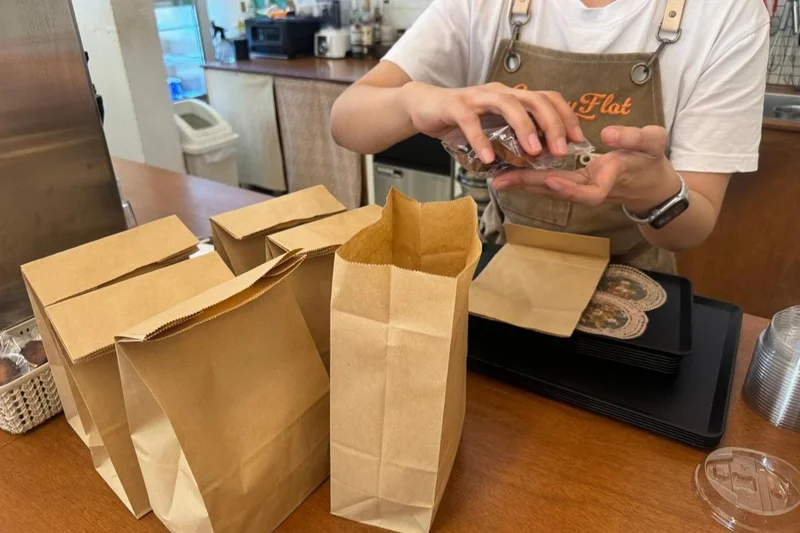
As evening settled over Seoul’s western Seogyo-dong neighborhood and closing time approached, customers streamed out of a bakery café carrying bags stuffed with bread.
The bakery sells its unsold bread and pastries at half price at the end of each day to customers who reserve them in advance. Owner Lee Yoo-jin, 35, has offered the end-of-day discount for two years and says demand has recently surged.
“We offer eight bags for reservation each day, and lately they’ve always been fully booked,” Lee said. “Sometimes we receive more reservations than the number of bags we have prepared, so we have to cancel some of them.”
**Consumers go extra mile for deals **
The bakery is not alone in seeing a flurry of customers as closing time approaches. The late rush is slowly becoming a trend in Korea as consumers seek to take advantage of end-of-day discounts to buy food at lower prices.
It contrasts with the “open-run” rush seen in Korea during the COVID-19 pandemic, when shoppers lined up outside luxury boutiques before opening to secure coveted items. Discount hunting was previously seen mainly for convenience store foods, but high inflation over the past two years has pushed consumers to become savvier in their spending.
Buying food at a discount often involves more cumbersome steps than paying full price. Customers must install an app that shows nearby stores offering the discounts and arrive at an exact time for pickup. The food they receive is random, depending entirely on what is left at the end of the day, and cancellations are common even after a reservation has been made.
Still, consumers flock to discounted food because the savings outweigh the inconvenience. Food is normally sold at half the original price. Bread is in particularly high demand, as its price has risen so steeply in recent months that the increase has been dubbed “breadflation.”
Park Ha-eun, 30, said she buys bread once a week by taking advantage of end-of-day discounts.
“I don’t usually buy bread or desserts because the prices are a burden. But using the app, I can sometimes buy them at half price or even less.”
The resurgence of discount hunting has been fueled by the perception that the practice is eco-friendly, as well as the introduction of apps that have made discounted food more accessible and convenient to buy. Local bakeries and restaurants have been joined by delivery platforms and large bakery chains in offering end-of-day discounts, expanding the range of food consumers can buy at affordable prices.
For store owners, it is a win-win strategy, as discount sales relieve them of the burden of discarding unsold food while also serving as a promotional tool.
“It is beneficial for sellers as well because it leaves us with no leftovers while also helping protect the environment,” said Yook Na-yoon, 23, who works at a bakery in Seoul’s Mangwon-dong neighborhood.
Lee also pointed to the promotional effect of the discounts. “First-time customers who visit in the evening often come back,” she said.
**Taking hold as a new consumer trend **
With high inflation persisting, observers say the rush for closing-time discounts may not end up being just a temporary phenomenon but instead become a new pattern of consumption.
“Prolonged high inflation and stagnant growth have pushed consumers to think twice before spending and to spend more wisely,” said Lee Eun-hee, a professor in consumer science at Inha University.
“Closing-time discounts will continue to attract consumers and become an established consumption pattern.”
This article from the Hankook Ilbo, the sister publication of The Korea Times, is translated by a generative AI system and edited by The Korea Times.