WASHINGTON — Northrop Grumman and the Canadian Space Agency said this week they will adapt what they had been working on for NASA’s lunar Gateway into applications for a planned lunar base, albeit with few specifics.
Northrop Grumman announced Aug. 4 that it will reuse hardware and technologies it had developed for the Habitation and Logistics Outpost, or HALO, module for the Gateway for a series of lander missions.
The company said it is planning three Lunar Infrastructure Demo, or LID, missions to the lunar surface carrying power, data and mechanical interfaces developed for the Gateway. “By demonstrating how key surface assets can remain powered, protected and connected through lunar night and shadow, these missions will give NASA critical data to shape Artemis surface campaigns and long-duration lunar operations,” the company stated.
“Our ready-to-fly, reliable HALO technologies allow NASA to move faster, putting in place robust infrastructure that can endure the lunar night and establish a strong blueprint for a future Moon Base,” said David Schiller, vice president of civil space and sciences at Northrop Grumman, in the statement.
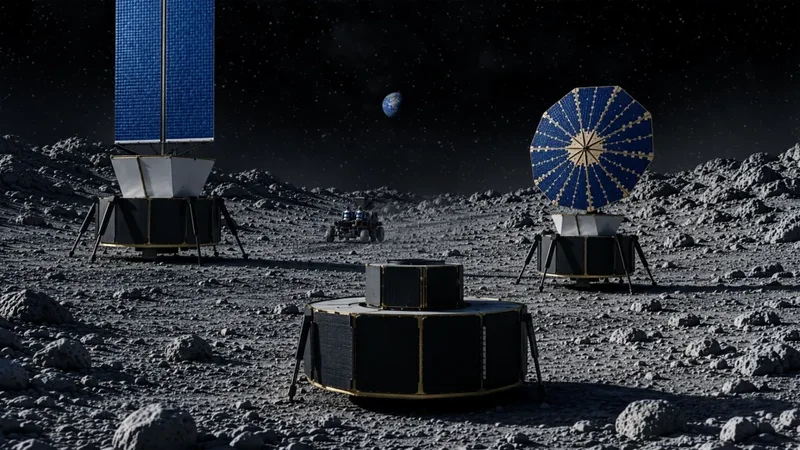
The announcement, though, did not provide any details about when the LID missions would fly or what specific payloads would be tested. The company released an illustration showing three identical landers on the lunar surface: one with a vertical solar array, another with a circular array like those Northrop has used on its Cygnus and other spacecraft, and a third with an indeterminate payload.
The LID missions, the company stated in a caption accompanying the illustration, will “rapidly mature lunar surface power, thermal, autonomy, communications and hosted payload services that can survive the lunar night and scale into persistent infrastructure near the moon’s south pole.”
The Northrop announcement was timed to the release of a broader update by NASA on its lunar base plans, focusing primarily on several other robotic lander missions and only briefly mentioning Northrop’s plans.
“NASA is working with Northrop Grumman to develop three technology demonstration payloads slated for delivery to the lunar surface,” NASA stated. The agency said the focus would be on power and avionics systems from HALO “now being repurposed following NASA’s shift from an orbital-focused lunar strategy to one centered on surface operations.”
A Northrop spokesperson told SpaceNews on Aug. 4 that the first LID mission would launch in Phase One of NASA’s Moon Base plans, which runs through 2029. The missions would be “NASA-funded,” but the company provided no details about the funding mechanism or cost.
NASA, in an Aug. 7 response to questions about the Northrop announcement submitted Aug. 4, said it would fly the payloads on future missions of its Commercial Lunar Payload Services, or CLPS, program. The agency said that all the payloads were slated to fly in Phase One of the Moon Base program.
The agency added that it is working with Northrop to finalize contracting details for the LID payloads.
The announcement did not discuss how Northrop might reuse other elements of HALO, a module intended to serve as an initial habitat for the Gateway. The company has previously suggested the module could be repurposed as a lunar habitat despite corrosion issues found with the module linked to the structure’s supplier, Thales Alenia Space.
“We are working with NASA to take the technology that we were developing under the HALO program and still have that contribute to their future Gateway plans,” Kathy Warden, chief executive of Northrop, said during a July 21 earnings call. “We are in the process of restructuring the contract to do that.”
Canadarm3 changes
The Canadian Space Agency, or CSA, announced Aug. 6 that it was revamping its contribution to the Gateway, a robotic arm system known as Canadarm3. The technologies being developed for it, the agency said, would be adapted both for lunar applications and for potential use in low Earth orbit on commercial space stations.
“Early deployment of robotics technologies on the moon is a key step in validating Canadian capabilities and positioning industrial expertise for future logistics activities on the lunar surface,” the agency stated. “At the same time, advancements made through Canadarm3 also offer the potential for these cutting-edge robotic systems to be adapted for space projects in low Earth orbit, creating new commercialization opportunities linked to emerging space stations.”
MDA Space is the prime contractor for Canadarm3 under a contract awarded in 2024 worth 1 billion Canadian dollars ($717 million). In an earnings call in May, a little more than a month after NASA announced it would halt development of the Gateway to focus on a lunar base, MDA executives said they were continuing work on Canadarm3 while discussing the project’s future with CSA.
In an Aug. 7 earnings call, Mike Greenley, chief executive of MDA Space, said he supported CSA’s decision to repurpose Canadarm3 work. “As the global effort to live and work on the moon builds momentum, MDA Space is in a strong position to expand our involvement in this endeavor,” he said.
Neither CSA nor MDA Space provided details about how the technology would be adapted for either a lunar base or commercial space stations. “The teams continue to work on their designs and development, but the use of those designs and developments is the thing that’s going through the adjustment at the moment,” Greenley said.
“We really appreciate Canada announcing its support for what we call the pivot, focusing on the lunar surface,” he added. “We’re going to work through that now in terms of contractually what that looks like, to make sure that all gets definitized properly as we go forward into the future.”