Promising another morose summer in the housing market.
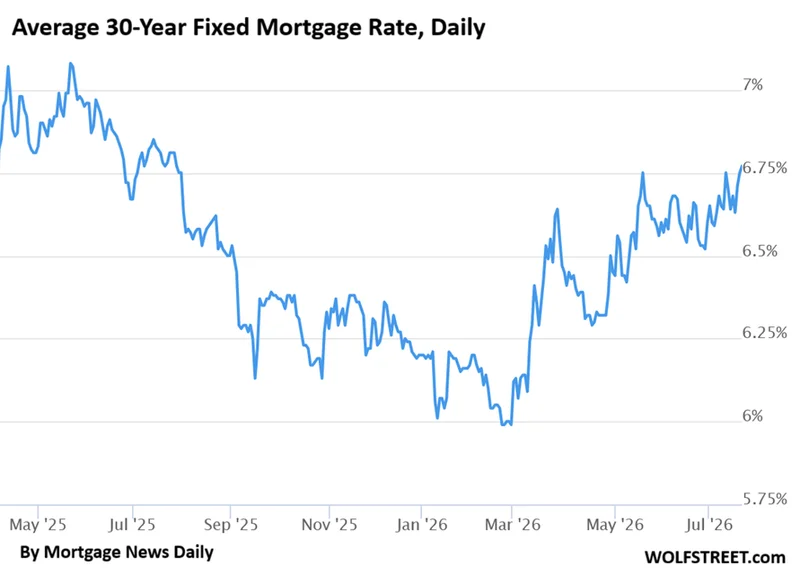
The average 30-year fixed mortgage rate rose to 6.77% today, the highest in a year, and a hair above the highs earlier in July and May, and up by nearly 80 basis points from the February low, per the daily measure by Mortgage News Daily.
Last fall there was talk that this was going to be the spring and summer when mortgage rates would drop below 5% again, and all this “pent-up demand” would be unleashed, and the housing market would shoot to the moon or whatever.
But reality is that inflation is high, and in “real” terms – adjusted for inflation – mortgage rates are fairly low, and so this is it, and sales of existing homes continued to scrape along the bottom.
The average weekly mortgage rate in the latest reporting week for conforming 30-year fixed mortgages, released today by the Mortgage Bankers Association, rose to 6.69%, the highest since August last year.
This measure of the average 30-year fixed mortgage rate has been in the 6% to 7% range since September 2022, except for some breakouts to the upside.
The 30-year fixed mortgage rate tracks long-term Treasury yields, such as the 10-year Treasury yield, but is higher, and that spread between them varies over time. And those long-term Treasury yields don’t follow the Fed’s short-term policy rates but are motivated by fears of inflation, which destroys the purchasing power of bonds, and by fears of an onslaught of new debt needed to fund the ballooning government deficits. And those bond-market fears flow through to mortgage rates.
So the 30-year fixed mortgage rate may go into the opposite direction of the Fed’s policy rates when the Fed cuts interest rates despite re-accelerating inflation – see the fall of 2024 when the Fed cut by 100 basis points, signaling to the long-term Treasury market that it will let inflation run hotter, and mortgage rates, following the frazzled Treasury yields, jumped by 100 basis points. And the spread between the Fed’s policy rates and mortgage rates widened by 200 basis points. That was an evil surprise for lots of people, especially in real estate.
To get mortgage rates down, the Fed must be hawkish and inflation must be low and stay low. And none of those three conditions are currently met and may never be met.
“Real” mortgage rates are not high. With inflation currently in the 3.5% to 4% range, the “real” 30-year fixed mortgage rate (mortgage rate minus inflation rate) is only at about 3%, which is relatively low compared to the periods before 2009, before the Fed’s QE began forcing down long-term interest rates with trillions of dollars of purchases of Treasury securities and Mortgage-Backed Securities.
In 2021, the Fed’s QE repressed mortgage rates below 3% while inflation had begun to surge, leading to deeply negative “real” mortgage rates that triggered the worst home-price explosion in history.
Those too-high home prices are now the hangover that the housing market is suffering from – not the normal-ish mortgage rates. And that inflation has refused to go back into the bottle, and has been rising since mid-2025, which pushed “real” mortgage rates down, even though nominal mortgage rates have risen.
Applications for mortgages to purchase a home – a forward-looking indicator of home sales – have been scraping along the bottom all year. In the latest week, they ticked up a little, but the four-week average, which irons out some of the weekly squiggles, fell for the third week in a row, according to data by the Mortgage Bankers Association today. The weekly measure was roughly unchanged from a year ago, and down by 36% from the same period in 2019.
Applications for mortgages to refinance a home are in an inverse relationship with mortgage rates: They fall when mortgage rates rise and rise when mortgage rates fall.
In the latest week, refinance mortgage applications (red) were down by 55% from the same week in 2019 and by 75% from the same week in 2021, as mortgage rates (blue) have risen.
Refinance mortgages have no impact on home sales per se, but were the promised land for homebuyers over the past few years who fell for the real-estate hype, “Date the rate, marry the house,” and then found out they actually married the price, and married the rate too, and now they’re having to support both.
But some refis are still happening for a variety of reasons, including cash-out refis though a lot of the cash-out demand has shifted to Home Equity Lines of Credit, and the use of HELOCs has surged.
In case you missed it: Home Prices in 33 Big Expensive Cities in America: 25 Fell Year-over-Year in June, 2 Rose to New Highs
Enjoy reading WOLF STREET and want to support it? You can donate. I appreciate it immensely. Click on the mug to find out how: