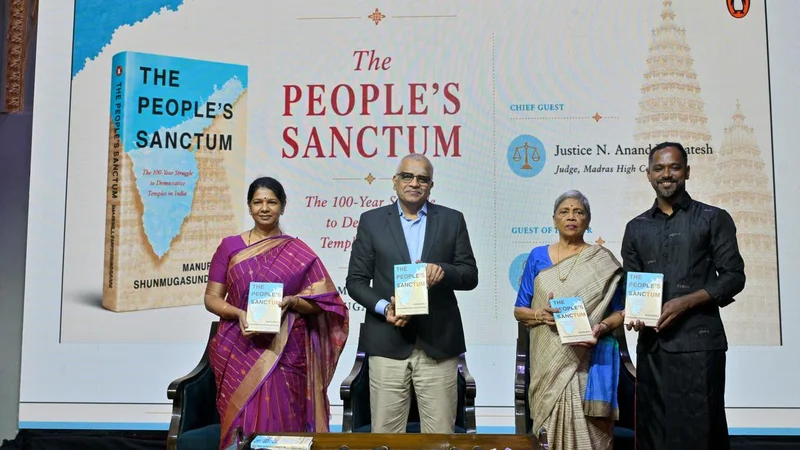
DMK MP K. Kanimozhi said on Saturday that the Dravidian movement, which believed that a religion preserving caste ought to be dismantled, was the very movement that fought continuously and successfully to ensure no barriers existed for believers who wished to enter temples.
She made these remarks at the book release event for The People’s Sanctum, authored by advocate Manuraj Shunmugasundaram, held at the Victoria Public Hall in Chennai. Ms. Kanimozhi and Madras High Court Judge Justice N. Anand Venkatesh attended the event, where senior advocate Ramani Natarajan received the first copy.
Speaking at the function, Ms. Kanimozhi said the book documented how an atheist movement and Periyar, who held atheistic principles as a primary philosophy of his life, played a leading role in temple entry struggles. She emphasised that the Dravidian movement, despite seeking to break down a religion that protects caste, fought relentlessly and won, to guarantee that believers faced no restrictions when entering temples.
“If we are fighting today to ensure that fields like medicine, the judiciary, IT, and industry become inclusive spaces for everyone, the entry into temples served as the very starting point for all these struggles, a fact Manu articulates clearly,” Ms. Kanimozhi added.
Justice Anand Venkatesh pointed to the book’s record of a board near the Mahadeva Temple in the Travancore Princely State, which specified with mathematical precision how far each caste should stand from a Namboodiri priest and remarked: “When viewing these rules, the heart of anyone with human empathy will tremble.” He further noted, “The historical court procedure for recording testimony from members of oppressed communities truly shook me.”
He affirmed that the right to worship was not a religious privilege, but a fundamental right of a citizen, adding that individual autonomy and dignity took precedence over ancient societal beliefs.
Participating in the discussion later, Mr. Manuraj said: “Even after 100 years, we have not achieved complete equality in temples. We still have many more steps to take on this journey. Therefore, the purpose of this book is to describe how this struggle has continued.”
He expressed optimism for the future, saying, “Through this book, you will read how society has progressed over 100 years of legal struggles—moving from a state where people could not even walk on the streets near temples to today’s debates surrounding the appointment of temple priests. While this transformation took 100 years, I hope it will not take another 100 years to appoint women or transgender persons as priests.”
Published - August 09, 2026 12:22 am IST