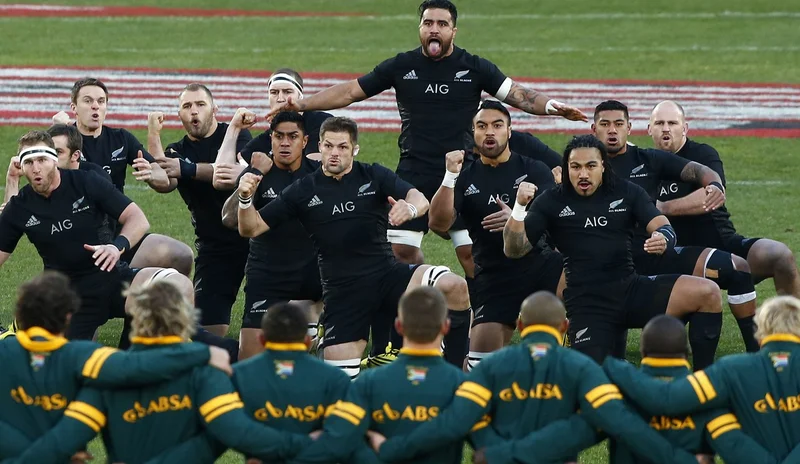
There are not many sports where the two best teams in the world will be locked in a physical and mental battle for more than a month. But thatâs what old-fashioned rugby tours bring and what a contest between the Springboks and the All Blacks means.
For almost all of rugbyâs history, either the Boks or the All Blacks have been the best team in the world. There have been brief moments when interlopers such as England, Australia or Ireland could claim that status, but for the most part, rugby success has been defined by the silver fern and the leaping springbok.
Nothing matches the intensity and history of clashes between the Springboks and All Blacks. The two fierce rivals, who have met 110 times since 1921, enter a new era this month with the Rugbyâs Greatest Rivalry series. Itâs a throwback to old-school tours that a century ago lasted three to four months and could include up to 30 games.
Todayâs world is faster and the 2026 tour â the first full tour in 30 years between the old foes â consists of eight games. Four of these are clashes between South Africaâs best club teams and the All Blacks, and four are Test matches on consecutive weekends.
Outside New Zealand and South Africa, some have scoffed at the âGreatest Rivalryâ claim, but the facts are indisputable. Between the Boks and All Blacks, they have won seven of the 10 World Cups played since 1987 â South Africa with four titles and New Zealand with three.
Since world rankings began in 2003, the two sides have dominated the top spot. The All Blacks have sat at the pinnacle for 747 weeks, the Springboks for 332 weeks. The next closest is Ireland at 74 weeks.
They each have the highest winning percentages in Test rugby, too. The All Blacks are well clear with a 76.66% winning ratio to the Boksâ 64%.
Recent success
Before the game went professional in 1995, the Springboks had a superior win-loss ratio against the All Blacks, but that has changed. The All Blacks have won 63 of the 110 Tests, the Boks 43, with four draws. But in the Rassie Erasmus era since 2018 in his role as head coach or director of rugby, the Boks have won eight of 15 clashes, lost six and there was one draw.
At home, they have won three and lost two in the same period. It all points to an extremely close series, despite the narrative that the current Boks are one of the best â if not the best â rugby teams of all time and the current All Blacks are not quite as good as their greatest teams.
The Boks obviously start as favourites, considering they have won the last two World Cups and Rugby Championships, are on an 11-Test winning streak and have won five of the last six meetings against the All Blacks. They have home-ground advantage for the first three Tests and the All Blacks are only three Tests into a new coaching set-up under Dave Rennie. The odds are stacked against them.
But this also means Erasmusâs team is under the most pressure. It would be a sporting disaster if the Boks failed to win the series given the statistics. In a way, though, it makes the All Blacks even more dangerous. They have nothing to lose and almost have a free pass to play without pressure.
If they donât win the series, they can chalk it up to experience and part of their evolution under Rennie. But his team is skilled and motivated, and many of the touring squad played for the All Blacks when they beat the Boks 24-17 at Eden Park last year. They know the world champions are beatable.
Rennie himself has a remarkable record as a coach against South African teams. As Wallaby head coach, he won three of four clashes against the Boks. As Chiefs head coach, Rennieâs team won 18 of 24 clashes in the Super Rugby era and he was Junior All Black head coach when they won three consecutive world titles. Rennie knows
what it takes to beat South Africa.
Erasmus has steered clear of commenting on the series as the Boks finalise their build-up with a clash against Argentina in Buenos Aires, yet he knows the challenge that awaits.
The first Test is crucial because the Boks have greater depth and should become stronger as the series progresses. The All Blacks simply must draw first blood at Ellis Park on 22 August to have a chance of winning the series.
Growing the game
The tour is also a chance for rugby to take centre stage in the global sporting calendar. There are no clashes with other major sporting events and broadcasters across the globe have gobbled up the rights to the series.
âWe need people to engage in the sport; we need to be competitive and it needs to be good to watch, but overall, it must be a sport that the youth of today can engage with,â former All Black captain Sean Fitzpatrick told Daily Maverick at the Laureus World Sports awards last year.
âIn terms of how we produce it and how we consume it, it is vital, and a Springboks versus All Blacks tour is a great story. Weâve got a lot to do to make it appealing. We canât just have a World Cup every four years and thatâs it.
âThe only part of our game that really makes money is international rugby. New Zealand rugby is funded by the All Blacks. In South Africa, the Springboks are responsible for the bulk of the gameâs income. The resumption of the tours is a massive chance to grow the gameâs appeal.â
No doubt the next month will pull eyes towards rugby, but it will also add sizeable income to the coffers of the South African Rugby Union (Saru) and New Zealand Rugby (NZR). The fourth Test, to be staged in Baltimore in the US, could bring in R100-million for South Africa alone.
The third Test at the 94,000-seater FNB Stadium will bring in close to that. The decision to rekindle full tours rankled partners such as Australia and Argentina, but the reality is Saru and NZR are cashing in on their status as rugbyâs biggest teams.
It has come at a cost to Australia and ArgenÂtina in particular, although the next World Cup will be down under, which will more than offset the loss of income from two editions (including the Boksâ reciprocal tour to New Zealand in 2030) of the Rugby Championship.
Boardroom issues aside, no one can deny this is the pinnacle of the game and the next month will underline why this is rugbyâs greatest rivalry. DM
This story first appeared in our weekly DM168 newspaper, available countrywide for R35.