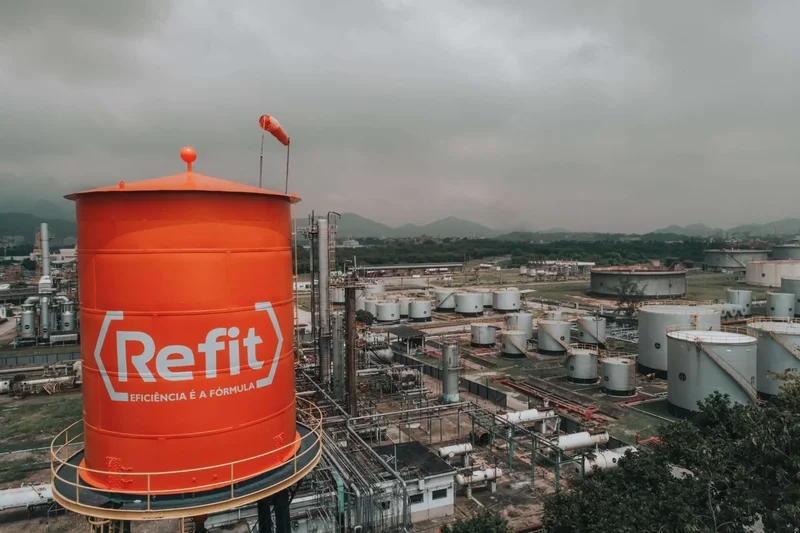
Refit Loses Fuel Licence as Suspended Tax ID Halts Operations
Brazil · Energy Policy
Key Facts
- Licence revoked— ANP unanimously revoked Refit’s operating authorisation on 7 August 2026, citing the suspension of its CNPJ since 29 May 2026.
- Tax debt— Rio state says Refit owes R$14.3 billion (US$2.8 billion) in ICMS; PGE-RJ puts total tax debt above R$25.7 billion (US$5.0 billion).
- Bankruptcy push— Rio state petitioned to convert Refit’s recuperação judicial into bankruptcy over the billion-dollar debt.
- Company response— Refit called the revocation disproportionate, citing a temporary CNPJ suspension by a court order, and asked ANP to wait for the STF.
- Unanimous vote— Directors Arthur Watt, Symone Araújo, Daniel Maia, and Fernando Moura voted with rapporteur Pietro Mendes.
- Earlier actions— ANP first interdicted Refit in September 2025; a total shutdown followed in January 2026, according to Folha.
Brazil’s fuel regulator pulled Refinaria de Manguinhos’ operating permit after the company’s tax ID was suspended, deepening its crisis.
If you hold fuel assets or supply contracts in Brazil, pay attention: ANP revokes Refit licence, and that’s a name that’s been a revolving door of legal troubles. The decision, made on Friday, 7 August 2026, came because the company’s CNPJ — the Brazilian tax ID every business needs to operate — has been suspended since 29 May. Without a valid CNPJ, Refit can’t legally sell fuel, and the regulator moved to pull the plug entirely.
Why the licence was revoked
The ANP (Agência Nacional do Petróleo, Gás Natural e Biocombustíveis) voted unanimously on 7 August 2026 to revoke Refit’s authorisation to operate. The official reason: the company’s CNPJ was suspended by the Receita Federal (Brazil’s tax authority) back in May. A suspended CNPJ means the company isn’t recognised as a legitimate business, so it can’t operate in a regulated sector like fuel refining.
The decision was reported by Poder360 and O Globo, and it wasn’t a surprise to those following the saga. Refit, based in Rio de Janeiro, has been in hot water for years, but this move effectively ends its ability to refine or sell fuel, at least until — if ever — the CNPJ issue is resolved.
The debt mountain
The financial picture is staggering. The Rio de Janeiro state government says Refit owes R$14.3 billion (about US$2.8 billion) in ICMS — that’s the state-level tax on goods and services, similar to a sales tax. But the state’s attorney general’s office (PGE-RJ) puts the total tax debt even higher, at more than R$25.7 billion (about US$5.0 billion).
To put that in perspective, that’s a debt so large it would crush most companies. Refit has been in recuperação judicial — Brazil’s version of bankruptcy protection — trying to negotiate with creditors. But the state government has had enough: it asked the Rio courts to convert that recuperação judicial into outright bankruptcy, citing the billion-dollar debt.
Company fights back
Refit didn’t take the revocation lying down. The company called the ANP’s decision ’disproportionate’, arguing that the CNPJ suspension was temporary and came from a provisional court order. It asked the ANP to hold off until the Supremo Tribunal Federal (STF), Brazil’s Supreme Court, decides on the matter. The company also warned that the revocation could jeopardise its recuperação judicial, making it even harder to pay off debts.
The ANP, for its part, framed the move as necessary for regulatory credibility. ’The revocation occurred to ensure the reliability of ANP’s regulation,’ said director Pietro Mendes, according to Valor. The unanimous vote backed him up.
A history of trouble
Refit’s problems didn’t start this week. ANP first interdicted the refinery — that’s a temporary halt on operations — in September 2025, according to Poder360. Folha reports a more complex timeline: a partial interdiction in October 2025, a partial reversal that same month, and then a total shutdown in January 2026 after a new inspection.
The legal pressure intensified in November 2025, when police launched Operação Poço de Lobato, executing 126 search-and-seizure warrants, per O Globo. The operation targeted alleged tax fraud and money laundering. Shortly after, in a related move, the STF ordered preventive detention for owner Ricardo Magro, and he is reportedly on Interpol’s Red Notice list.
In July 2026, a court ordered the auction of the refinery’s land and building, according to Folha. Meanwhile, the STJ — Brazil’s superior court of justice — has authorised Rio state to resume collecting tax debts from the group, after an earlier suspension. That decision clears the way for more aggressive enforcement, per Diário do Rio.
Refit’s revenue tells the story: over R$1 billion (US$196 million) per month in 2025, but practically zero by early 2026. The combination of revenue collapse, mounting legal actions, and now licence revocation leaves the refinery’s future bleak.
ANP revokes Refit licence: what this means for investors and expats
If you’re invested in Brazilian fuel infrastructure, or even just buying fuel in Rio, this matters. Refit is a major fuel supplier in the region. Its shutdown could tighten supply, potentially nudging prices up at the pump — a direct hit to your wallet if you drive in Rio or depend on fuel for your business.
More broadly, this is a signal that Brazilian regulators and courts are getting tougher on tax enforcement. The STJ’s decision to let Rio resume collections, combined with the auction order and the ANP’s licence revocation, shows a coordinated push against companies that rack up massive tax debts. If you’re eyeing any distressed asset in Brazil, be very, very careful about the CNPJ status and any recuperação judicial — a suspended CNPJ can kill your deal overnight, and the state is now more willing to force bankruptcy and sell off assets.
For expats, it’s a reminder that fuel prices aren’t just about global oil; local regulatory drama can hit your wallet too. And if you’re considering a business in Brazil, treat tax compliance as a non-negotiable — because the authorities are clearly in no mood to forgive.
Frequently Asked Questions
What is ANP?
ANP stands for Agência Nacional do Petróleo, Gás Natural e Biocombustíveis, Brazil’s national agency for petroleum, natural gas, and biofuels. It regulates, contracts, and supervises activities in the fuel sector, from refining to distribution.
What is a CNPJ?
CNPJ is Brazil’s corporate tax ID number, issued by the Receita Federal. Every business needs one to operate legally — to open bank accounts, issue invoices, and sign contracts. A suspended CNPJ means the company can’t legally function.
What is recuperação judicial?
Recuperação judicial is Brazil’s court-supervised bankruptcy protection process. It helps companies in financial distress restructure debts and avoid actual bankruptcy, while keeping operations running under court oversight.
How does this affect fuel supply in Rio?
Refit’s shutdown could reduce local fuel supply, potentially leading to higher prices at pumps in Rio de Janeiro. The full impact depends on how quickly other suppliers fill the gap, but it’s a risk for consumers and businesses.
Connected Coverage
Sources: ANP (Agência Nacional do Petróleo, Gás Natural e Biocombustíveis); Procuradoria-Geral do Estado do Rio de Janeiro; Receita Federal; Valor Econômico; Folha de S.Paulo; O Globo; Poder360; Diário do Rio.
This article was produced by The Rio Times’ automated newsroom system. How we use AI · Report an error
LatAm Markets: Live Signals → — real-time movers, turnover leaders and FX across Latin America.