- See more Daily Mail on Google - save us as a Preferred Source
What to make of the Burnham bounce? Labour have found themselves ahead in recent polls - a situation hard to imagine even a few weeks ago.
Very much unlike his predecessor, the new Prime Minister dominates the headlines with a blizzard of plans and policies. Andy Burnham seems to have changed the political weather, an achievement that few politicians can claim. But has he changed the climate?
The bounce is real enough. My latest poll - in which I ask people how likely they think they are to vote for each party at the next election when it comes, rather than (as with most surveys) which they would pick in a hypothetical election tomorrow - finds a four-point Labour lead.
Former Labour voters who drifted away over the past two years are now more likely to say they would turn out and back the party again at an election.
In the three-way best PM stakes, Burnham leads Kemi Badenoch and Nigel Farage with numbers Keir Starmer never saw in his last 18 months in the job. A significant chunk of voters say they think the new regime will be different from and better than Starmer's.
Listening to people in my focus groups around the country over the past couple of weeks, it's clear that many like what they see.
'There's a warmth about him that we haven't had for a while,' one observed. Others noted 'a tad more common sense' and that 'he's not your run-of-the-mill posh boy'.
They recognised his persona would take him only so far (world leaders 'are not going to go, 'Oh, he likes The Smiths, so we'll do a deal with him',' as one man shrewdly put it). But from what they could see so far, 'he seems to be more focused on what he's doing. He seems to be making definite plans'.
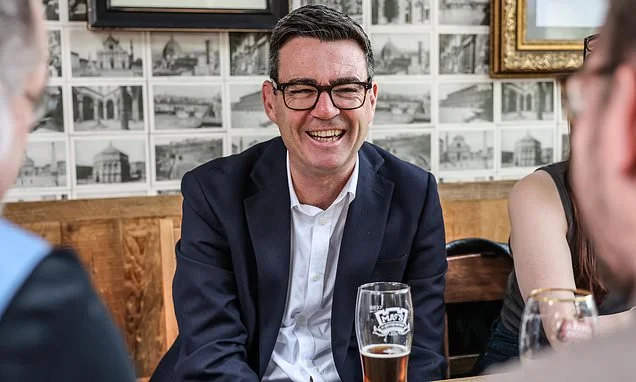
Prime Minister Andy Burnham enjoys a pint in Harlow in Essex. Polling has found that the new PM is enjoying a Burnham bounce
Pictured: Andy Burnham in Bath announcing a cap on bus fares. Burnham has had about the best start he could have hoped for, Lord Ashcroft writes
All this means voters are largely willing to give Burnham some time. I found the numbers demanding an immediate election down from last month, as people want to see what he can do rather than endure another round of drama and disruption.
They also seem more inclined to give his party the benefit of the doubt on the economy: fewer are blaming Labour decisions, with more pointing to the last Conservative government or the world situation for Britain's predicament.
In other words, in purely political terms, Burnham has had about the best start he could have hoped for. But there is a sense among voters - and probably inside No 10, if they're smart - of waiting for the other shoe to drop.
Zoom out from the novelty of a new leader with new ideas, and the wider picture looks depressingly familiar.
Few object to many of the policies pouring forth from Downing Street, with two caveats.
First, where is the money coming from? I found that Darren Jones's revelation that taking VAT off electricity bills couldn't be paid for by scrapping digital ID because there had been no budget for digital ID in the first place (a mini-version of outgoing Chief Secretary to the Treasury Liam Byrne's 2010 'I'm afraid there is no money' note to his Tory successor) had registered with a wide audience.
Of 19 Burnham plans I tested in my poll, only six had a majority saying they were both welcome and affordable. Many think that if his plans require extra spending, this should come from cuts elsewhere, but will in fact come from higher taxes.
Burnham takes a selfie during a visit in Sheffield. A significant chunk of voters say they think the new regime will be different from and better than Starmer's
Overall, voters are more likely than not to think that taxes will end up being higher under Burnham than they would have been if Starmer and Rachel Reeves had stayed where they were.
Second, as another focus group participant put it: 'He's giving away lots of little snippets at the moment. We'll see how he deals with the bigger issues.'
Capping bus fares and taking a pound a week off electricity bills for six months are all very well, but talking about the small things isn't going to make the big things go away.
These big things, as nobody needs reminding, include illegal migration, a gargantuan welfare bill, growing pressure on our inadequate defence budget, and an uncompetitive economy hampered by stifling debt, taxes, regulations and energy costs.
All these things require action that Labour backbenchers abhor. They did not go into politics to cut welfare spending, liberalise employment rules, ease Net Zero commitments, enforce borders or moderate spending in order to keep taxes down.
The voters know this. They remember Starmer's ignominious defeat over welfare reform and ask whether Burnham would do better, or even try. His rapturous reception and uncontested 'election' by the parliamentary Labour Party make many suspicious.
'He's been picked by the party because he's the one that will do their bidding without arguing with them too much,' said another of my participants.
'And that worries me a bit. Has he got the strength to stand up to the rest of the party and say, 'This is how it's going to be?'
Burnham is more popular than rival political leaders including Kemi Badenoch (pictured) and Nigel Farage
Burnham holds a a National Economic Council meeting at No 10 North in Manchester. Many voters when asked raised concerns that No 10 North is a way of shoring up Labour's support in the North and a sign that Burnham will always favour his beloved Manchester
There are other concerns that Burnham will favour the instincts of his party over those of the wider public. Is No 10 North a sign of worthwhile political decentralisation beyond Westminster in all directions? Or, as many suspect, a way of shoring up Labour's support in the North and a sign that Burnham will always favour his beloved Manchester? ('What about the East? What about the South?' as one voter asked last week in Lowestoft, arguably a much more neglected corner of the country).
For Labour's opponents, this opens an opportunity. If Burnham concentrates on worthy but second-order issues, they can set out plans to tackle the fundamentals. But the new PM has an unpalatable choice: disappoint his newfound fans by siding with the country on welfare, migration, taxes and Net Zero, or do the opposite and risk facing the same ire as his predecessor.
Whatever the weather, politics is one place where climate change is definitely not happening.
Lord Ashcroft is a businessman, philanthropist, author and pollster. His research is at LordAshcroftPolls.com.
X/Facebook @LordAshcroft