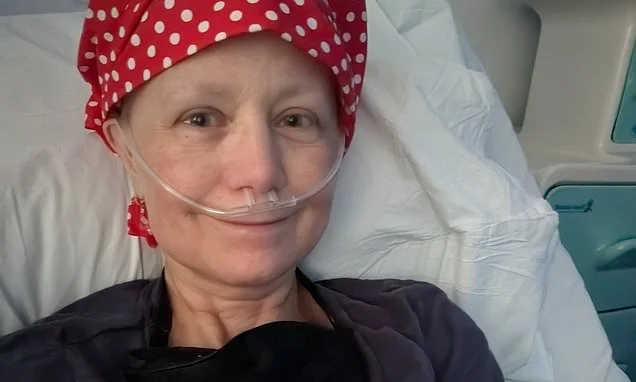
My surgeon’s kind face gave nothing away as I sat down to hear how my operation had gone. He knew, as I did, that what he was about to tell me would shape the rest of my life.
Finally, he smiled. ‘The pathology report is clear,’ he said. ‘All the cancer cells have been killed. It’s the best possible result.’
My partner, Richard, was hugging me before the words had fully sunk in.
The previous eight months had been the hardest of my life, as I’d endured gruelling treatment for an aggressive form of breast cancer.
Before my operation, I’d undergone 14 rounds of chemotherapy alongside immunotherapy – one of the newest cancer treatments available, which harnesses the immune system to hunt down and destroy cancer cells.
It had worked. But as the fear of dying finally began to lift, I knew my extraordinary news had come at a price.
The immunotherapy had turned my immune system against my own body, leaving me with life-threatening – and potentially long-lasting – side effects.
Because, as I discovered, a super-charged immune system doesn’t have an off-switch. And even though my last dose of immunotherapy was 17 months ago, I am still living with the side effects today. And now research shows that I’m far from alone.
Immunotherapy has, with good reason, been hailed as revolutionary. Introduced less than two decades ago, it has transformed the outlook for cancers that were once considered almost impossible to treat.
The previous eight months had been the hardest of my life, as I’d endured gruelling treatment for an aggressive form of breast cancer, writes Kate Harrison
The most dramatic example is advanced melanoma, the deadliest form of skin cancer. Until little more than a decade ago, fewer than 5 per cent of patients were alive ten years after their diagnosis. Today, thanks to immunotherapy, more than half survive that long, and some are considered cured – an astonishing turnaround that many cancer specialists once thought impossible.
Similar breakthroughs have followed in some forms of lung and kidney cancer. Researchers are also seeing encouraging results in pancreatic cancer and other notoriously difficult tumours, raising hopes that immunotherapy’s success story is only just beginning.
But, as I discovered first-hand, this extraordinary treatment can come at a cost. Patients often develop side effects caused by their immune system attacking healthy tissue. Some, like me, are left with health problems that persist long after treatment has ended.
The most frightening part is that it’s impossible to predict who will develop these complications, or which organ the immune system will attack.
I was the fittest I’d ever been when I was diagnosed with cancer. Aged 56, I ran three times a week, had been a vegetarian since my teens, didn’t smoke and drank in moderation. I’d even written books about health.
I found the lump in my right armpit in November 2024 during my regular breast self-check. I reassured myself: it’s not in my breast so it’s probably nothing.
It wasn’t nothing.
A month later, after scans and a biopsy, I heard the words we all dread: ‘You have cancer.’
Not just any breast cancer, but triple negative breast cancer (TNBC) – a rarer, more aggressive form that is harder to treat because it lacks the receptors that are targeted by many of the most effective drugs.
The lump in my lymph node had grown to the size of a brussels sprout. It was an irony that wasn’t lost on me: I received my diagnosis just before Christmas. Stranger still, doctors couldn’t find the original tumour in my breast.
The treatment was almost as frightening as the diagnosis. I faced six months of chemotherapy, followed by surgery and radiotherapy. Even then, there were no guarantees.
In clinical trials, around one in four women like me who received standard treatment alone saw their cancer return within three years.
But there was one reason to hope. Just two years before my diagnosis, the NHS had approved pembrolizumab, an immunotherapy drug, for patients like me. It belongs to a new generation of treatments that work by taking the brakes off the immune system, allowing it to recognise and attack cancer cells that would otherwise slip under the radar.
My oncologist was candid about the risks. By unleashing the immune system against the cancer, the drug could also cause it to attack healthy organs. My thyroid was one possibility. My lungs, liver, bowel, skin or heart could also be affected. I could say no.
But knowing the poor prognosis women with TNBC face, I wanted to throw everything at the tumour. Besides, I was already signing chemotherapy consent forms listing scores of nasty complications. A few more seemed the least of my worries. I said yes.
Treatment started the day before Christmas Eve. It wasn’t pleasant, but side effects such as nausea were mostly controlled by the party bag of medications I received after my weekly infusions.
I wore an icy ‘cold cap’ to try to save some of my hair, and tried to keep walking the dog and working.
But overnight in early March everything changed. I developed acute diarrhoea, up to 14 times a day. As I got weaker, my consultant diagnosed colitis – inflammation of my large intestine.
My immune system was attacking my digestive system. Colitis can be life-threatening, so I spent every day in the emergency department receiving high-dose steroid infusions, along with other specialist medications.
I’d undergone 14 rounds of chemotherapy alongside immunotherapy – one of the newest cancer treatments available, which harnesses the immune system
After decades of healthy eating, I had to ditch my five-a-day for what is known as a low-residue diet – low in fibre to reduce the amount of work my damaged bowel had to do – consisting of white bread, jacket potatoes and the occasional banana.
The cancer treatment had to stop completely while the oncology team tried to calm down my fiery immune system.
It took a month for the treatment to kick in and ease my symptoms, and the steroids left me so wired I couldn’t sleep.
When insomnia struck, I’d lie awake researching the condition for the blog I’d started after my diagnosis. I wanted to understand what had happened to me. The answer lay in something known as immunotherapy toxicity.
By revving up the immune system to attack cancer, immunotherapy can also cause it to attack healthy parts of the body – as I’d been warned. But what I hadn’t fully grasped was that unlike chemo, where side effects are unpleasant but usually short-lived, immunotherapy toxicity can flare up years after treatment.
Professor Richard Simcock, chief medical officer at Macmillan Cancer Support, explains: ‘One of the hardest aspects of immunotherapy toxicity is its unpredictability. We don’t yet have a way of understanding who will be affected, what side effects they may get and, crucially, how long problems may last.
‘All of this massively contributes to the uncertainty.’
I had to stop pembrolizumab after just three doses instead of the planned 17, but I was able to restart chemotherapy. By June, I could no longer climb the stairs without stopping to catch my breath, and I’d developed a relentless dry cough.
One night, after a blood transfusion, my temperature soared and I struggled to breathe. We called 999 and, within minutes, I was in an ambulance, blue lights flashing as we raced to A&E. I was given an oxygen mask as doctors tried to work out what was wrong. Antibiotics made no difference – I was getting sicker by the hour.
My chest felt as though it were being crushed in a metal vice.
Too frightened to sleep, and convinced I was dying, I searched my symptoms online. The most likely culprit? Pneumonitis. My super-charged immune system was now attacking my lungs.
Finally, after 48 terrifying hours, a specialist toxicity team started me on huge doses of IV steroids. Within hours my breathing improved. By day two I could manage without oxygen.
My surgery was delayed while my lungs recovered, but by the end of July I had the best news of my life: there was no sign of cancer. It’s impossible to know which of the five medications killed off my tumour but I toasted the team, the chemo and the pembrolizumab that night.
Except my immune system hadn’t quite finished with me.
As soon as I came off steroids, my colitis returned with a vengeance, scuppering plans for an August enjoying my recovery.
The saving grace was the fantastic immunotherapy toxicity team here in Sussex, where expert nurses delivered more steroid infusions and kept my morale high. My colitis improved enough for me to have radiotherapy.
But I also had severe joint pains, probably caused by the steroids weakening my muscles. I started doing gentle physio and drinking all the protein smoothies I could stomach. But by January this year I felt 96, not 56, as the pains spread to my hips, knees, wrists, elbows, even my heels.
Could my immune system have found a new target? Sure enough, when I restarted steroids, the pain started improving overnight, confirming a diagnosis of inflammatory arthritis.
But steroids are not a long-term solution. I can live with the swollen moon-face they cause, but the reduced immunity they cause means I catch every bug going.
Doctors want to find an alternative but some of the newer treatments are not available on the NHS. For now I’m trying another drug that leaves me nauseous and dog-tired three days out of seven. If that fails, I may get compassionate funding for the more expensive meds.
At first I assumed I was just unlucky. But now we know that wasn’t it. The biggest study in Europe followed 545 patients who had the same treatment as me, in 34 UK hospitals. Two-thirds suffered an immune-related side effect, nearly half needed unplanned stays in hospital, and four patients died, including three whose lungs were attacked by pneumonitis.
The team that treated me was set up by Professor Anna Olsson-Brown, chief executive of the Immuno-Oncology Clinical Network (IOCN) and chair of the UK Society for Medical Oncology.
She says: ‘Severe or life-threatening toxicity affects somewhere between one in five and one in two patients, depending on the treatment, with many left with long-term, life-altering, symptoms.
‘With 25,000 patients treated with immunotherapies last year in England alone, these toxicities are not a rare complication. They are a routine part of the treatment.’
The effects go beyond individual patients. The list price of a full course of pembrolizumab is nearly £90,000, though the NHS does get a discount. But emergency admissions, specialist drugs and years of follow-up add to the burden on struggling cancer units.
I was lucky to have access to a specialist team, but these services are few and far between.
Doctors talk about a golden age of cancer care thanks to treatments such as immunotherapy. But I’ve learned we need to choose what is right for us. Always ask to have the effects explained more than once, or to see the research.
I’ve also learned that you have to be your own champion. Non-specialist medics don’t always understand immunotherapy side effects, but it’s your body and you have the right to be taken seriously.
During sleepless nights, when the cocktail of pills or joint pains keep me awake, I relive those terrifying times in A&E. Did I make the wrong decision in agreeing to immunotherapy? Deep down, I know I’d still say yes.
It’s very likely it helped get rid of my cancer, just as it has for tens of thousands of people. I just hope that medics also discover new ways to treat the sting in the tail.
Kate’s blog, My Big Cancer Plot Twist, includes advice and links for anyone affected by cancer.