For years, crypto has been described as the future of money. People have used it to invest, trade, and move funds around the world. Still, for most people, it has never felt much like the money sitting in a bank account.
Regular money is easy to understand. You get paid, check your balance, and use a card to buy what you need. You can pay rent, order food, send money to a friend, or withdraw cash. Most of the time, you do not have to think about what is happening behind the scenes.
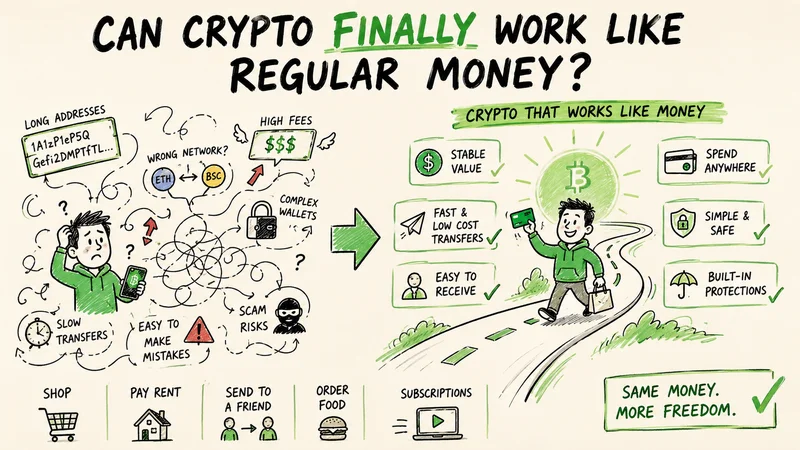
Crypto has often required more effort. Users may need to choose the right wallet, copy a long address, check the network they are using, and make sure they are paying the right fee. A small mistake can be difficult to fix. That makes crypto feel more like a specialist tool than everyday money.
However, the situation is slowly changing.
What would crypto need to do?
For crypto to work like regular money, it needs to do a few basic things well.
It needs to be easy to receive, safe to store, and simple to spend. Its value also needs to remain steady enough for people to plan around it.
That last point has always been a major problem.
The price of Bitcoin and many other digital currencies can move sharply in a short period. Something worth £100 today might be worth £90 or £110 a few days later. That may be acceptable for an investment, though it is much less useful when someone is trying to budget for groceries or rent.
Businesses face the same problem. A shop does not want to sell a product for an amount that could lose value before it reaches the bank. Customers may also avoid spending an asset if they believe its price could rise later.
That gap becomes clear when you look at how people are actually using crypto. In a 2025 Federal Reserve survey, nearly one in ten US adults said they had bought or held it as an investment, while only 2% had used it to buy something, make a payment, or send money. For most people, crypto is still something they keep rather than something they spend.
Stablecoins have made crypto more useful
One of the biggest changes has been the growth of stablecoins.
A stablecoin is a digital currency designed to stay close to the value of ordinary money. Most are linked to the US dollar, so one coin is usually meant to be worth one dollar.
That simple idea makes a big difference.
If someone receives $500 in a stablecoin, they can expect it to remain close to $500. This makes it easier to use for payments, savings, and money transfers.
The numbers suggest that stablecoins are already being used on a large scale. Visa estimates that around $10.2 trillion worth of stablecoins changed hands over the past year, which was 63% more than the year before.
Much of that money was moved between businesses and financial services rather than spent in shops, though it still shows how quickly their use is growing.
Stablecoins are already popular among people who work across borders. A freelance worker may receive payment from a company in another country without waiting several days for an international bank transfer. A family member may send money home without relying on a traditional transfer service.
They can also be useful in countries where the local currency loses value quickly. Some people use dollar-based stablecoins as a way to hold money in a form that may be more stable than their national currency.
There are still risks. A stablecoin depends on the company behind it. Users need to trust that the company actually holds enough money or safe assets to support the coins it has issued. Some stablecoins have also lost their expected value in the past.
Even with those concerns, stablecoins have brought crypto much closer to something people can use as money.
Crypto cards make spending feel familiar
Another major change is the rise of crypto payment cards.
These cards usually work in a similar way to a normal bank card. A person holds crypto in an account or wallet. When they make a purchase, the service changes the crypto into ordinary money. The shop receives the payment in the usual way.
This solves an important problem because the shop does not need to understand crypto or accept it directly.
From the customer’s point of view, the experience can feel normal. They tap a card, enter a PIN, or pay online. The complicated part happens in the background.
This means crypto can be used at many places that already accept card payments. It can cover shopping, travel, food, subscriptions, and other everyday costs.
There are some limits. The service may charge a fee when it changes crypto into regular money. The rate may also be less favourable than the one shown on a public market. Some cards have spending limits, and not every service is available in every country.
These cards also depend on banks and large payment networks. If a provider loses access to those services, the card may stop working.
Still, they offer one of the easiest ways for crypto owners to spend their money today.
Sending money abroad may be the strongest use.
Crypto may be most useful when money needs to cross borders.
International bank transfers can be slow and expensive. They may involve several banks, each taking a fee along the way. Transfers can also be delayed by weekends, public holidays, or checks by financial companies.
Sending money abroad can be expensive too, with someone sending $200 losing around $12.72 on average to fees and the cost of changing it into another currency, according to the World Bank.
Crypto transfers can happen at any time. In some cases, the money arrives within minutes.
This can help freelancers, small businesses, and families who regularly send or receive money from another country. It may also be useful for people who do not have easy access to a bank account.
The challenge often comes at the end of the process.
Receiving crypto is only useful if the person can spend it. In many places, they still need to change it into local currency. That may require an exchange, a payment app, or a local agent. These services can charge fees or ask for personal information.
So crypto can make the transfer itself easier while leaving the final step unresolved.
Every day use still has problems
Crypto has become easier to use, though several problems remain.
Losing access to a wallet can mean losing the money inside it. Some services offer recovery options, while others place the full responsibility on the user.
Mistaken payments are another issue. Bank transfers and card payments can sometimes be reversed. Crypto transfers are usually final. Sending money to the wrong address can mean it is gone for good.
Fraud is also common. Scammers may pretend to offer investment opportunities, payment services, or account support. People who are unfamiliar with crypto may struggle to tell which services are genuine.
Tax rules can make even small purchases more complicated than they need to be. In some countries, spending crypto can be treated in the same way as selling an investment, which may mean keeping track of any profit or loss every time you make a payment.
Regular money also comes with protections that people rarely have to think about. A bank may refund certain fraudulent payments, a card provider can help settle a dispute, and savings may be protected if a bank fails.
Crypto users may not always have the same level of support when something goes wrong.
So, can crypto finally work like regular money?
In some situations, it already can.
Stablecoins can hold a fairly steady value. Crypto cards allow people to spend digital assets at ordinary shops. Transfers can move across borders quickly and at any hour.
However, the experience still depends on extra services. Most users need a wallet company, an exchange, a card provider, or a payment app to make everything work smoothly.
Crypto is becoming easier to use because these services are hiding the difficult parts.
That may be how it becomes part of everyday life. People may not need to understand how the technology works. They simply need it to be safe, reliable, and simple.
Crypto may never replace regular money completely. It could still become another way to store, send, and spend value alongside bank accounts and cards.
For most people, the final test is simple. They will use crypto like money when it feels as easy and dependable as the money they already know.