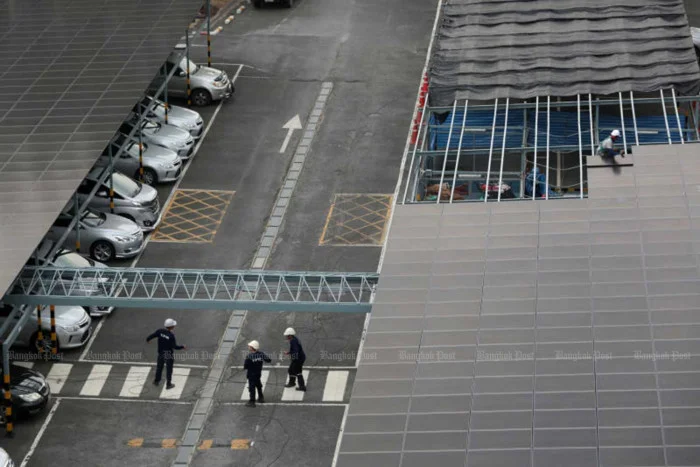
The government is stepping up work on a rooftop solar scheme aimed at promoting clean energy and reducing household electricity costs.
The Finance Ministry is working with the Interior Ministry, the Metropolitan Electricity Authority (MEA) and the Provincial Electricity Authority (PEA) to accelerate the plan.
Deputy Prime Minister and Finance Minister Ekniti Nitithanprapas said the government plans to offer a subsidy of 50,000 baht per household under the second energy-transition programme funded by an emergency borrowing decree.
The scheme will also introduce a net billing system, allowing households to sell surplus electricity to the grid and offset the proceeds against their electricity bills.
The Government Savings Bank and Government Housing Bank will provide low-interest loans to cover installation costs not covered by the subsidy. The banks will use a new credit assessment model that partly relies on households' historical electricity consumption, improving access to financing.
Loan repayments will be linked to monthly electricity savings. For example, a household that saves 2,000 baht a month could allocate 1,000 baht to loan repayments while retaining the remaining 1,000 baht as a reduction in electricity expenses.
Mr Ekniti said preliminary estimates indicated the investment could break even within three to four years. Households would then enjoy the full benefit of lower electricity bills from the fourth or fifth year onward without needing to make a large upfront investment.
The scheme is expected to benefit between 500,000 and 1 million households, particularly those with monthly electricity bills of 3,000-4,000 baht. A minimum 5-kilowatt solar installation is estimated to cost slightly more than 100,000 baht.
Mr Ekniti said Thailand currently relies on imported natural gas for about 60% of electricity generation, making household power generation an important component of long-term energy security.
The programme will operate through a one-stop service system, with the MEA and PEA responsible for certifying installation standards and screening contractors to reduce safety risks.
The Board of Investment will also support the use of locally manufactured solar panels and related equipment.