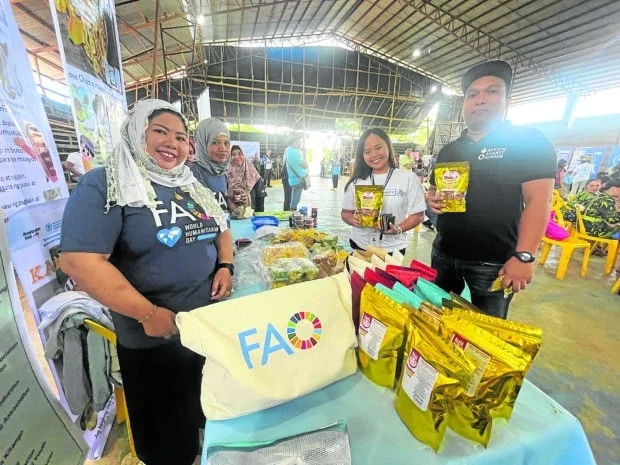
LINKAGES Women-led community organizations, including those established with the support of the Australian government, joined World Humanitarian Day activities in South Upi, Maguindanao delSur, on Aug. 19, 2024. —Photo From FAO/UN
COTABATO CITY, BARMM, Philippines — In the heart of Talitay town, Maguindanao del Sur, the aroma of freshly made banana chips is everywhere. These snacks have transcended their simple origins to become a symbol of resilience and innovation for the local community.
The snack food, produced by an association of some 50 women and youth who experienced being internally displaced persons (IDPs) due to man-made and natural calamities, has become an important part of the community’s economic and social revival.
Article continues after this advertisement
“What began as a modest endeavor has grown into a significant force for change,” says Maguindanaon Rahma Amilil, a 42-year-old mother of two and a leader of the community-based organization Magapas Agricultural Farm Product Association in Talitay.
“It’s more than just a business; it’s a symbol of our collective efforts and resilience,” she added.
READ: Changing of the guard: BARMM women find empowerment
The group has been a recipient of livelihood assistance package and home-based equipment provided by the Ministry of Agriculture, Fisheries and Agrarian Reform (Mafar) of the Bangsamoro Autonomous Region in Muslim Mindanao (BARMM), as well as the Food and Agriculture Organization (FAO) of the United Nations, with funding support from the Australian government.
The group launched its product in August 2024 during the “Bai the Best” trade fair in Cotabato City, which promoted community-based women and youth enterprises.
Article continues after this advertisement
HAND CRAFTED Rahma Amilil, leader of the Magapas Agricultural Farm Product Association in Talitay, leads the production of homemade banana chips to promote nutrition interventions in local communities and schools, in this photo taken in July 2024.
Lifeline for families
In Maguindanao, hundreds of families have been repeatedly displaced due to conflicts between warring clans. Prolonged conflict, displacement, and recurring natural disasters have severely impacted their economic stability and social cohesion, with women and youth particularly vulnerable to such disruptions.
READ: Former women combatants demand end to stigma linked to being ex-NPAs
Article continues after this advertisement
“Flood levels have always forced us out,” said Guimelan Sayutin, 49, a mother of three and a leader of women’s organization Sigay Nu Mga Babay, in Datu Saudi Ampatuan, Maguindanao del Sur.
Her family was displaced in 2008 during clashes between government troops and Moro separatists. Since then, they have been unable to return home since floods have also grown more frequent and severe in her village.
The Sigay programs have, however, “provided a lifeline to my family,” said Sayutin. “Through initiatives such as resilient gardens, vertical farming, and food processing, we have gained the knowledge and resources needed to rebuild our lives and communities.”
“We’re now able to transform locally grown crops, which we previously only sold raw, into high-demand products like banana chips, various condiments, and sweet treats,” Sayutin added. “We’re looking forward to creating a reliable source of income for our community-based organization.”
She also expressed gratitude to the Australian government for the support. “Through this project, we’ve learned that even in uncertain times, our skills can help us find ways to support our families and continue our education,” Sayutin said.
Productive young women
Likewise, “Receiving this equipment has transformed our ability to produce and market our products. It has not only provided us with a source of income but also brought our community closer together. FAO and Mafar have given us the confidence to continue growing and reaching more people with our healthy, locally made snacks,” she said.
BARMM’s labor ministry has provided community groups guidance and resources, including registration as community-based organizations.
Maila Dimatingkal, a 29-year-old member of a youth organization, said such assistance “has given us hope and a clear path. We are learning skills that will stay with us for life, and we are contributing to the well-being of our entire community.”
“The knowledge and tools we received have empowered us to grow our own food,” added Hasana Sampayan, a 45-year-old mother and leader of a community organization. “I’m happy to see our gardens flourish and provide for our families.”
With the support of FAO and Mafar, their group received home-based food processing equipment worth P3 million.
“We are now able to process our harvest into healthy snacks and meals. This has not only improved our nutrition but also created new income streams,” Sampayan said.
The community groups now also advocate serving only healthy food in schools, and encourage parents and teachers to shift to healthier snacks.
The banana chips project, along with other products like baling, kangkong chips, and chili garlic sauce under the “Bai The Best” brand, helps the community unite and work together on shared goals.
“We gather to prepare, cook, and package our products,” Amilil said.
“This collaborative effort has not only strengthened our bonds but has also helped us share in each other’s lives and challenges. Through shared laughter, storytelling, and mutual support, we have forged a more connected community,” she added.
Food safety and quality are paramount in this initiative. “We follow rigorous hygiene practices to ensure that our products are safe and of high quality,” Amilil stressed. “Our commitment to these standards has earned us the trust of our customers and solidified our reputation.”
Economic stability
Helen Roxas, team leader of “Resilient Livelihoods Development for Women and Youth Internally Displaced Persons in Maguindanao” project, said that at the broader level, the project “addresses immediate food security needs and fosters long-term economic stability.”
Amilil said that after over a year of their enterprise, their families now earn more and are no longer mainly dependent on the income of their husbands from fishing in the Ligawasan marsh.
Their participation in food exhibitions and trade fairs have also paid off in terms of greater exposure to potential clients. Through a recent international food exhibition at the World Trade Center in Manila last May, they gained orders from several clients.
But the worsening flooding in Maguindanao, according to Amilil, is hampering their supply of raw bananas for chips processing. Still, she remains optimistic. “Our success (so far) shows the power of unity and perseverance,” she said.
For Salha Salik, 41, a community-based leader in Shariff Saydona Mustapha, Maguindanao del Sur, these community activities are all about being resilient to challenges.
“Resilience is not just about bouncing back from hardships; it’s about moving forward with strength and unity,” she said.
Your subscription could not be saved. Please try again.
Your subscription has been successful.
Badria Dalanda, 33, a woman leader from Datu Odin Sinsuat, Maguindanao del Norte, added: “For us, resilience means creating opportunities where there were none, and supporting each other through thick and thin.” /cb