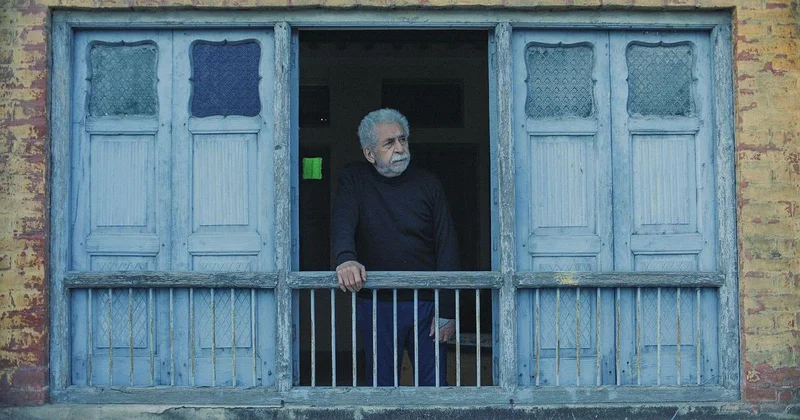
Imtiaz Ali’s Main Vaapas Aaunga is out on Netflix following its theatrical run. The film’s centrepiece is a heart-rending performance by Naseeruddin Shah as an ailing 95-year-old man desperately clinging to the memories of the woman he had loved as a youngster in undivided India.
In Gurvinder Singh’s Rehmat, Shah once again plays a character dealing with the lingering effects of Partition. This time, Shah is Rashid, who is born in a village in the Indian side of Punjab and returns to his ancestral home years later.
Rehmat is part of the prestigious Locarno Film Festival’s International Competition section. The cast includes Diya Kamboj, Suvinder Vicky, Mita Vasisht, Harwinder Aujla and Jaswant Zafar.
The Punjabi-language feature – Singh’s fifth since his debut Anhey Ghorhey Da Daan in 2011 – is based on stories by the writer Ajeet Cour. Singh’s screenplay places on a continuum the experiences of a young woman who shelters a man accused of and later killed for being a militant, his family’s attempts to make sense of his death, and Rashid’s appearance in the village of his birth.
Rehmat has Gurvinder Singh’s trademark long takes, subtle movements and restrained performances. In its own understated way, Rehmat creates vivid connections between people, places and personal histories through unusual visitations and journeys across time.
A Film and Television Institute of India alumnus, 51-year-old Singh grew up in Delhi but has made Punjab the locus of his practice. All but one of his films, as well as his documentary Trolley Times, about the farmers’ protest in 2020 and 2021, examine various facets of Punjabi society. In an interview with Scroll, Singh discussed Rehmat, collaborating with Naseeruddin Shah and his artistic approach. Here are edited excerpts from the conversation.
Punjab, particularly Punjab since the 1980s, features prominently in your films. Why is that?That’s the consciousness I grew up with. The consciousness of being a Sikh, of being a Punjabi, came about post-1984 [the anti-Sikh riots in Delhi].
Although I now live in Chandigarh, I grew up in Delhi. I had never been to Punjab. I began travelling to Punjab only in 2002 after film school to document the oral Qissa tradition and folk music.
My grandparents had moved from Pakistan to Delhi. We didn’t have any close relatives in Punjab. I knew about religious identity, the consciousness of being uprooted. I had heard tales from my grandparents about how they suffered and how they restarted their lives.
Even with Rehmat, I am trying to imagine what it must have been like for those who had to leave this part of Punjab and go elsewhere. The film is about different migrations, forced or voluntary. The forced migration of 1947, the forced migration of the 1980s, when people left villages to go to cities, the voluntary migration of Sikhs to the West.
How did you get involved with the film, which has been co-produced by the artist Arpana Caur?
The offer to adapt Ajeet Cour’s stories came from her daughter, Arpana Caur. I had known Arpana for quite some time and had read her mother’s stories. Arpana would tell me, you are the most suitable person to make a film on her stories. I said sure, but it’s very difficult to find funding.
In 2025, Arpana said she would support the film. Everything happened very quickly and very smoothly.
Which of Ajeet Cour’s stories made it to Rehmat?
Ajeet Cour’s stories deal with a variety of themes – feminism, sexuality, displacement, migration, class consciousness, class conflict. I chose stories that I thought I could connect with, and also link together. I had complete freedom to interpret and re-imagine them.
I wanted to place all the stories in the present rather than the past. The first story, about the intruder, was originally set during the period of militancy in Punjab, but I placed it in the present. I have worked the last 100 years of Punjab into the film, and how architecture is playing a role in that.
You start with a kind of house that you typically see all over North Indian cities. Then you come to rural, post-Partition architecture. Then you come to a house that is pre-Partition. And then you go to a school that was built after the revolt of 1857. I am using the space as a kind of unit of a particular period in history, but connected through how it’s perceived in the present.
There are different characters, from the young woman who engages with the intruder to Rashid, who is the oldest person around. There are different spaces – the city, the village. You have the present, but you also see the past through spaces. You’re talking of the waves of migration.
All these ideas bounce off each other. Through their contrast, their juxtaposition, their engagement with each other, things emerge.
As a filmmaker or an artist, you want to put things together. What you are trying to do, what is happening, is for the audience to think about. I don’t need to put out a statement about what I am trying to do.
Your chosen mode of affect is minimalistic and restrained, even though you deal with heavily emotive subjects.
The entire film has to work on evocation, otherwise it won’t work. Of course, my own relationship with cinema is that I see the medium as an exploration of time.
Great cinema is when you see time unfolding, rather than being linear in terms of presenting the story through a set of protagonists. Every shot should have a feeling, an emotion. Your work should surprise you. You are not out there merely to execute something. It is more about finding, discovering, being surprised all the time, looking at the film at every stage with a fresh eye.
I have tried to do that in all my films, be it Anhey Ghorhey Da Daan or Chauthi Koot or Adh Chanani Raat. You’re not following a single protagonist, but a thread from the beginning to the end.
One of the motifs in Rehmat is hospitality, the trust that is extended to strangers, whether it’s a man accused of being a militant or Rashid.
Yes, throughout the film, strangers are being let into homes, strangers are trusted. That is my own experience of Punjab. I saw how welcoming people were.
Initially when I used to visit Punjab, I would stay in hotels. I soon realised how pointless that was. Everybody was welcoming. They would let us stay over for the night. I then visited with the confidence that I would get a place to stay after dark, I would be fed.
It’s fascinating for a land that has seen so many invasions. Yet, people are very open and very welcoming. That’s also the case with someone like Rashid, who was born there and is returning after so many years. It will be very emotional for the people living there.
In a way, all my films are about displacement and homecoming. When I heard the title Main Waapas Aaunga, I thought, well my film is more, Main Vaapas Aa Gaya.
What conversations did you have with Rehmat’s cinematographer Shashank Walia?
Light, the textures, the walls – these are obvious things. As a director, I try to incorporate everything in the shot design. I told Shashank that there would be a lot of long takes and uncut scenes. Many scenes might be just one shot, wherever possible.
The conversation actually starts when you visit a location with the cinematographer and start talking about the place as a character. There is no point talking beforehand.
A lot of the writing happens after a space is chosen: that is the re-interpretation of the screenplay. When you design the shots, you are actually rewriting the screenplay from the point of view of the camera and the sound.
The narrative of the setting itself is important – there is a story prior to our story. When the camera enters the house that Rashid’s grandfather originally built, the house is already telling us a story without us having to say anything. You get to know more of it as the story unfolds.
As a filmmaker, I am presenting an event, but there is a pre-event to my event, which the space makes us feel. There is always an exchange between the pre-event and the event. Our staging, our creating of the event, is not the only thing we are doing here.
How you take the past, the life that particular space has already seen and place your event in the present – this interplay is always there. Many films I watch are so stuck up on their staging, their events that they are simply not able to see beyond that.
What made you pick Naseeruddin Shah for the main role in Rehmat?
When the story came to me, I couldn’t think of any actor other than Naseer to interpret the role. I knew of his calibre, that he would carry the resonance of the character.
I called him even before writing the screenplay. I used Saeed Mirza as a reference. He told me he had watched my films and that he didn’t even want to read the script. Suddenly, the ball was in my court.
I wrote the script keeping Naseer in mind, which was a new experience for me. I could see Naseer elaborating the scenes, speaking the dialogue. That propelled the writing, the conversations Rashid has with other people, the walk through the lanes of the village.
When we started shooting, I was observing, rather than directing Naseer. He had come prepared. All I did was read out the dialogue to him in Punjabi. It was like he was telling me about the craft of acting. That was great for me. After a couple of days, he told me, the best directors are the ones who haven’t directed me.
Main Vaapas Aaunga was happening at the same time. He did our film in between.
I was also amazed at the tone of the Punjabi that he caught. He told me that he used to listen to Om Puri and his FTII classmate Jaspal speak Punjabi.
The late Mani Kaul, who taught you at FTII, is one of your mentors. You also translated a book of conversations he had with Udayan Vajpeyi, titled Uncloven Space.
He never taught in a fixed way. His teaching wasn’t about a particular kind of filmmaking. What he taught could apply to any kind of filmmaking.
He only looked up to Robert Bresson and Yasujiro Ozu, but mostly Bresson. And Ritwik Ghatak to some extent. He never spoke about his own work, and he never encouraged us to watch his films.
He’s still there with me. When he passed away in 2011, I was editing Anhey Ghorhey Da Daan. He didn’t see the completed film, but he saw the first seven-eight minutes.
We welcome your comments at letters@scroll.in.