On another sweltering day in Tokyo last Sunday, some residents took to the streets to meticulously measure just how hot it was.
According to the Japan Meteorological Agency, the mercury reached a high of 35.3 degrees Celsius that day.
But the reality on the ground in Nakano Ward turned out to be a bit more complex.
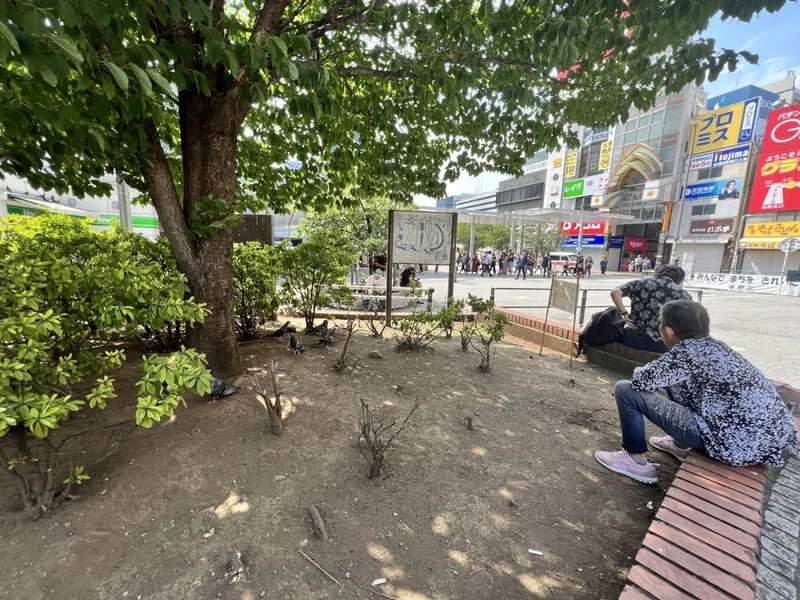
Temperatures under the shade of a mountain cherry tree just outside Nakano Station were slightly higher than the JMA’s data, measuring 37 C at around 1:30 p.m. On an asphalt road just a few meters outside the shaded area, however, a thermometer tied to a pole at a height of 130 centimeters showed it was 44.5 C.
Closer to the ground at a height of 50 cm — roughly shoulder height for young children on foot or seated in strollers — the temperature was even higher, at 46.7 C.
“Weather forecasts often say the highest temperature of the day is 35 C or 36 C,” says Sumiko Sasamoto, a member of Minna no Kokage @Nakano, a grassroots group set up last year to study how to increase tree cover in the ward. “But outside a tree canopy, few places are actually at that level. We are in fact walking on streets of 46 C.”
Later, at around 2 p.m., in a shaded area of a street lined with Japanese white oak trees, temperatures were in the 36 C range both at 50 cm and 130 cm. The street felt even cooler than that thanks to good wind circulation.
As extreme heat fueled by human-induced climate change drives daily highs into the upper 30s and even 40s across Japan, the presence or absence of tree canopy makes a world of difference, especially in urban areas, where asphalt roads and concrete structures absorb and radiate heat, and intensify the heat island effect.
And while experts agree that urban greening is crucial to mitigating the impact of urbanization and climate change, trees are becoming even more scarce in Japanese cities.
In Tokyo’s central 23 wards, “tree canopy cover,” the proportion of land area covered by tree crowns (branches and leaves) when viewed from above, declined from 9.2% in 2013 to 7.3% in 2022, according to a study by Kinya Shiraishi and Toru Terada, both researchers at the University of Tokyo, that was published in 2024.
Tree canopy cover has become one of the widely used metrics for measuring and setting urban greening targets around the world. Tokyo’s 7.3% is considerably lower than other global cities, such as New York (23.4%), Paris (21%), Barcelona (25%) and Melbourne (15.3%), according to data released by each city.
“Considering that Tokyo’s tree canopy cover is less than 10%, the situation is grim,” Shiraishi says.
It’s not just Tokyo.
According to the National Institute for Land and Infrastructure Management, as of 2022, the number of roadside trees was 6.29 million, down by half a million from the peak recorded in 2002.
While cities in North America and Australia commonly set numerical tree canopy cover targets, Japan has yet to adopt the benchmark. Most local governments currently use broader indicators such as “green coverage ratio,” which includes not only tree canopy but also other vegetation such as grass and shrubs, and “green ratio,” which includes even paved squares within parks and water surfaces.
“Tokyo, despite confronting rising annual average temperature and the heat island effect, has yet to incorporate urban forestry into its urban planning framework,” Shiraishi writes in the paper.
Myriad benefits
On top of providing shelter from the sun, which reduces ground surface temperatures and can keep buildings cooler, reducing energy consumption, experts point to multiple benefits of urban forestry. Unlike concrete, trees hold a lot of moisture, which, when evaporated by heat, helps cool the air. Tree crowns intercept rain and reduce stormwater runoff, preventing floods, too.
Urban trees are known to improve water quality by absorbing pollutants such as oxidized nitrogen and reactive phosphorus from rainwater, while offsetting traffic-related carbon dioxide emissions through photosynthesis and removing ozone, a key component of smog, from the atmosphere.
Furthermore, urban forestry has therapeutic effects: Shinrin-yoku (forest bathing) is known to reduce stress hormones in the blood, activate natural killer cells — a type of white blood cell — and generally improve people’s mood.
With all of these benefits in mind, why is the tree canopy decreasing?
Based on satellite imagery and land-use data, Shiraishi analyzed where and how the canopy coverage is declining in Tokyo. He discovered that, over the 10 years through 2023, tree cover fell by 38% on public land and 57% on private land.
Residential areas saw the highest percentage of tree cover loss, with single-family houses seeing drops of 39.8%, along with roads (14.7%), educational and cultural facilities (10.8%) and parks (10.4%).
Many old houses in residential districts of Tokyo used to have large gardens with trees on their premises. But with the aging of many landowners, there has been a trend toward selling land to reduce tree maintenance costs.
Shiraishi also points out that Japan’s inheritance tax rate is prohibitively high, with the maximum rate at 55%. When an occupant of a property dies, their families often have no option but to pay the tax with money gained from selling parts of their land. Since land prices are going up in Tokyo, property developers divide the land into several plots to build smaller detached homes on each, sacrificing trees in the process.
Many municipal governments in Tokyo encourage private homeowners with large trees to keep them by designating them as “protected trees” and providing pruning subsidies and other support, such as regular checkups by arborists. But such designations are not forceful enough, and owners of protected trees can fell them without punishment if they so desire.
“Urban trees are decreasing abroad as well,” Shiraishi says, noting that redevelopment pressures remain strong in many cities. Urban environments, where roadside space is very limited, also create exceedingly harsh growing conditions for trees.
“But many cities, such as New York, are trying hard to stem the decline or restore tree cover. In Japan, the legal protection of urban forestry is very weak,” he says.
Citizen effort
To reverse the trend, Shiraishi says the government should provide more incentives for residential owners with large trees on their land to keep them. He also believes that Japan should fully embrace the concept of urban forestry, which requires a holistic, long-term approach to growing and maintaining trees, while also maximizing their value.
At the same time, the negative impact of increasing tree cover in cities should be weighed as well, he says. Some people may frown on the cost of maintaining trees or the darkness that dense canopies bring, while others may suffer from allergies. Others may also dislike having the ground covered in fallen leaves or lament the bugs and birds that are something of a package deal with trees.
“Concerns are varied, depending on individuals, communities or nations, so policies should weigh people’s views (carefully), not ignore them,” he says.
One thing he hopes to see more of in Japan is citizens’ active involvement in urban forestry management.
Kaoru Morimoto, co-founder of Minna no Kokage @Nakano, says she started the group in February 2025 after experiencing a torturously hot summer the year before and discovering that local shrine grounds shaded by trees felt much cooler.
Last year, the group’s members measured temperatures at 43 locations around the ward over two days, and found that on a hot day with a temperature of 35 C, shaded areas could be as much as 13.5 degrees cooler than areas under direct sunlight. The group submitted a report to ward officials and proposed that the ward incorporates tree canopy cover as a policy goal.
While the ward government has not adopted the group’s proposal, it has shown interest in creating a “model district” featuring roadside trees together with citizens, Morimoto says.
This year, the group hopes to increase the number of observation spots to enhance accuracy. Morimoto is asking participants to look up the species of tree that they survey through a smartphone app, and to “feel” the difference in the air in the shade and in the sun.
“Let’s get friendly with the trees,” she told a recent explanatory meeting. “You can touch, hug and place your ears up to the trees. You can also observe the animals around them.”
As Morimoto and Sasamoto continued to measure temperatures near a mountain cherry tree outside Nakano Station, several pigeons parked themselves in the shade at the tree’s roots.
It was a subtle scene, but one that showed that even Tokyo’s birds know where to go for a break on a scorching summer’s day.