Adult summer camps offer grown-ups a chance to get away from it all
Psychologist says camps allow adults to re-engage with their fun-loving side
Every year, kids across the country spend part of their summer at camp. Whether they're staying at cabins in the forest, or spending days at local community centres, camp is usually filled with crafts, snacks and laughter.
Sounds like fun, doesn’t it? Shelby Sanford thinks so, and she says grown-ups deserve some of that joy, too.
“I wanted to relive the summer camp that I enjoyed when I was a kid,” Sanford told The Current guest host Piya Chattopadhyay.
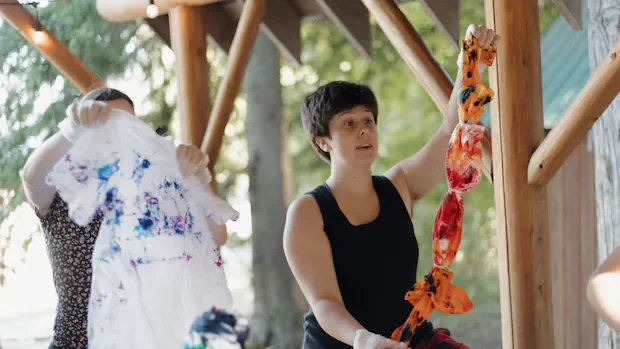
Sanford is the co-founder of Camp Rewind, an adult summer camp for women and non-binary people held in the East Kootenays region of B.C. This year, it will take place at Blue Lake Camp, near Canal Flats, about 80 kilometres from Cranbrook. The camp is into its second year and Sanford says its guests range in age from 19 to 60-something.
Camp Rewind and others like it are taking off, capitalizing on a desire to recreate the magic of summers you enjoyed as a kid. According to Yelp, searches for adult summer camps in the U.S. were up 300 per cent this year compared to 2025.
While there is no comparable Canadian data, some adult summer camps have been around for years, like Canadian Adventure Camp and Two Islands. Both are based in Ontario cottage country, as is the so-called Zombie Survival Camp in Cardiff, Ont.
It’s also an idea people are embracing around the world. There's the women-only Camp Chateau that’s hosted in the French countryside. Meanwhile, Book Club Summer Camp in the Poconos in Pennsylvania caters to readers. And Black-owned Camp Yoshi in Portland, Ore., is a space for racialized people to reconnect with nature.
Sanford says camp gives grown-ups a chance to simplify their lives for a few days.
“There are no kids pulling at your shirt or partners asking you to do XYZ or work e-mail dinging in the background,” she said.
Finding friends IRL
Adult summer camps also offer people a chance to make friends in ways they can’t when they’re busy with work or running around to get the children to and from school and extracurricular activities, says Sanford.
While the activities are fun — like capture the flag or friendship bracelet-making — and let adults tap into their inner child, she says Camp Rewind guests told her connecting with others was their biggest takeaway.
The activities encourage guests to get out of their shells and interact with others, says Sanford.
According to a 2025 Statistics Canada survey, less than 20 per cent of Canadians saw their friends on an average day in 2022, down from 47.9 per cent in 1986.
Matt Cullen spent a week at Maine’s ‘Camp’ Camp for 2SLGBTQ+ adults. He says he was craving connection and looking for fun ways to meet people.
“My job as a content creator can be quite lonely sometimes because I'm at home all the time just editing by myself,” said Cullen, who is based in Los Angeles.
Cullen says while he documented the experience for his social media channels, he avoided his devices as much as he could because he wanted to be present with the group.
The commitment to being connected felt intentional and rare, he says.
“It made us able to bond with each other and reach a different level of understanding,” said Cullen. “We were all there choosing to be there for that week.”
‘Play is essential’
Clinical psychologist Lara Hiseler says she isn’t surprised adult summer camps are becoming so popular.
“Play is essential, relevant, and at the core of who we are as human beings."
Adult summer camps let participants tap into positive experiences like joy, connection and creativity, she says, and important for people's social development.
“These camps are sort of like a safe space for adults to learn and be able to be OK with connecting with these parts of themselves that they would’ve known as children, but maybe haven’t been as in step with as they entered adulthood,” she said.
Hiseler says while play is considered essential for children’s development, it’s often deemed frivolous for adults.
“Engaging in play can come with this almost type of stigma when you become an adult,” she said.
Most people don’t have a reference for what play looks like as an adult, Hiseler says. But she encourages adults to re-engage with their fun-loving side.
“Think about who you were as a child, what you were interested in, then extrapolate. Are those things still of interest?”
It can feel emotionally risky to show up places and put yourself in front of strangers, Hiseler says, but by following your interests — for instance, enrolling in a camp that’s more artsy than sporty, if that’s your jam — you have a higher probability of meeting more like-minded people.
But keep open to possibility, says Sanford. She says one Camp Rewind guest initially "drew the line" at lip syncing, then ended up giving three performances.
Some guests want to make returning to the camp an annual tradition, Sanford says. She says a few of them have organized events outside of camp, like a trip to Disneyland and starting a book club.
Sanford says the relationships that were formed are heartwarming.
“These are people we met for just a couple of days, but it does feel like we've made these lifelong connections."
Shelby Sanford and Matt Cullen interviews produced by Cecelia Armstrong