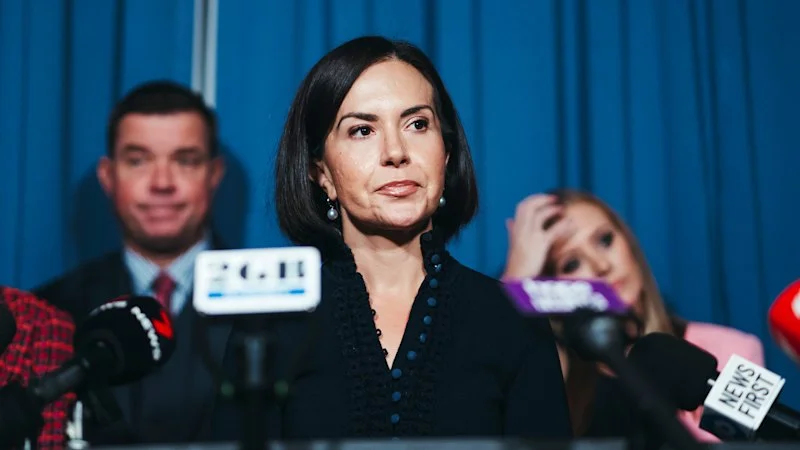
A radical overhaul of the Higher School Certificate would bar year 12 students from completing unsupervised take-home assignments as Education Minister Prue Car vows to safeguard the integrity of the NSW education system from the threat of AI.
The move comes after it was revealed the use of artificial intelligence was driving a sustained and elevated rate of misconduct in year 12 assessments, with more than 1000 cases of cheating in HSC school-based tasks recorded in 2025.
Car has written to the NSW Education Standards Authority (NESA) to ask for a “moratorium” on take-home assessment tasks. It is subject to advice from NESA, but is expected to start as soon as next term when current year 11 students begin their year 12 studies.
“The value of the HSC as a highly trusted credential depends on it accurately reflecting student knowledge, ability, and understanding. That confidence will be undermined if assessment outputs can be produced without students performing the intellectual work that the course requires,” Car said in a letter to NESA chair, Professor Peter Shergold, last month.
Removing take-home assessment would be an interim measure and will form part of a broader review on the impact of AI on student learning, amid concerns that students are outsourcing the most basic of tasks to AI.
The removal of take-home tasks makes NSW the first jurisdiction in Australia to do so.
Car said the purpose of schooling was to build knowledge, judgment, resilience and critical thinking over time, but that faced being undermined if students were using AI.
“The settings for the HSC have an impact on learning throughout high school. Where teachers and students know they face an offline environment in final exams, that will likely impact they way they are prepared for those exams,” she said.
“If you want to run a marathon, you don’t practise on a computer. You don’t build grey matter by getting a computer to do the thinking for you.”
While educational analysts have acknowledged the capacity of AI to enhance learning, a report drawing on surveys of 3400 NSW teachers revealed this year students were using it to complete assignments as well as outsourcing thinking to AI to help them perform even low-stakes activities like class discussions.
Car said it was better to put sensible safeguards in place as policymakers came to fully understand AI’s long-term impact on student learning.
“We need to act now as the evidence continues to emerge,” she said.
Final exams account for 50 per cent of a student’s HSC mark, while school-based tasks comprise the remaining half. Until now, they comprise a mix of both in-class (such as in-class tests and speeches) and take-home assessment.
When the interim measures are introduced, it is expected there will be some exceptions for subjects with major projects, such as art and technology.
Some principals report moving away from take-home tasks in response to AI, while most have updated their assessment policies to warn students they must be able to prove work done outside the classroom and submitted for assessment is their own.
“Teachers will continue to use standard monitoring, draft checkpoints, and oral reflections (viva voce) to ensure all submitted work genuinely reflects a student’s own learning and authentic understanding,” Oakhill College in Sydney’s northwest informed parents earlier this year.
All Saints College in Maitland warns students that teachers “may use a viva voce, examine the digital footprint of the document, ask for research notes and drafts as part of the investigation to discover the authenticity and originality of student work”.
Of the 1270 total cases of cheating in HSC assessment tasks recorded last year, the majority of misconduct cases related to take-home tasks.
The HSC shake-up comes as higher education analysts warn entry to universities in Sydney has become increasingly competitive due to funding changes. Next year will be worse, they say.
Federal Education Minister Jason Clare said since the advent of widespread generative AI in 2022, the technology must be part of the education landscape, citing its ability to “personalise education”.
This year, Norway moved to implement a near total ban on primary school students using AI because of the risk pupils could skip important steps in their education.
A similar push is under way in Australia. Last week, the Heads Up Alliance – an organisation that spearheaded the push to ban adolescents from using social media – launched a new campaign to stem the widespread use of tablets and laptops in Australian schools.
A key principle of their campaign is that “Generative AI has no place in school learning”.
“It turns out that Australia’s Digital Education Revolution of 2008 was, in effect, a vast experiment on our children. Today, the results of that experiment have become impossible to ignore,” founder Dany Elachi said.