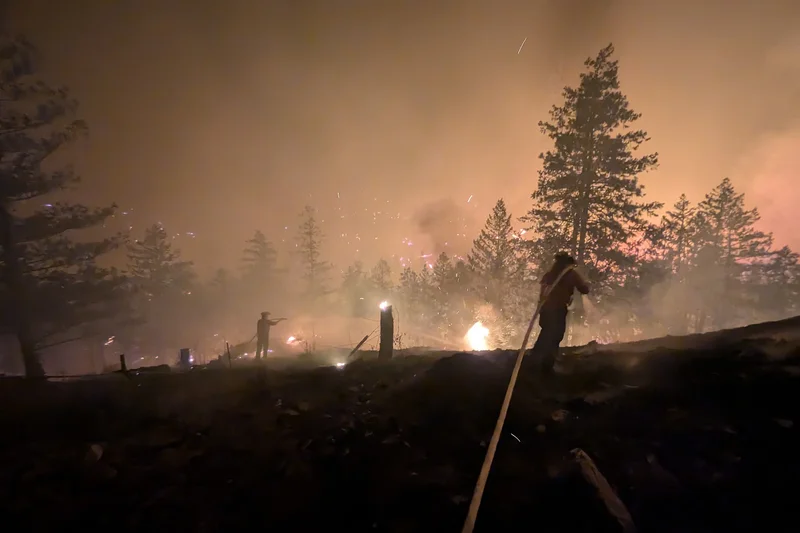
A massive wildfire that burned more than 100 square kilometres Saturday, forcing thousands in the Summerland region to flee and prompting the British Columbia government to declare a state of emergency, showed little growth overnight.
The RCMP said late Saturday that it was investigating a report of a possible death related to the fire, which the province said had caused ‘significant structure loss.”
The Bald Range wildfire was first reported at 4:29 p.m. Friday, but it grew in size, burning 50 square kilometres in a few hours. By Saturday afternoon, the fire had doubled, growing to 103 square kilometres.
More than 20,000 residents were forced to evacuate Summerland, population 12,000, and other Okanagan Lake communities Friday night and Saturday morning as the wildfire destroyed homes in its path. About 8,000 more people were ordered to leave their homes Saturday in and around Peachland. By Saturday evening, the evacuation alert extended to the northern edge of Penticton.
On Sunday, about 10,000 homes were under evacuation orders in Summerland, Peachland, the regional districts of Okanagan-Similkameen and Central Okanagan, and the Penticton Indian Band lands. More than 3,300 homes were under evacuation alerts.
B.C. Premier David Eby declared a provincial state of emergency Saturday, saying protecting lives was the government’s top priority. He said the wildfire was like a bomb going off.
Jim Carpenter said he woke up on Saturday at 2:30 a.m. to the sound of police banging on his door, shouting that he had to evacuate.
In the 30 years Mr. Carpenter has lived in Peachland, located roughly 23 kilometres southwest of Kelowna, he has never been ordered to evacuate, until Saturday.
He grabbed his cat, some insurance papers and ran to his motorhome and drove to Kelowna. As he was driving away, daylight revealed the thick smoke that blanketed the road.
Mr. Carpenter said he’s not sure whether his home will be safe.
“You got to be worried about embers that can be launched away into the air by the fire and come down and start spot fires on your property,” he said.
A Facebook post by the Interior Wildlife Rehabilitation Society said the fire swept through their facility in Summerland so fast, they were only able to escape with their own pets and the animals in their care.
The post added that they watched on the security cameras as the flames engulfed the entire compound, before the power went out and everything went black.
Summerland Mayor Doug Holmes said the fire torched barns and other infrastructure within the valley, which has many orchards and vineyards. He said he left the community at 3:30 a.m. Saturday and joined a winding convoy travelling towards Penticton because the fires closed the highways heading north.
“Everything behind us is on fire now,” he said. “People have lost property and my heart goes out to them. It’s going to be a challenging time ahead, but we’ll get through it,” he said.
RCMP said in a statement that the report about a possible fatality came from a resident of Meadow Valley, west of Summerland.
“Hazardous conditions are present in the region and police, along with the BC Coroners Service, are investigating to confirm,” the statement said.
“Officers are working closely with the impacted family.”
Officials said there have been 70 new fires in the last seven days, bringing the total across the province to 105 as of Saturday morning. They warned drought-like conditions and high temperatures could spark more fires.
Minister of Emergency Management and Climate Readiness Kelly Greene said the provincial emergency powers were needed to help secure necessary accommodation for the growing number of evacuees and to impose travel restrictions.
“Our focus is going to be ensuring that the teams on the ground have the tools they need to respond and save lives and protect communities,” she told a news conference Saturday.
The BC Wildfire Service said more fire crews, structure protection personnel, fire departments, heavy equipment and aircraft had been mobilized.
“Helicopters and airtankers will be used for various objectives, including water and suppressant delivery, and reconnaissance as conditions allow. Smoke and visibility may present challenges for aircraft,” the wildfire service said Saturday.
- With a report from The Canadian Press