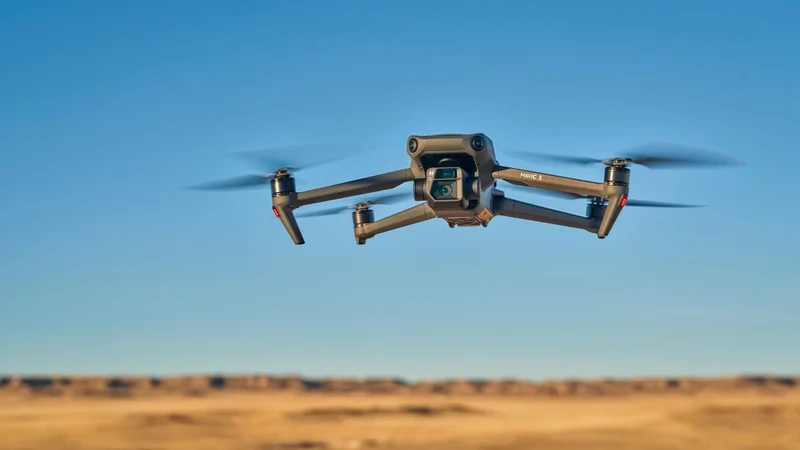
The Federal Communications Commission (FCC) is moving to ban drones with LiDAR obstacle-avoidance features, a move that would remove a number of popular consumer drones from US shelves. In a public notice published in the Federal Register on August 3 (DA 26-758), the agency proposed retroactively banning the import and sale of any foreign-made drone on its Covered List that “contains or integrates” a LiDAR sensor, categorizing the technology under a broad “military-grade” umbrella.
The proposal builds on a ban the FCC set in motion late last year. On December 22, 2025, the agency added all foreign-made drones and their critical components to its Covered List — a roster of communications equipment that a U.S. national-security authority has determined poses an unacceptable risk. The listing blocked any new foreign drone model from receiving the FCC authorization it needed to be sold in the U.S., effectively banning sales of new models.
However, models that had already cleared authorization before the listing could continue to be imported and sold. The new DA 26-758 proposal seeks to retroactively strip sales clearance from previously approved drone models that ”escaped” the initial ban, starting with those it deems military-grade. The proposal is open for public comment until September 2, 2026, and if adopted as written, the ban on imports and sales would take effect roughly 180 days after publication.
LiDAR (Light Detection and Ranging) is a remote sensing technology that uses laser pulses to measure exact distances and build precise 3D maps of objects and environments. Drones, delivery bots, and self-driving cars all rely on it for obstacle avoidance. A ban would mean that popular consumer models such as DJI's Air 3S and Mini 5 Pro — both of which use LiDAR for obstacle detection — would no longer be available for sale in the US. The proposal would not affect existing owners, who could keep flying the drones they already have, but as DJI has warned, those owners could find official spare parts increasingly hard, or eventually impossible, to source over time.
Under the FCC's broad ”military-grade” classification, the ban would also reach drones that carry thermal imaging sensors, can dispense agricultural sprays (”economic poison” in the notice's language), weigh 55 pounds or more, include docking stations, integrate a defense article, or operate in coordinated swarms — a category the FCC defines widely enough to include synchronized drone light shows. U.S.-made drones and other drones not on the Covered List are not touched by the ban, regardless of whether they carry any of these features.
The FCC frames the move purely as a national security issue, leaning on an executive-branch determination that foreign-made drones pose an “unacceptable risk.” It tentatively concludes that the economic hit would be minor, as military-grade models are a small minority in a market dominated by recreational fliers. Conversely, the notice also details the billions that domestic drone makers like Skydio, which has committed $3.5 billion to US manufacturing, have raised since the original ban.
DJI, one of the manufacturers affected by the ban, has argued that the “military-grade” label is a category error, sweeping in civilian tools that first responders, farmers, and hobbyists rely on. Its core objection lands on the LiDAR clause, specifically arguing that the technology is a safety feature, not a weapon. DJI had earlier sued the FCC to overturn the December ban, claiming the agency exceeded its statutory authority.
Get Tom's Hardware's best news and in-depth reviews, straight to your inbox.
Etiido Uko is a news contributor for Tom's Hardware covering the latest updates in big tech and the PC industry. He is a mechanical engineer and senior technical writer with over nine years of experience in documentation and reporting. He is deeply passionate about all things engineering and technology, and is an expert in gadgets, manufacturing, robotics, automotive, and aerospace.