- Do YOU have a story? Email tips@dailymail.com
- See more Daily Mail on Google - save us as a Preferred Source
Last week, the world watched on as some 60,000 asylum seekers, spurred on by social media posts, swam across the border from Morocco to the Spanish city of Ceuta.
Closer to home, however, on the shores of northern France, looking out across the Channel to England, things look slightly different.
The crossings asylum seekers are making to Britain are just as perilous, the violence they are fleeing as extreme, and the realities of life in migrant camps similarly brutal.
But where border crossings to Spain came in a dramatic, unprecedented surge, the presence of those looking for passage to the UK is evident in quieter and more quotidian ways.
Indeed, of all places, it is sporting goods stores in the northern French towns of Calais and Dunkirk that have become key to the operations of gangs smuggling people into Britain.
Migrants appear to be buying up lifejackets en masse from the retailers, with the flimsy, €17.99 garments offering little protection against the perilous crossings they are set to undertake.
This, however, is only the last step in a vast international supply chain, spanning all the way to China, which is profiting off migrants' desperation, misery and suffering.
The Daily Mail can now uncover the pipeline arming people smuggling gangs, lining the pockets of traffickers – and fuelling the continued provision of treacherous Channel crossings.
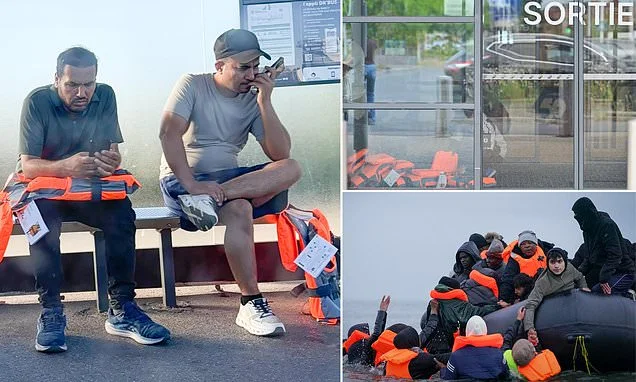
Of all places, Decathlon stores in the northern French towns of Calais and Dunkirk have become key to the operations of gangs smuggling people into Britain. Pictured: Two men sitting at a bus stop with lifejackets, just metres from the Decathlon shop in Dunkirk
Migrants appear to be buying up lifejackets en masse from the retailers, with the flimsy, €17.99 garments offering little protection against the perilous crossings they are set to undertake. Pictured: A man packs lifejackets into a bag in the Decathlon store in Dunkirk
This, however, is only the last step in a vast international supply chain, spanning all the way to China, which is profiting off migrants' desperation, misery and suffering. Pictured: Iraqi migrants with lifejackets bought at Decathlon in Dunkirk – which they told the Daily Mail they will use on a small boat crossing to the UK
Some 120 miles of the northern French coast, from Dunkirk to Dieppe, has served as a launching pad for small boats to Britain since the European migrant crisis exploded in 2015.
Across the area, large asylum seeker camps have emerged, as those fleeing violence and persecution await their turn to make the perilous journey across the Channel to the UK.
Calais was previously known for one such settlement, nicknamed the 'Jungle', which at its largest housed around 8,000 migrants – but was cleared by French authorities in 2016.
Around 700 migrants are still sleeping rough in the city, according to charity Care4Calais, whose possessions are often seized by police determined to stop another long-term camp forming.
And the port city of Dunkirk has become a similar hotspot, with thousands of asylum seekers living in tents in the Grande-Synthe and Loon-Plage areas of the city.
Facing an indeterminate wait for a crossing they have likely paid extortionate sums to traffickers for, the migrants often need to be prepared at a moment's notice.
To do this, they seem to have been turning – of all places – to the sporting goods chain store Decathlon.
One branch in Dunkirk is in a retail park in the heart of the city's Grande-Synthe suburb, an inland industrial area just off the motorway, to the west of the harbour and port.
Migrants living in the area, on arable and wooded land next to the busy D601 road, are understood to often catch the bus to the store.
When the Daily Mail visited this week, men, women and children could be seen walking from a complex of tents along the highway to reach a bus station outside a nearby shopping complex.
There, they appeared to buy essentials like food – many were seen walking back with large bags of baguettes – or travel onwards on the bus roughly 5km to the Decathlon store.
Indeed, it was at a bus stop across the road from the chain sports shop where two people who appeared to be migrants could be seen waiting with lifejackets.
Rather than arriving by car – like most visitors to the retail park the Decathlon store is in – the men were on foot, buying only the buoyancy aids and no other gear before heading off.
Outside the front entrance to the shop, the Daily Mail spoke to another two men who had each purchased around a dozen lifejackets inside, which they had stowed in grey bin bags.
The pair, from Iraq, who wished to remain anonymous, fearing for repercussions from the British government, confirmed they were set to use the vests to take a small boat to the UK.
When asked, 'Did you buy lifejackets in there?' and, 'Is it for a boat crossing? Are you going to be on a boat to the UK?' they simply responded, each time, 'Yes'.
One of the Iraqi migrants the Daily Mail spoke to outside Decathlon in Dunkirk said the pair (pictured, with their bags full of lifejackets) had waited with their relatives in France for two months to be able to cross
Another man (pictured) was spotted leaving the store with at least ten lifejackets. Like the Iraqi men, he had come prepared, bringing bin bags to carry them in
He was seen (pictured) packing the vests just inside the exit from the store
He then tied the bags together and slung them over his shoulder (pictured). When approached by the Daily Mail, he did not respond
One man, who said the pair had waited with their relatives in France for two months to be able to cross, added: 'We are with our family. These are not all for me!
'We've had a long journey to get here. We've travelled a long way.'
The man wished our reporter a nice day before saying goodbye. It was sobering – while her day would carry on, his, with a perilous boat crossing imminent, might end quite differently.
It also suggested migrants appear to have to buy their own buoyancy aids – and that they are not covered by their extortionate crossing fares.
Another man was spotted leaving the store with at least ten lifejackets. Like the Iraqi men, he had come prepared, bringing bin bags to carry them in.
He was seen packing the vests just inside the exit from the store, before tying the bags together and slinging them over his shoulder. When approached by the Daily Mail, he did not respond.
A group of three other men were also spotted carrying similarly sized bin bags across the car park away from the store.
Purchases appeared to happen in waves – perhaps in line with and reactive to when a particular crossing was planned.
Indeed, over the three days the Daily Mail visited the Decathlon store in Dunkirk, all lifejacket transactions witnessed happened on a single day and in quick succession.
Inside the shop, there is plenty of choice – the shelves in the water sports section are full of orange lifejackets, immediately recognisable after years of migrant-related headlines.
Racks on racks – along with a large bin, sitting under a print of an ominously enormous wave – offered a range of sizes, with a high proportion designed for babies, of only 10 to 15kg.
Starting at just €17.99 for the most basic design – little more than polyester-bound foam – the aids ranged in price up to €89.99, for the most sophisticated gas cylinder-powered model.
Various combinations of whistles, additional straps and reflective patches saw other designs offered for €19.99, €29.99 and €34.99.
It was these mid-range versions which most often appeared in purchases witnessed by the Daily Mail. Buying ten, for example, might therefore set you back several hundred euros.
The gas-powered vests, meanwhile, were priced higher, at €54.99, €55 and €79.99 as complexity increased – with some even labelled as 'tested and validated by French Lifeguards'.
Inside the Decathlon shop in Dunkirk (pictured), there is plenty of choice – the shelves in the water sports section are full of orange lifejackets
They were immediately recognisable after years of migrant-related headlines. Pictured: Migrants attempt to board a boat from the beach at Dunkirk in April
Racks on racks – along with a large bin (pictured), sitting under a print of an ominously enormous wave – offered a range of sizes
Starting at just €17.99 for the most basic design – little more than polyester-bound foam – the aids (pictured, at the Decathlon store in Dunkirk) ranged in price up to €89.99
More sophisticated gas-powered vests were among the more expensive on offer – some of which (pictured) were even labelled as 'tested and validated by French Lifeguards'
Many aids of all kinds bore the same understandable yet sinister liability warning: 'Personal buoyancy equipment only reduces the risk of drowning. It does not guarantee rescue.'
In response to previous criticisms around their volume of apparent migrant customers, Decathlon bosses have insisted they do not sell lifejackets in bulk.
But the level of stock available during our visit cast doubt on this claim, with the shelves rarely left less than fully stacked.
Despite such a plentiful supply, two large cardboard boxes, postmarked for Dunkirk and labelled as containing lifejackets, were at one point wheeled out to add even more to the racks.
Notably, though, there were no inflatable boats available – as Decathlon bosses have previously said they stopped selling such vessels around Calais or Dunkirk in 2021.
A spokesman at the time said the products were being 'misused as boats to cross the English Channel', contrary to the 'intended design of these products'.
They added, however, that the branches would still sell 'products that improve safety at sea', citing examples including lifejackets and oars.
When the Daily Mail visited, there were no oars in the store – and a stand-up paddleboard was the only kind of larger vessel for sale.
People who appeared to be migrants seemed to be purchasing other kinds of goods from Decathlon too, with one group seen walking away with a camping stove.
Another branch of the store, in nearby Calais, is just a few kilometres from the former 'Jungle', which sat right on the French coast, near the entrance to the Channel Tunnel to England.
Here, lifejacket provision was less extensive than in Dunkirk – perhaps in line with the French government's concerted effort to quash any signs of another 'Jungle' in the city.
But alongside their smaller section of lifejackets were two-man blow-up kayaks – in contrast with Decathlon's policy against selling inflatable boats in northern France.
The events witnessed over only a few days in the two branches' water sports sections were just a snapshot of a long-running trend at the chain's stores.
Migrants have otherwise been pictured and filmed in recent weeks at the Dunkirk outlet buying up lifejackets en masse.
One video shared on social media platform TikTok shows two Brits approaching a pair of young men leaving the store with carrier bags full of the vests to ask: 'Where are you going?'
After one man simply responds, 'Jungle', the other answers in the affirmative when further asked: 'Are you going to go to the UK?' adding he plans to travel with his family of five.
Many aids bore the same understandable yet sinister liability warning (pictured): 'Personal buoyancy equipment only reduces the risk of drowning. It does not guarantee rescue'
The shelves were rarely left less than fully stacked - and at one point, two large cardboard boxes (pictured) were wheeled out to add even more stock to the racks
The boxes (pictured) were postmarked for Dunkirk and labelled as containing lifejackets
Notably, though, there were no inflatable boats available – as Decathlon bosses have previously said they stopped selling such vessels around Calais or Dunkirk in 2021. Pictured: The Decathlon store in Dunkirk
The Britons can also be seen asking another group of customers with their hands full of the orange vests: 'You taking these for a boat tomorrow?'
As one man covers his face and swiftly walks away to avoid being filmed, another responds: 'Yes, my friend' – before he is beckoned away by a woman saying, 'No camera!'
A man, woman and child are seen emerging with armfuls too, while another group, of three young men, declines to answer, 'Why so many lifejackets?' as they stuff them into bin bags.
Another video of the same group of young men shows them selecting and paying for around ten lifejackets before carrying them away on foot in plastic bags.
The other Brit asks them, 'Excuse me, are you getting the boat to England tomorrow? Are you guys getting on a small boat tomorrow to England?' but receives no response.
Addressing the camera, he adds: 'They're just going to walk off to the bus station here back to the migrant camp round the corner so this is exactly how easy it is.
'They're €28 each. There's at least ten, 12 of them, I counted. That's over €300 and they all paid in crisp £50 notes.
'How are these people affording this? This is madness. What are we doing?'
Elsewhere in Calais and Dunkirk, signs of a roaring trade in lifejackets were evident, with the vests pumped out into the wider city community.
On one road in Calais city centre, a buoyancy aid could be seen abandoned on the grassy verge – while in Dunkirk, piles of jackets could be seen at the Loon-Plage migrant camp.
Closer to the city's Grande-Synthe migrant camp, people could also be seen walking in the direction of the site holding large bags of lifejackets.
But before even reaching the French coast, Decathlon's vests themselves are processed through an enormous cross-continental supply chain.
The standard model sold by the store, the orange and grey LJ Easy Ad 100 Newtons, is first produced in a factory in China for a range of different weight passengers, up to 120kg.
In fact, the same jacket is available for sale on Hong Kong-based e-commerce website HKTVmall for HK$249 – around €27.50, slightly undercutting the €29.99 price at Decathlon.
It is one of a range of Decathlon swimming goods available on the platform, which is run by a company called Hong Kong Technology Venture (HKTV), for a slightly cut price.
HKTV, founded in 1992 and chaired by tech tycoon Ricky Wong, initially sought to become a television station but moved into e-commerce after various licensing attempts were rejected.
Another branch of the store (pictured), in nearby Calais, is just a few kilometres from the former 'Jungle' migrant camp, which was dismantled by French authorities in 2016
Here, lifejacket provision (pictured) was less extensive than in Dunkirk – perhaps in line with the French government's concerted effort to quash any signs of another 'Jungle' in the city
But alongside their smaller section of lifejackets were two-man blow-up kayaks (pictured) – in contrast with Decathlon's policy against selling inflatable boats in northern France
Migrants have otherwise been photographed and filmed (pictured) in recent weeks at the Dunkirk outlet buying up lifejackets en masse
One video (pictured) shared on social media platform TikTok shows a group of men selecting and paying for around ten lifejackets
They can then be seen carrying them away on foot (pictured)
It is then assessed for health and safety by Alienor Certification, a firm based in Chatellerault, a town in the Nouvelle-Aquitaine region of France, near the city of Nantes in the east.
The company examines both personal protective equipment (PPE) and sports gear to ensure it aligns with EU regulatory standards, with approved products marked with the CE symbol.
It also has a branch in London, to assist with CE marking in the UK – which the British government still recognises post-Brexit – as well as the UK equivalent scheme, UKCA.
Alienor's parent company, CRITT Sports Loisirs, is a PPE and sport equipment testing laboratory, also based in Chatellerault, France.
Some of the lifejackets are also certified by FORCE Certification, a Denmark-based approval body, which also provides CE marking services, or Paris-based Apave Exploitation.
Many of the gas-powered lifejackets at Decathlon, meanwhile, are made in Romania and approved by DGUV Test, a German safety inspection and product certification system.
The process is carried out by the German Social Accident Insurance (DGUV), an umbrella organisation of workplace accident insurance providers in Germany.
The DGUV stamp of approval shows the lifejacket is certified for use under German-specific health and safety regulations.
Shadow home secretary Chris Philp has previously blasted the provision of lifejackets for migrants at French Decathlon stores.
'It is outrageous that this French store is facilitating illegal migration by selling lifejackets,' he told The Sun late last year.
'It is a total disgrace that this large French corporation is deliberately and knowingly profiting from people smuggling.
'They are encouraging and facilitating illegal immigration just to make money. In the UK, this is illegal – the French government should prosecute them.'
Natacha Bouchart, mayor of Calais, has similarly also said: 'Lifejackets, on the one hand, save lives, but at the same time, their sale contributes to fuelling the mafia-like organisations of an entire system that leads people to their deaths.'
Guy Allemand, mayor of Sangatte, another town in the Calais area, has also previously echoed these sentiments, calling the sale of lifejackets at Decathlon stores 'disgraceful'.
'A resident alerted one of my deputies. We checked. There were even migrants in the store buying ones that are currently on sale,' he said.
But migrant aid organisations have insisted that removing lifejackets from shelves is not the answer to halting small boat crossings over the Channel.
It comes as an overcrowded mega-dinghy carrying 157 migrants caught fire in the Channel, forcing all on board to jump into the sea. Pictured: Migrants who were on the vessel disembark from a French ship which rescued them from the water
A spokesman for Calais-based Utopia 56 previously said: 'This will never stop anyone, at the end of their migration journey, from joining their family in England or fleeing their regime.'
Decathlon has been approached for comment.
More than 2,000 migrants have arrived on UK shores in small boat crossings since Andy Burnham became Prime Minister late last month, according to the latest figures.
Last Saturday alone, some 326 migrants arrived in four boats, bringing the total number to 2,057 since the former Manchester mayor took over from Sir Keir Starmer on July 20.
Last Wednesday marked the busiest day for small boat crossings across the English Channel so far this year, with 752 migrants arriving in the UK.
It came just under a week before an overcrowded mega-dinghy carrying 157 migrants caught fire in the waterway, forcing all on board to jump into the sea.
Rescue efforts began at around 6am on Tuesday when the inflatable's engine burst into flames shortly after leaving a beach near Boulogne-sur-Mer.
Two British Border Security Command boats and an RNLI lifeboat were deployed to assist the rescue operation, which was led by the French.
Some 54 of the migrants were taken to France aboard the British vessels, while the rest were picked up by the French.
There have been no reported fatalities although some of the passengers suffered minor burns.
The provisional total number of migrants who have arrived in the UK this year so far is 14,526 – a significant drop compared to the figures recorded by this time in 2025.
In fact, this is 43 per cent lower than the total recorded by this time last year (25,436) and down 14 per cent on the same period in 2024 (16,903).