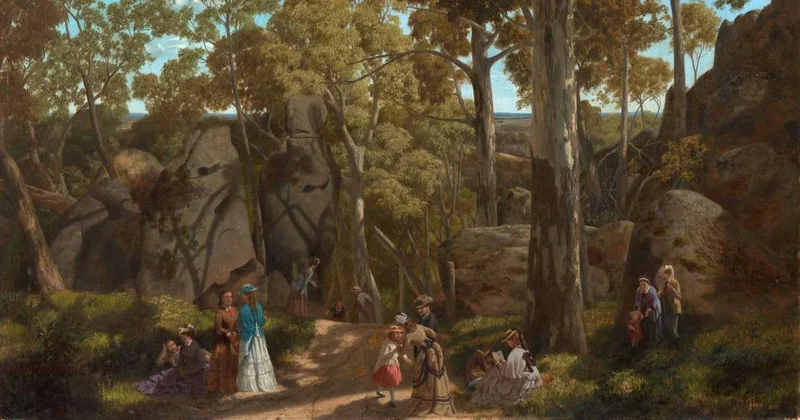
“Listen all of you! They’re
dead…dead.Miranda and Marion and Miss McCraw. All dead as doornails in a nasty old cave full of bats on the Hanging Rock.”
A few days ago, while watching Lena Dunham’s independent movie, Tiny Furniture, I heard the character played by Jemima Kirke ask Dunham’s character if she’d like to watch * Picnic at Hanging Rock*. An exciting coincidence, for I was reading Joan Lindsay’s novel at the time.
Lindsay’s 1967 novel about three missing schoolgirls and their governess is an Australian classic. The author uses letters, newspaper reports, and police diaries to frame the story and leaves it to the reader to decide whether it is “fact or fiction”.
There were four
The novel begins on February 14, 1900, on St Valentine’s Day, admittedly the most exciting day at Appleyard College, an all-girls’ boarding school. It is hard to say where the swoon-worthy cards come from but each female member seems to have received them and the premises are overflowing with romantic mementoes. It’s a bright summer day in the Australian countryside, and the schoolgirls are preparing picnic at Hanging Rock, a few million years old volcanic rock formation and a sacred Indigenous site.
The Indigenous peoples are rarely to be found there anymore and it is the perfect setting for a day of frolic for upper-class schoolgirls. Lindsay traces the principal characters’ roots to England or Europe, with some of their families actively participating in colonial projects in faraway continents. Much of their wealth is made in this way and their adventurous spirit comes from touring the supposed wilderness of places like India. The teachers, including the headmistress, have been imported from England and elsewhere, while lower-class Australians make up the housekeeping staff.
Hanging Rock, which might have been a familiar territory for the native communities, is a place of danger and excitement for the Appleyard girls. The teachers, governess, and other staff are also poorly acquainted with it and can do little when four women among them go missing. The strange, unknowable rock under the blazing summer sun creates a haunting background, where, despite the abundance of light, little can be seen.
Mrs Appleyard, the headmistress, rules the college with an iron fist. She personally picks girls who are fit to attend the picnic, holding back the rest. The girls are told to put on their gloves, hats, and corsets, even during the picnic in the scorching heat. Time and again, the girls complain about their impractical clothing which keeps them from truly relaxing on their day off. Excessive control defines the culture at Appleyard Culture, so it is rather jarring when the governess is sighted without her skirt and only in her “pantalones” when she goes missing. Like the schoolgirls who have no knowledge of the history and beauty of Hanging Rock, so is Mrs Appleyard oblivious to the untameable beauty of youth – the heat, quite literally, is unbearable and full of temptations. The only way to cool down is to run away.
Then there were none
The missing schoolgirls Miranda, Irma, and Marion are assets to the school. Miranda for her beauty, Marion for her brain, and Irma for her wealth. A fourth girl, Edith, who accompanies the group, informs the rest about the missing girls. She remembers how the girls suddenly went into a trance and climbed the rock, not heeding her warnings. A search is launched, but the girls are nowhere to be found. The party heads back to the school, two hours late, much to Mrs Appleyard’s disapproval. The novel reveals nothing about the girls’ motivation for such a transgression, making the disappearance feel all the more sinister. Is it criminal in nature, an escape, or a supernatural occurrence?
The news naturally gives rise to sordid imagination of girls bloodied and broken, murdered and raped, and every attempt to find them yields no success. When an unconscious Irma is discovered, she can remember nothing when she wakes up. Answers, if there were any, disappear into a black hole. Meanwhile, the other girls at the college become hysterical, and a teacher leaves, fearing the strangeness all around. Parents start withdrawing their daughters from the school and soon Appleyard College starts to resemble a graveyard of ghosts.
The Picnic on the Hanging Rock ends on a more chilling note than it begins with. The novel does not bother itself with solving its central mystery and instead chooses to focus on the fatal unknowability of what we cannot control. The Gothic genre, which often relies on atmospheric settings like mist, rain, and darkness for full effect, finds its definition expanded with Lindsay’s novel, where heat, light, and an open expanse hide as many secrets. The authorial voice should not be confused with that of the detective’s, for Lindsay is not too keen on playing one – what instead captures her interest are the opportunities of freedom that emerge from oppressive settings. The scintillating images of the governess in her knickers and Irma without her corset are just as confounding and delightful.
Picnic at the Hanging Rock, Joan Lindsay, Penguin Classics.
We welcome your comments at letters@scroll.in.