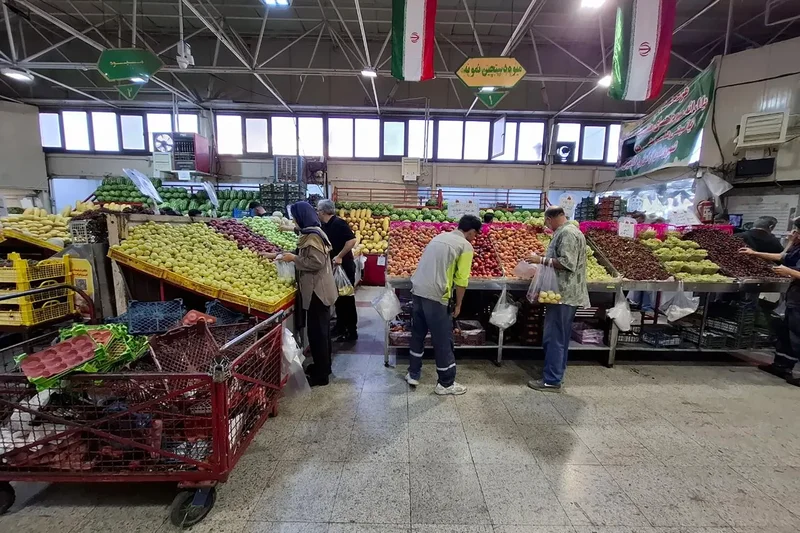
Tehran, Iran – On Fadaeiyan-e Islam Street in the south of the Iranian capital, Tehran, a woman in her 50s stands contemplating a bag of rice, looking closely at its price before turning away with a sigh.
“Inflation has taken a toll on our family’s income for decades, but this year it is almost wiping out our dining table,” she says. “The prices of all goods have doubled.”
Recommended Stories
list of 4 items- list 1 of 4‘Thousands of bookings to cancel’: Iran war upends Europe’s summer holidays
- list 2 of 4Hormuz deal ‘close’: What’s the latest on each side’s positions?
- list 3 of 4Why is Pakistan PM Shehbaz Sharif visiting Saudi Arabia amid Gulf tensions?
- list 4 of 4Iran tightens security grip at home as war conditions with US linger
This is a familiar scene these days across Iran, a country suffering from a naval blockade, two successive wars and a collapse in the value of the national currency.
According to the latest data from the Statistical Centre of Iran, food inflation rose by 128 percent in the month of Tir in the Iranian calendar (June 21 to July 20) compared with last year.
The price hikes have turned going to the market into an agonising experience for many Iranians, especially since the inflation index for eight of the 10 main food groups has exceeded the 100 percent barrier.
“A year ago, I used to buy the monthly household needs with my entire salary. Today, my salary amount, even with its annual increase, is not enough to cover just the food for our table,” said a woman, who identified herself as Sheila.
“Food prices have doubled several times over, and I no longer know what to cook. Every time I leave the market, I am carrying less than what I used to buy,” added the mother of three, who is about to retire from the Ministry of Education.
‘Bitter tragedy’
On the same street, home to middle-class households that once formed the backbone of the Iranian economy, Maziar, a 45-year-old man who works at a private company, was leaving one of the largest grocery stores holding some plastic bags.
“Do not look at the number and size of the bags; we have given up buying red meat, the desirable Iranian rice, and the high-quality oils that used to be a staple on our table,” he said.
“As soon as I receive my salary, I rush to buy household necessities, especially food items, for fear that their prices will rise tomorrow,” he added in a tired voice. Briefly smiling, he added: “It might sound like a funny joke, but unfortunately, it is a bitter tragedy.”
Similar accounts are not limited to southern Tehran, where low-income families are increasing in number. In Tajrish Square, in the north of the capital, grocery shop owners are also struggling to keep up with currency fluctuations and rapidly changing commodity prices.
“Prices change every day, and whenever I open the shop in the morning, I find that the wholesale price has risen compared to the past few days,” said Mahmoud, a 63-year-old grocery store owner.
”Customers, most of whom are wealthy, now come just to ask about prices, whereas in past years they used to buy regardless of the cost,” he said, adding that some of his customers are asking now to buy “goods with credit”.
“How can I sell on credit when I don’t know tomorrow’s price? I have been a merchant for over 40 years, and I have never seen conditions like these. Even during the years of the Iran-Iraq War [1980-88], the markets maintained a minimum level of daily purchasing activity, but today the market has reached a state of clinical death.”
War pressure
Millions of people across Iran are struggling for livelihood and survival, but the country’s embattled economy is still far from a state of collapse despite five months of war with the United States and Israel.
The vast and resource-rich country of more than 92 million people has developed a relatively diversified domestic economy for a major oil exporter, as the authorities over decades leaned on self-sufficiency in the face of harsh Western economic embargoes and confrontation with the US and Israel.
Still, the figures from the Statistical Centre of Iran showed that inflation has encompassed most commodities.
The prices of oils and fats top the list, recording a point-to-point inflation rate of 261.5 percent in a country where home cooking relies primarily on oil.
Following next are dairy products, particularly milk and cheese, with an inflation rate of 147.1 percent, while red and white meat and their derivatives recorded an inflation rate of 145.2 percent.
Even bread – the primary sustenance of the poor – has not been spared from the price hikes, with inflation for the bread and cereals group reaching 116.7 percent.
The impact of war and growing economic challenges is felt by many sectors of society in Iran, including private-sector employees.
“Two years ago, I used to go to the market and fill the cart without thinking,” Maryam, a 34-year-old architect, said while shopping for fruit and vegetables.
“Today, I count every rial. My husband and I work in large private sector companies, yet we are no longer able to live as we used to,” she added.
“The poverty line in the city of Tehran has risen to 900 million rials [a little more than $654], which means we may soon slip below this terrifying indicator. We were among the high-income families up until two years ago, but today we have become ‘the wealthy poor’.”