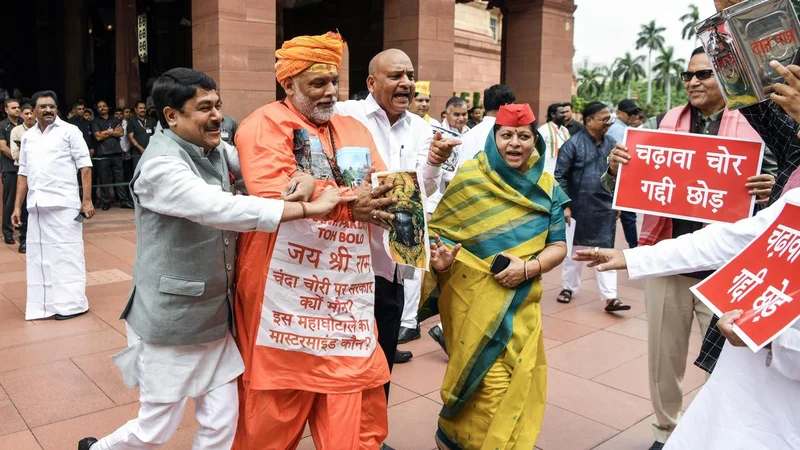
A Prayagraj court’s summons to Independent MP Rajesh Ranjan alias Pappu Yadav for his skit at the Parliament complex over the alleged theft of donations at the Ram Temple raises the question of territorial jurisdiction, which the judiciary is expected to strictly enforce to prevent “forum-shopping” by unscrupulous litigants as a means to harassment.
The court summons to the MP to reportedly appear before it on August 11 was based on a complaint filed before the court in Prayagraj. Section 223 of the Bharatiya Nyaya Suraksha Sanhita (BNSS) begins with the words ‘A Magistrate having jurisdiction’, suggesting that the Magistrate should have territorial competence while taking cognisance of an offence on a complaint.
Ordinarily, the law expects the registration of FIRs or filing of criminal complaints in the place where the cause of action arose. Section 177 of the Code of Criminal Procedure (replaced by Section 197 of the Bharatiya Nagrik Suraksha Sanhita) prescribes the basic rule that “every offence shall ordinarily be inquired into and tried by a court within whose local jurisdiction it was committed”.
Filing of private complaints and registration of FIRs at a place geographically far away from the occurrence of the incident has been interpreted by the Supreme Court as a deliberate ploy to intimidate the accused person.
Take the case of Arunachal Pradesh versus Kamal Agarwal, in which the FIR was lodged in the north-eastern State for a property dispute in Rajasthan. Even the people involved were residents of Rajasthan. A Supreme Court Bench headed by Justice Vikram Nath took no time to quash the FIR, even pointing out that the dispute was not even of a criminal nature.
The State High Courts could be approached to quash cases which artificially create territorial jurisdictions. The Supreme Court has, time and again, forcefully reiterated that forum-shopping by litigants must be “crushed with an iron hand” (Chetak Construction Ltd. versus Om Prakash).
The court has also discouraged a recently seen trend to register multiple FIRs across various States, forcing the accused to run pillar-to-post, answering one summons after the other, especially in criminal defamation cases involving political and media personalities. In the Arnab Goswami case of 2020, a three-judge Bench of the top court decisively laid down the law that “successive FIRs/complaints founded on the same cause of action are not maintainable”.
However, an exception to territorial jurisdiction could be found in the registration of ‘zero FIRs’ for cognisable offences.
The concept of zero FIRs is based on the principle that a police officer cannot turn a deaf ear to a genuine complaint about a cognisable offence merely on the ground of territorial jurisdiction. The concept of ‘zero FIR’ for booking cognisable offence has been statutorily recognised in Section 173 BNSS (which replaced Section 154 CrPC). A police officer registering a zero FIR can then transfer it to the jurisdictional police station.
The concept of ‘zero FIR’, that is, the registration of an unnumbered FIR at any police station regardless of territorial jurisdiction over the offence, was recommended by the Justice J.S. Verma Committee, which had considered amendments to criminal law following the Nirbhaya rape case.
In 2013, the same year as the Justice Verma Committee report, a Constitution Bench in Lalita Kumari versus State of Uttar Pradesh also held that the registration of FIR was mandatory if the information disclosed commission of a cognisable offence. The court had explained that if a police officer was given any “discretion, option or latitude” in the matter of registration of FIRs in such cases, it may lead to serious consequences affecting the rights of victims.
The apex court had even held that if a police officer refused to register a cognisable offence, the informant was entitled to approach the Superintendent of Police, who has to either investigate the complaint or direct a probe by a subordinate officer (Ramesh Kumari versus NCT of Delhi).
Published - August 09, 2026 08:25 pm IST