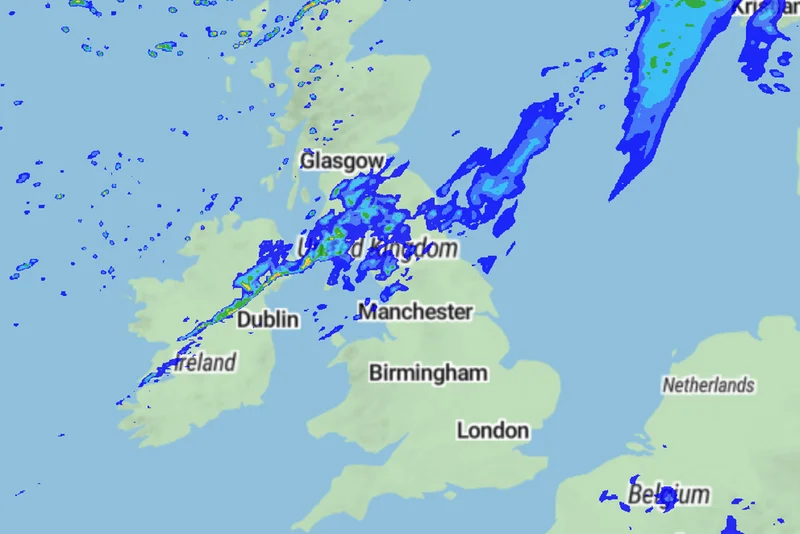
More than half a month’s rainfall hit Scotland this weekend as England and Wales continued to brace for a fifth heatwave of the summer, with temperatures of 36C expected this week.
North-west Scotland and parts of Northern Ireland were in the path of heavy rain on Sunday, but the Met Office forecast the wet weather could move southwards, leaving cloud of Wales and central England overnight.
Meteorologist Tom Morgan said north-west Scotland had already seen over 100mm of rain on Friday and Saturday, while 19 counties across England saw 1mm or less throughout the whole of July.
Forecasters expect that tomorrow will be slightly cooler, but heatwave conditions will likely return later in the week, peaking at 36C in parts of East Anglia and the South East by Thursday.
Highs of up to 30C are possible in parts of England and Wales by Tuesday, increasing to 32C and 34C respectively by Wednesday.
Mike Silverstone, deputy chief forecaster at the Met Office, said: “Temperatures will climb through the weekend and, more significantly, through much of next week. After a brief dip on Monday, high pressure will move across the UK before settling to the east, allowing a southerly flow to develop.
“A fairly widespread heatwave is likely across large parts of England and Wales, with hot conditions developing in places. The heat is expected to peak for much of England, Wales, Northern Ireland and Scotland on Wednesday.”
He added: “Humidity levels are also expected to increase through the week, which may make conditions feel more uncomfortable, particularly overnight.”
The UK Health Security Agency (UKHSA) has issued yellow heat health alerts for the East Midlands, West Midlands, South East, South West, East of England, Yorkshire and the Humber, and London.
The yellow heat health alerts are in place until 9pm on Tuesday, but may well be extended as the hot weather continues.
The extreme weather of summer 2026 has included two record-breaking heatwaves in May and June that led to more than 2,800 excess deaths.
Two more heatwaves in July, the driest July in England and Wales since records began in 1836, have fuelled drought and wildfires.
Half of England and all of Wales were plunged into drought as the heatwaves gripped last month.
The UK’s health watchdog this week issued a warning to take extra precautions if people are taking medicine in the hot weather.
The Medicines and Healthcare products Regulatory Agency (MHRA) said on Friday that drugs like ibuprofen and naproxen could increase sensitivity to the sun, making burns more likely.
Other treatments that can increase sensitivity include antibiotics like doxycycline and tetracycline, acne treatments like isotretinoin and topical retinoids, and antifungal medicines such as voriconazole, they said.
Dr Alison Cave, chief safety officer at the MHRA, said: “Some commonly used medicines can affect the body’s ability to stay hydrated, regulate temperature, or protect itself from sun exposure.
“Simple precautions can make a significant difference. Staying hydrated, avoiding the strongest sun during the middle of the day, and using protective clothing and sunscreen can all help reduce risk.”
Do you have a story? Contact james.reynolds@independent.co.uk