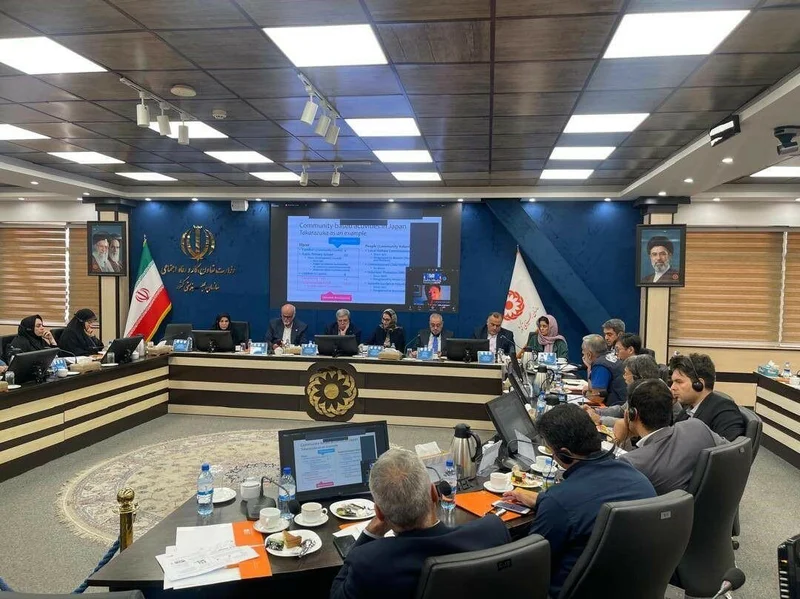
Welfare Organization, UNFPA underline shared commitment to strengthening local communities
TEHRAN – State Welfare Organization and the United Nations Fund for Population Activities (UNFPA) have highlighted their shared commitment to strengthening local communities through participatory and community-driven models.
In July, State Welfare Organization and UNFPA jointly organized and hosted an International Hybrid Webinar on Community-Based Models, titled ‘Strengthening Local Communities and Social Participation through Community-based Models”.
The high-level event was organized on the occasion of the 46th anniversary of the establishment of the State Welfare Organization. It brought together national leaders, UN officials, international experts across Asia, and national civil society actors to exchange technical expertise, explore innovative social solutions, and showcase successful community-level intervention models. The discussions were in line with the State Welfare Organization flagship initiative, “Salam Mahaleh”, which has been piloted successfully in more than 2,760 communities and neighborhoods across Iran, UNFPA website announced in a press release on July 20.
The event was officially launched by the speech of the head of State Welfare Organization, Seyed Javad Hosseini, emphasizing on the transformative strategic shifts the organization undertook, aimed at promoting welfare and improving quality of life.
Ms. Maysaa Al-Gharibawi, the United Nations Resident Coordinator in Iran, who is also the head of the World Food Program (WFP) in the country, highlighted the critical role of neighborhood-centered initiatives like Iran’s “SALAM” (SALAM Mahalleh) in enhancing social resilience and community support and in ensuring that no one is left behind.
‘Salam Mahalleh’ is a participatory, empowerment-focused national program designed to improve citizens’ quality of life, support vulnerable groups, and strengthen social participation and social capital across Iran.
By combining government capacity, volunteer service providers, NGOs, and active resident participation, the plan reduces bureaucracy, revives neighbourhood identity, and creates opportunities for local progress. It aligns with the fourteenth government’s policies on social justice, public participation, and neighbourhood-based governance. Piloted in Tehran’s District 4 – with 20 schools plus one school per province in its first phase – it has since expanded nationwide.
The initiative aims to improve citizens’ quality of life and social resilience, empower vulnerable groups and increase self-reliance, promote social vitality and enhance social capital, expand social participation and civic engagement, and grow social-health and welfare services, quantitatively and qualitatively.
Building a local network linking facilitators, volunteers, and government bodies, empowering he elderly through cultural, sports, artistic, and dialogue-based programs, identifying and guiding adolescent talent (ages 13–18) in academics, careers, and entrepreneurship, delivering rehabilitation, screening, and psychological counseling to all target groups, encouraging active public/volunteer participation and local organizing, and strengthening participatory decision-making and neighborhood governance are among the other goals.
Addressing Iran’s evolving demographic landscape, Mr. Keita Ohashi, UNFPA Representative in the Islamic Republic of Iran, commended the Iranian Government and States Welfare Organization for their proactive efforts and made the following key points:
Demographic Shift: Iran’s population is reaching approximately 93 million, with around 70 percent in the working-age alongside a rapidly growing older population.
Intergenerational Solidarity: Establishing a resilient society requires platforms where different generations can share experiences and support one another.
UNFPA Support: UNFPA recently supported a comprehensive training package for standard, formal elderly care and continues to promote novel social resilience frameworks, including Time Banking initiatives.
“At UNFPA, we believe every individual deserves a life of dignity throughout their entire life cycle,” emphasized Mr. Ohashi. “Local communities in Iran play a pivotal role in promoting active, empowered aging and reducing vulnerabilities.”
Complementing this perspective, Dr. John Jabbour, the World Health Organization (WHO) Representative in Iran, reaffirmed social participation as a core determinant of health.
The webinar featured insightful sessions from technical international high-level experts and across South- East Asia. UNFPA Regional Vision on Active Aging:
Dr. Abhijit Visaria, Population Dynamics Technical Adviser at the UNFPA Asia and the Pacific Regional Office (APRO), outlined UNFPA’s strategic framework for healthy aging and social inclusion.
Dr. Rintaro Mori, Mayor of Takarazuka, Japan, shared insights from Japan’s community centers (Kominkan) and neighborhood councils.
Prof. Chen Gong, Director of the Institute of Gerontology and the Institute of Population Research at Peking University, presented on the topic ‘Time Banking: A Powerful Tool for Sustainable Community Engagement and Empowerment.’
Dr. Paul Ong, Deputy CEO and Chief Strategy Officer at the Tsao Foundation, Singapore, highlighted strategies to address non-medical determinants of aging.
Mr. Quyen Tran, Senior Adviser to the Vietnam Association for Healthy Aging, detailed Vietnam’s nationwide network of Intergenerational Self-Help Clubs.
Services to the elderly
The Welfare Organization is planning to train consultants on aging or aging life care professionals. It has launched community-based rehabilitation (CBR) projects in less privileged and remote areas where access to welfare services is limited. Social workers receive a 20-hour training to start their jobs as facilitators in these centers. The project has so far covered 95 percent of the rural areas, and is planned to cover 30 percent of urban areas, as well.
According to Hosseini, the Welfare Organization has validated some 300 elderly day-care centers in cooperation with the national standard organization, and it is planning to establish new elderly service centers such as the elderly villages and elderly social health towns, behzisti.ir reported.
Prevention of disability in old age, home rehabilitation, home care services, and livelihood assistance for the elderly with severe disabilities are among other programs of the organization. The financial assistance has increase by 80 percent for nursing and 100 percent for home visit services.
The Welfare Organization has started to implement a forty-day training program for old people to improve their quality of life.
The program includes 240 different educational subjects such as health, life skills, arts, communication skills, digital and entrepreneurship, music, sports, games, and other leisure activities.
It was planned to be implemented as a pilot program in Tehran. Each individual registers to participate in the program for forty days within the three-month duration.
Participants are divided into two groups to attend the sessions either on odd or even days, with educational programs provided daily in two different parts. The first 15 minutes is dedicated to physical workout, the next 45 minutes focus on specialized training, and 90 minutes is allocated to recreational programs. During the educational courses, each person receives detailed training essential for self-care and improving their quality of life. Last year, over 200 older people received training.
So far, 19 cities in the country have taken necessary measures to develop age-friendly communities. These cities are located in different provinces, including Tehran, Gilan, Yazd, Isfahan, East Azarbaijan, West Azarbaijan, Lorestan, Hamedan, Khuzestan, and Bushehr.
Age-friendly communities are places where age is not a barrier to living well and where the environment, activities, and services support and enable older people to have opportunities to enjoy life and feel well.
MT/MG