It intends to provide clinical care for people with cancer in the same space where research is undertaken, the latter of which the university will fund and provide resources for.
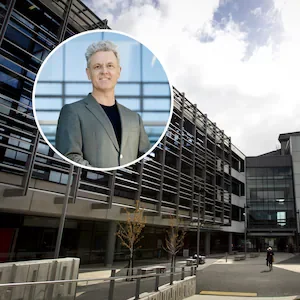
Dr Ben Lawrence has been named the inaugural head of the University of Auckland's new Department of Cancer Sciences.
“We know that clinical care is better in places that do research,” Lawrence said.
“It’s hard to know exactly what it is, but it’s probably because people are ... on the cutting edge.
“They have some hope that they can change the future, and the patients feel that.”
Veteran broadcaster Paul Henry expressed support for the idea when announcing his Act candidacy last week, saying he would love to build a “world-class cancer hospital” that would treat both Kiwis and foreigners and arguing the case for similar investments.
While Henry estimated the cost for his vision would be in the billions, Lawrence said the university’s centre will be “a lot less than that”.
“We know that there is a cancer building, for example, at Auckland Hospital which is past its use-by date, and Health New Zealand is planning to replace that,” Lawrence said.
“That would be a great time to add research into that building.”
Lawrence said planning the dedicated cancer centre required a lot of time, care and collaboration as they look to bring health professionals, researchers and cancer patients under one roof.
The project follows nearly a decade of planning at the University of Auckland, which is tightly connected to Auckland City Hospital. Photo / Natalie Slade
“You don’t really want everybody driving into the middle of Auckland every day to get their cancer care.
“You want to have a mothership which runs that, which is a cancer centre.”
New Zealand has one of the highest rates of cancer incidence globally, ranking second only behind Australia.
Having spent time overseas at Yale University and elsewhere, Lawrence said there were things he noticed New Zealand falling behind on in cancer care and research.
“I think in life, it’s never one thing, and in cancer care and cancer research, it’s never one thing.
“We need to bring population health, lab scientists, drug discovery, clinical trials all together. And that’s what other centres can do overseas.“
Lawrence said there were roughly 30 comprehensive cancer centres worldwide, and hundreds more whose fields operate separately but in tandem with each other.
New Zealand increased cure rates by 10% between 2000 and 2020, which Lawrence attributed mostly to new knowledge from research and healthcare improvements.
“You can’t beat being in the same place, bumping into the same people when you come out of clinic and you’ve got a problem that you can’t solve, and the scientist is there and you can talk to them about it, and then they can go away and try to solve those problems,” he said.
“That’s the ... heart of a comprehensive cancer centre; better care, better understanding of cancer, put them together and you get better outcomes for patients.”
Sign up to The Daily H, a free newsletter curated by our editors and delivered straight to your inbox every weekday.