Wrangle Over Expropriation Act Risks Sinking South Africa’s Government of National Unity
South Africa · POLITICS
A signature becomes a coalition crisis
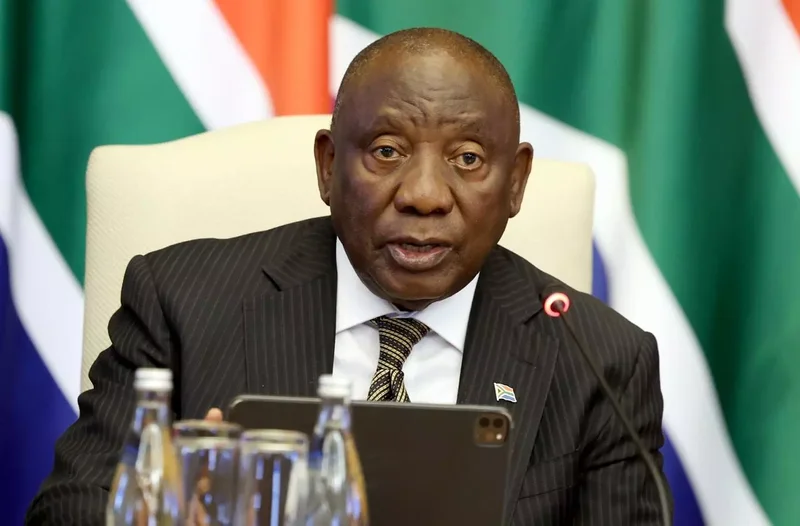
President Cyril Ramaphosa signed the Expropriation Act, 2024 into law on 23 January 2025, replacing a statute that had governed expropriation since 1975. The new Act provides a framework for the state to expropriate property for a public purpose or in the public interest, with a requirement to first attempt agreement with owners before proceeding.
The Democratic Alliance (DA), the second-largest party in the Government of National Unity (GNU), immediately declared a formal dispute. DA leader John Steenhuisen said the party had not been properly consulted and invoked the GNU’s dispute-resolution provisions under the coalition’s Statement of Intent.
The DA argues the Act is unconstitutional and damages property rights, investor confidence, and the trust architecture that holds the coalition together. Smaller GNU parties including the Freedom Front Plus (FF+) and the Inkatha Freedom Party (IFP) also voiced objections, though the IFP has at times preferred quieter intra-coalition management.
What the Expropriation Act actually does
The Act is not a blanket land-grab law, despite how it has been framed in some political rhetoric. It sets out specific circumstances where compensation may be nil, including cases where land is unused, abandoned, or where the state’s investment in the property exceeds its market value.
Compensation remains the principle in most cases, and the state must first attempt to reach agreement with owners. Reuters has reported that no land has been seized to date under the new law, a fact that has done little to calm the political storm.
The DA has nonetheless moved to challenge the law in court, later joining forces with AfriForum and IRR Legal in a Cape Town High Court challenge. The litigation ensures the dispute will continue on parallel tracks: inside the coalition’s political machinery and before the judiciary.
Why land remains South Africa’s most combustible issue
Land reform is one of the most emotionally charged questions in post-apartheid politics because redistribution has been painfully slow. A Wilson Center study found that between 1994 and 2019, just 8% of white-owned farmland was redistributed to black citizens.
That long failure has kept the issue alive for liberation-era politics and given traction to more radical positions such as uncompensated seizure, a stance associated most clearly with the Economic Freedom Fighters (EFF). The African National Congress (ANC) faces pressure from its left flank to deliver on promises of economic transformation, even as it governs in a coalition with pro-business partners.
The Expropriation Act row is therefore a proxy battle over whether the ANC can use GNU machinery to advance its long-standing land-reform agenda. For the DA, the fight is about whether it can preserve market-friendly constraints on state power from inside the coalition.
The money and investment stakes
Property rights are central to credit, investment, agriculture, infrastructure, and capital formation. Reporting around the dispute has repeatedly noted concerns that legal uncertainty could deter investment and worsen sentiment toward South Africa’s already fragile economy.
The DA frames the Act not just as a constitutional issue but as a macroeconomic one. The coalition fight is also a fight over whether South Africa can reassure domestic and foreign capital while pursuing redistribution, a tension that runs through many of the continent’s emerging markets and is explored in Africa: The New Scramble.
The GNU is not a single-party majority government. It is a negotiated arrangement in which the DA has leverage as the second-largest party, but no veto power over every ANC priority. That structural tension makes every policy disagreement a potential coalition-breaking event.
How a domestic law became a foreign-policy row
The issue spilled into international politics when United States President Donald Trump publicly attacked South Africa over the law and over claims about white farmers. Trump cited the land issue when cutting aid or sharpening pressure on Pretoria, turning a domestic legal dispute into a foreign-policy confrontation.
South African officials have stressed that the Act is constitutional land-reform legislation, not race-based confiscation. The exchange has nonetheless made the law part of a broader contest over South Africa’s external alignment, with Pretoria wanting room to pursue domestic redistribution and a non-aligned foreign policy.
Washington and other partners read property-rights protection as a signal of rule-of-law credibility. The dispute therefore tests whether South Africa can maintain investor confidence while advancing transformation, all under the glare of great-power scrutiny.
What to watch as the coalition strains
The immediate question is whether the GNU’s dispute-resolution mechanisms can contain the fallout. The DA has invoked those provisions, but the ANC shows no sign of retreating on a law that is central to its political identity.
The Cape Town High Court challenge will run in parallel, with a coalition of the DA, AfriForum, and IRR Legal arguing the Act is unconstitutional. A ruling against the government would deepen the coalition crisis, while a ruling in its favour would strip the DA of its legal argument while leaving the political dispute unresolved.
The deeper story is that land remains South Africa’s most potent symbol of unfinished economic transformation. The expropriation row is less about one statute than about whether the country’s new coalition can reconcile three incompatible imperatives at once: redistribution, property-rights certainty, and coalition discipline.
Frequently Asked Questions
What is the Expropriation Act and when was it signed?
The Expropriation Act, 2024 is a law providing a framework for the state to expropriate property for a public purpose or in the public interest, signed by President Cyril Ramaphosa on 23 January 2025.
Why is the Democratic Alliance opposing the Expropriation Act?
The DA argues the Act is unconstitutional, damages property rights and investor confidence, and was signed without proper consultation within the Government of National Unity.
Has any land been seized under the new Expropriation Act?
No land has been seized to date under the new law, according to Reuters reporting, and the Act still requires compensation in principle for most expropriations.
Sources
This article was produced by The Rio Times’ automated newsroom system. How we use AI · Report an error
LatAm Markets: Live Signals → — real-time movers, turnover leaders and FX across Latin America.