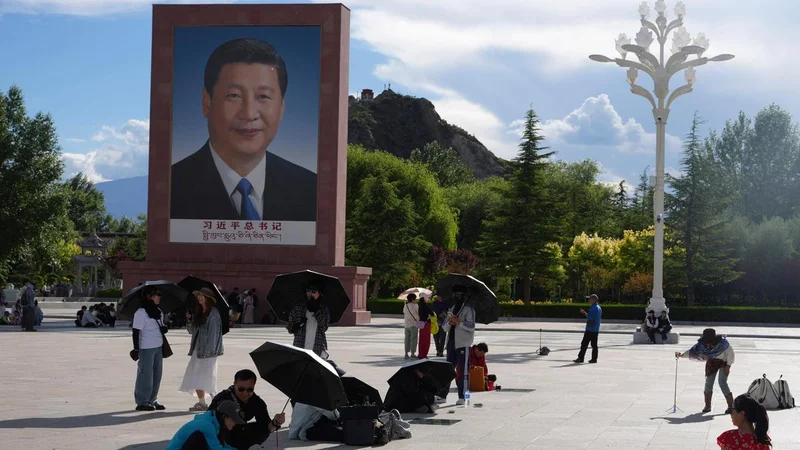
The July meeting of the Politburo of the Communist Party of China (CPC) ended with an announcement that the fifth plenary session of the 20th Central Committee will convene in Beijing in October.
The meeting said that the plenum would focus on major issues concerning comprehensive and strict self-governance within the party. This concept has been closely connected with the ruthless anti-corruption and conduct improvement campaign that China’s President Xi Jinping has been carrying out ever since he first took charge in 2012.
The plenum’s focus on it is indicative of an effort to further deepen Mr. Xi’s control over the party ahead of the 21st Party Congress next year, where, in all likelihood, Mr. Xi will seek a fourth term as General Secretary.
The tables appear to have been set for precisely that outcome as there is no serious contender in sight, and much of the machinery that Mr. Xi has built over the past 13 years has been geared, in one way or another, towards ensuring that there is none.
Beyond scale
It is difficult to overstate the scale of Mr. Xi’s anti-corruption campaign.
Between 2012 and 2025, some 7.011 million party members were disciplined or dismissed, among them 930 ‘tigers’, or centrally managed senior cadres. The unprecedented reach of all this is underscored by a striking fact: that three members of the 20th Politburo — a body constituted only in October 2022 — have been sacked.
Additionally, alongside the anti-corruption wave, a sweeping campaign has been targeting the persistent issues of formalism, bureaucratism, hedonism and extravagance within the party, which are the four ills that undermine party conduct, according to the central Eight-Point Regulation issued in 2012. By official accounting, roughly 1.5 million people have been caught in this crackdown since 2012. Mr. Xi has left little doubt that neither drive will ease. If anything, the message from Beijing is that the pressure will be sustained, and intensified.
Yet reading the comprehensive and strict party self-governance project through the anti-corruption lens alone misses its ambition.
Mr. Xi’s party-building agenda is considerably more broader.
Strengthening the foundation
Earlier this year, Cai Qi, a member of the Politburo Standing Committee and a close confidant of Mr. Xi, formally announced the establishment of ‘Xi Jinping Thought on Party Building’ — a branch of the wider canon of ‘Xi Jinping Thought on Socialism with Chinese Characteristics for a New Era’.
Chinese media commentary and policy discourse have since stressed the depth of its significance, emphasising that this is not merely a set of instructions on discipline, but rather a systematised body of doctrine that distils the laws governing how a long-term ruling Marxist party should build and govern itself.
In practice, this means an ideological and institutional edifice is being constructed to further entrench Mr. Xi’s authority, and bind the CPC ever more tightly to his vision. Ideology supplies the frame, organisational control and incentive structures shape who rises, and discipline enforces loyalty. Together, they are the tools with which Mr. Xi is remaking the party in the image of his own reading of China’s trajectory and policy goals, the future he believes the country must pursue, and the kind of cadre he believes must carry it there.
This mindset runs through a recent authoritative essay from the party’s discipline inspection and supervision apparatus. There are three key takeaways from it, which are indicative of what one can expect in the months and years ahead.
First, there is unabashed praise for Mr. Xi. The essay attributes all the achievements of discipline work in the new era to Mr. Xi’s “navigation and helmsmanship” and instructs cadres to mould themselves in Mr. Xi’s “selfless and fearless” image. The goal of discipline, in other words, exists in no small part to put the chairman at ease.
Second, the essay repeatedly presses for institutional innovation to make compliance permanent, calling to “lock power in an institutional cage,” to turn discipline into “a genuinely electrified high-voltage line,” and to build a “digital” inspection system that harnesses big data to detect and pre-empt wrongdoing.
And third, the animating purpose of discipline is not just loyalty to Mr. Xi but also to the cause that he has outlined. So inspectors are called to ensure that “what the Party Central Committee advocates is resolutely responded to, what it decides is resolutely carried out, and what it forbids is resolutely not done”, and to “clear obstacles and provide escort” for the goals and tasks of the 15th Five-Year Plan.
Moulding a political class
In essence, the goal of the Xi Jinping Thought on Party Building and comprehensive and strict party self-governance is not simply to punish wrongdoing.
Rather, the aim is to produce a political class that is, by design, composed of believers and adherents. Of course, this is much easier said than done, as evidenced by the fact that the anti-corruption campaign seems to be an endless affair for a leader who has been in power for 13 years.
The solutions he continues to offer are more of the same pursued with greater intensity, and now dressed in the permanence of doctrine and institution.
Manoj Kewalramani is Chairperson, Geostrategy Programme, The Takshashila Institution
Published - August 10, 2026 01:37 am IST