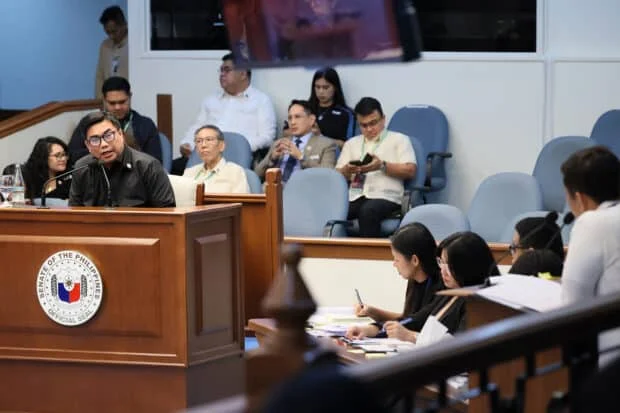
GRILLED ANEW National Bureau of Investigation Director Melvin Matibag takes the witness stand for the second day in the continuation of his cross-examination as a prosecution witness in the impeachment trial of Vice President Sara Duterte. —Niño Jesus Orbeta
MANILA, Philippines — The House prosecution panel on Wednesday rested its case on the first article of impeachment against Vice President Sara Duterte after National Bureau of Investigation Director Melvin Matibag completed two days of testimony by declaring that Duterte’s own public admission that she had spoken to someone to kill President Marcos was enough to consummate the constitutional offense of betrayal of public trust.
Appearing before the Senate impeachment court for the final time on Article IV of the verified impeachment complaint, Matibag said identifying the alleged assassin remained important to the bureau’s criminal investigation but was no longer essential to the impeachment charge because Duterte herself had admitted talking to a “mamamatay-tao” to kill Marcos, first lady Liza Araneta-Marcos and former Speaker Martin Romualdez, and that the person had agreed.
Article continues after this advertisement
“The betrayal of public trust as the issue in the impeachment court, we don’t need to investigate even if we pinpointed the person contracted. The point being is the betrayal of public trust was already consummated when she publicly admitted,” Matibag testified during the continuation of his cross-examination by defense lawyer Mark Vinluan on Day 9 of the trial.
READ: NBI chief: VP’s kill threat a national security concern
“There was already an admission that she contracted a killer. That itself is an admission,” Matibag said, adding that such an act violated the Vice President’s oath to preserve the Constitution, faithfully execute the laws and “do justice to every man.” “What you want to do is not execute the law but execute the President,” he pointed out.
Criminal probe separate
Asked whether the NBI intended to file another impeachment complaint after completing its investigation, Matibag replied that the bureau’s probe was meant to determine criminal liability, not to substantiate the impeachment case, because the alleged betrayal of public trust had already been established by Duterte’s own statements.
READ: Only threat, not ‘hitman,’ matters in VP Senate trial – prosecutor
Article continues after this advertisement
The defense immediately moved to strike Matibag’s answer from the record, arguing that it amounted to an improper legal conclusion. Lead prosecutor and Batangas Rep. Gerville Luistro objected, noting that the answer was responsive to the defense’s own question. Presiding officer Sen. Francis Escudero denied the motion and ordered that the testimony remain part of the record for the senator-judges’ consideration.
Matibag nevertheless maintained that the alleged assassination plot remained an active national security concern because the person Duterte allegedly contracted has yet to be identified.
Article continues after this advertisement
Search for alleged assassin
“We’re sure that there was someone spoken to and who agreed, but the identity has yet to be known,” he said, adding that protecting the President is part of the NBI’s mandate and that the bureau continues to conduct threat assessments with Malacañang.
Under questioning by Sen. Joel Villanueva, Matibag said investigators had narrowed their list of persons of interest from a much larger pool to fewer than 20 individuals.
“We started with a lot of names. We are narrowing it down already to less than 20 individuals,” he said, adding that investigators had interviewed relatives and associates of several persons of interest and hoped to identify the alleged assassin within three to six months.
Matibag disclosed that the investigation includes active uniformed personnel, including one person of interest from the Vice President’s Security and Protection Group (VPSPG). Investigators are also looking into possible links to the Davao Death Squad, relying on intelligence gathering, informants, open-source information and a process of elimination to narrow the list.
Asked by Sen. Erwin Tulfo whether the bureau had identified specific suspects, Matibag declined to disclose names but confirmed the list had been substantially reduced.
Sen. Raffy Tulfo questioned what he described as the unequal treatment of ordinary citizens and powerful officials, citing the warrantless arrests of individuals who offered bounties online for the death of former President Rodrigo Duterte. Matibag acknowledged that those cases were eventually dismissed and agreed that former Vice President Leni Robredo could have been arrested had she made similar statements during the Duterte administration.
Vinluan also asked whether the NBI would disclose its investigative leads if subpoenaed by the impeachment court. Matibag replied that the bureau would first study any subpoena and determine what information could legally be released while complying with established procedures.
Senators spar over witnesses
Sen. Robinhood Padilla, instead of questioning Matibag, asked Luistro what to call a witness who repeatedly changed his testimony, suggesting that such a person was a liar. Referring to former Davao police officer Arturo Lascañas, Padilla urged prosecutors not to present witnesses facing perjury issues.
Padilla ended his interjection with a remark that the prosecution “should not be one-sided” and suggested that they refrain from presenting witnesses facing perjury cases.
Sen. Panfilo Lacson later clarified that the Senate committee on public order and dangerous drugs, which he chaired in 2017, never recommended filing perjury charges against Lascañas despite his conflicting testimonies on the alleged Davao Death Squad. Lacson said the committee instead recommended stronger penalties for false testimony, which later became Republic Act No. 11594.
“I will confirm that Arturo Lascañas retracted and changed his testimony after several hearings … But I did not file perjury. I just want to correct that,” he said during the trial.
Sufficiently established
After the defense concluded its cross-examination, prosecutors waived their right to conduct a redirect examination.
Luistro said the prosecution believed it had “sufficiently established” that Duterte’s threats against Mr. Marcos had escalated into a national security concern and supported the impeachment charge of culpable violation of the Constitution and betrayal of public trust.
Although interrupted by defense objections that she was already arguing conclusions of law, Luistro maintained that further questioning of Matibag was unnecessary.
The prosecution’s decision formally closed its presentation of witnesses for Article IV, the first of four impeachment articles accusing Duterte of culpable violation of the Constitution and betrayal of public trust.
Outside the Senate session hall, prosecution adviser and Surigao del Norte Rep. Robert Ace Barbers said the panel was satisfied with the testimony of its three witnesses.
“The prosecution panel is satisfied with the statements made by the three witnesses presented. They corroborated their statements,” Barbers said. Using a basketball analogy, he added: “We’re still in the first quarter … But we have a lead.”
Next: Confidential funds
Before adjourning, the impeachment court issued subpoenas to former Land Bank of the Philippines branch managers Violeta Constantino and Nenita Camposano to appear when the trial resumes at 10 a.m. on July 29.
Your subscription could not be saved. Please try again.
Your subscription has been successful.
They will be the prosecution’s first witnesses on the next impeachment article involving the alleged misuse of confidential funds by the Office of the Vice President and the Department of Education. /cb