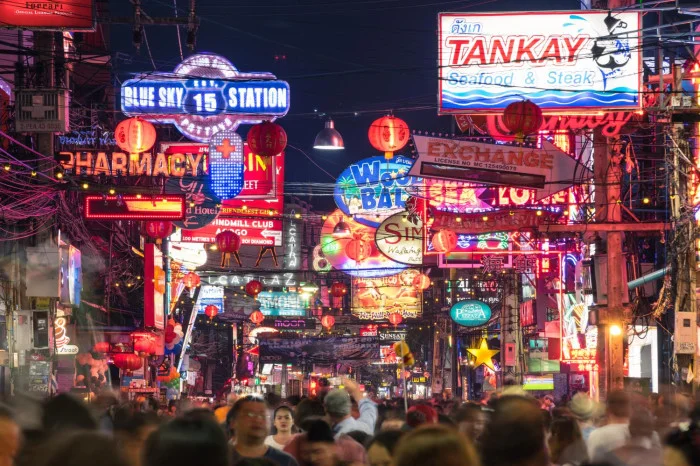
From Soi Cowboy in the bustling Sukhumvit corridor of Bangkok to Pattaya's Walking Street, the sex trade remains an open secret that authorities are often reluctant to acknowledge, despite its visible presence.
While Thailand promotes itself as a premium destination to lure high-spending travellers, it still struggles to reposition its image while keeping one foot in the sex tourism industry.
The recent case involving an Australian man who murdered a 17-year-old Thai teenager put Thailand's night-time economy in the spotlight.
The nation's reputation has long been associated with sex tourism, particularly Pattaya, a city known for its vibrant nightlife and entertainment scene, although tourism authorities have consistently distanced themselves from this segment.
Prostitution and sex work are illegal in Thailand under the Prevention and Suppression of Prostitution Act of 1996.
However, movements advocating for the decriminalisation or legalisation of sex work continue to gain traction, with supporters arguing that such reforms would improve workers' welfare and safety, helping to prevent further tragedies.
FLOURISHING INDUSTRY
The estimated number of sex workers across Thailand is more than 200,000, of which the majority are located in Pattaya and Bangkok, said Surang Janyam, director of Service Workers in Group Foundation (Swing), a non-profit organisation promoting equal rights and offering education and healthcare for service workers.
Ms Surang said although many entertainment venues closed during the pandemic, there is no slowdown in the sex industry.
Some workers shifted from entertainment venues to offer freelance services through social media platforms. The workforce also appears to be increasingly diverse in terms of gender, reflecting changing demand, noted Swing.
Pattaya is estimated to be home to more than 50,000 sex workers. The scale of the industry is reflected in the city's night-time economy, which is believed to generate 100-200 billion baht a year.
Pattaya's Walking Street is considered the centre of the city's sex industry, with numerous entertainment venues attracting tourists from around the world.
"Sex workers are part of the tourism sector. They provide services to tourists, who also travel to other parts of the city and take part in a range of other activities," said Ms Surang.
Thanet Supornsahasrungsi, president of the Association of the Chonburi Tourism Federation, said although tourism operators promote activities that position Pattaya as a family-oriented destination, it is undeniable that sex work exists there.
With several entertainment venues and massage parlours known to covertly offer sexual services, a grey area creates opportunities for corruption, allowing officials to demand bribes or extort money from sex workers, he said.
LEGAL LOOPHOLES
In 2023, 19,648 people were arrested for breaking the prostitution law, down from 38,139 arrests in 2022, according to the Royal Thai Police.
Ms Surang said as sex work remains illegal, workers are effectively excluded from the formal employment system and the wider economy.
"Sex workers lack the legal power to negotiate for their livelihoods. The law treats them merely as objects rather than human beings entitled to certain rights," she said.
Thailand's reputation for being open to foreign tourists is reflected in the abuse and crimes committed against sex workers, as reported in the media, said Ms Surang.
In addition to offering healthcare services to workers, Swing is working to empower and educate them about the law and methods to take care of themselves.
The foundation helps workers coordinate with police when they are assaulted or abused by clients, in order to arrest the offender and prosecute the case.
For instance, in a case involving the murder and mutilation of a transgender woman, Swing helped her family coordinate the case until the trial and compensation was ordered.
Similarly, the foundation assisted the family of the teenager who was murdered by the Australian man.
Police have become more aware of issues affecting sex workers and their broader social impact, noted Ms Surang. As a result, they are less likely to view sex workers as criminals and are less inclined to pursue excessive or exaggerated charges against them.
To help improve relations between the two sides, Swing regularly holds workshops bringing together police officers and sex workers in Pattaya to promote understanding and reduce conflict.
Since the enactment of the 2022 Act on the Imposition of Regulatory Fines, offences under Section 5 of the prostitution law are punishable only by fines and are no longer treated as criminal offences.
The authority to impose such fines was transferred from the police to officials under the Social Development and Human Security Ministry. In many cases, sex workers may be required to perform community service instead of serving a prison sentence, she said.
CLEARING THE GREY AREA
Ms Surang said sex workers remain in a grey area, vulnerable to abuse and bribery based on the regulations of the 1996 law, even though entertainment venue operators and workers want the trade to be legalised.
Swing is advocating to decriminalise sex work by abolishing the law, which would allow people 18 or older to work in the industry.
"We want the state to treat sex workers as a normal occupation," she said.
They should receive labour protection under the law, just like workers in other professions, and be able to join the social security system and access welfare benefits, said Ms Surang.
Greater regulatory oversight would also help reduce crimes against sex workers, she said.
Once sex work is decriminalised, a key challenge will be training law enforcement personnel and administrative officials to adapt to the new approach, noted Swing.
Even in countries where sex work is decriminalised, law enforcement agencies have sometimes struggled to keep pace with the changes.
"Decriminalising sex work does not necessarily mean that more people will choose to enter the profession. The government can still enforce anti-human trafficking laws to prevent minors and individuals who are coerced or forced into sex work from being exploited," said Ms Surang.
As Swing waits for the 1996 law to be repealed, it is pushing for a ministerial regulation to provide greater protection for sex workers, guaranteeing fair wages, access to social welfare and labour rights, and recognising their obligation to pay taxes.
Mr Thanet said the authorities should establish a designated red-light district, with appropriate zoning and regulated oversight of sex work, similar to models adopted in other countries.
This system would prevent such activities from affecting visitors who may not wish to encounter them in the city, he said.
The approach would also help strengthen the city's brand image while improving safety for residents, workers and tourists, said Mr Thanet.
However, Ms Surang argued that restricting the sex trade to a designated area could actually increase the risk of bribery and corruption as questions could arise over whether services provided outside the approved zone would be legally permitted.