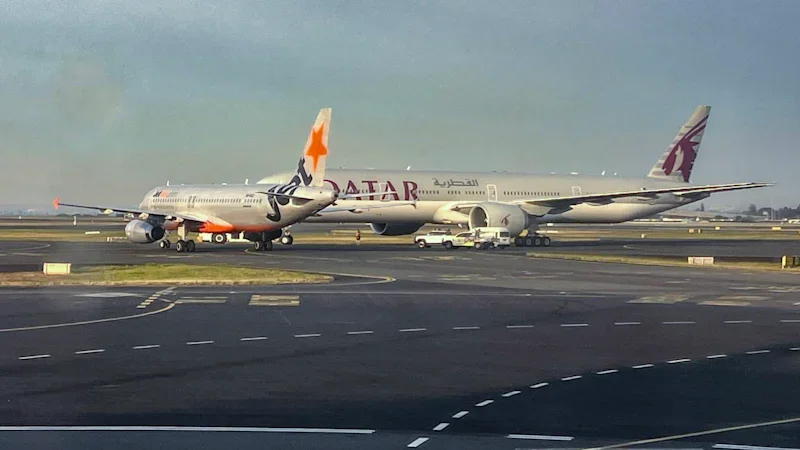
The chief executive of Australia’s air traffic control agency was summoned to a meeting with Transport Minister Catherine King after days of flight delays and two near misses on the tarmac within a fortnight.
Rob Sharp, the chief executive of Airservices Australia, spoke with King on Monday after a Jetstar pilot was forced to slam on the brakes to avoid striking a Qatar Airways jet on Sunday, just weeks after a similar incident in which planes had been given contradictory instructions by controllers at Sydney Airport.
The Australian Transport Safety Bureau is now investigating. Its chief commissioner Angus Mitchell said the incident occurred at low speed but still had the potential to be “very significant”.
“Those two aircraft should not have come as close as they did,” he said on Seven’s Sunrise. He would not prejudge his organisation’s investigation, but flagged that the traffic control system had been under significant stress.
There have reportedly been several staff shortages in recent days. Air traffic controllers have unlimited sick leave and it can take about 18 months to train a new controller to manage a specific piece of airspace or part of the airport.
“Now we have another airport in Sydney that’s up and starting that build up phase, a new air space design that’s only just come into effect in the last few weeks,” Mitchell said.
Airservices has been dogged by persistent troubles in hiring and training enough staff since a mass retirement of controllers in 2021 as COVID shut down the aviation sector. Additionally, questions have lingered about the work culture of the ASA.
Dean Long, chief executive of the Australian Travel Industry Association said the number of delays caused by Airservices has jumped compared with before COVID. When the agency has insufficient air traffic controllers it delays flights to ensure it can manage them safely.
He said that the rest of the travel sector had restored performance after the pandemic but “Airservices, for whatever reason, does seem to be really struggling to get their performance where it needs to be.”
“The amount of disruption that causes – not just for the airlines or the passengers, but even the flow-on implications for travel management companies, for travel agents, for connecting flights in other markets – it is disproportionate, and it does need to be sorted.”
More to come.
The Business Briefing newsletter delivers major stories, exclusive coverage and expert opinion. Sign up to get it every weekday morning.