- See more Daily Mail on Google - save us as a Preferred Source
Elvis, The Colonel And The Mob (Ch4)
Rating: Four out of five stars
Elvis Presley is ancient history. Next year sees the 50th anniversary of his death. The King of Rock 'n' Roll is closer to the era of silent cinema than to us.
Yet he's still one of the most famous entertainers in the world — instantly recognisable to more people, I suspect, than even Taylor Swift or Ed Sheeran.
And we're still trying to make sense of how he was able to destroy himself so completely: first his pop career, then his looks, then his talent, then his life.
Elvis, The Colonel And The Mob laid all the blame squarely on his corrupt manager, a former carnival huckster who called himself Tom Parker but whose real name was Andreas Cornelis van Kuijk.
I'm unconvinced, and not simply because narrator James MacPhee called him 'The Colonel' throughout. That's not quite right — Parker was just 'Colonel', as though it was his first name, whether people were talking about him or to him.
Even his wife Loanne called him 'Colonel'.
A gambling addict who lost up to a million dollars a month in the Las Vegas casinos, he was deep in debt to the Mafia.
Without hard evidence but based on plenty of hearsay and rumour, the documentary argued this was the real reason Elvis never toured abroad. The gangsters had his manager on a string.
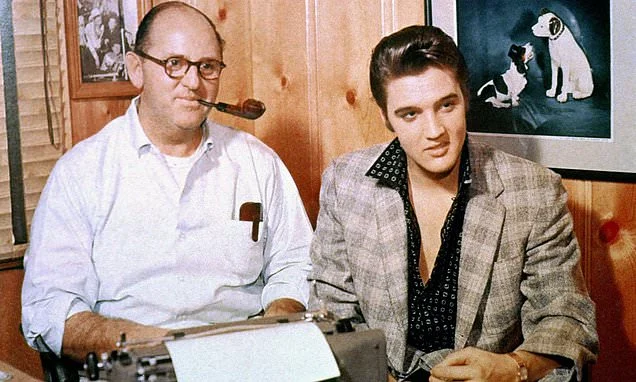
Elvis, The Colonel And The Mob laid all the blame squarely on his corrupt manager, a former carnival huckster who called himself Tom Parker but whose real name was Andreas Cornelis van Kuijk (right)
Elvis Presley with his manager, Colonel Tom Parker, signing a record contract in 1955
Without doubt, Colonel was a conniving, cheating, bullying, slimy piece of work, dishonest to the tips of his fingers...literally.
This two-part documentary, aired as a double bill, included a great story of how he used to shortchange punters when he ran a fast food stall at travelling funfairs.
Parker had a quarter (25 cents) glued to his wedding ring, so he could hold back a little money as he showed the customer his change before pressing coins into his hand.
Details like that conjure a vivid picture, and this show served up lots of them, including a telling anecdote about a Vegas show in 1970 where Elvis was so paranoid and wired on amphetamines that he pulled a Derringer pistol from his boot and waved it at the audience when a fan yelled his name.
Turned out the poor chap just wanted to request Don't Be Cruel.
No such luck for us. We didn't hear a note of the hits, even during archive footage of live performances.
The budget was so limited, in fact, that there was no audio of Elvis or Colonel talking either.
Engrossing though it was, I'd have liked to see more balance. Veteran music journalist Peter Guralnick published a biography of Colonel last year, and uncovered heartfelt letters from the manager to the star as Elvis's crazed behaviour tore their partnership apart in the 1970s.
But there was no padding. The Elvisologists, including Daily Mail writer Ray Connolly, offered a stream of insights and strong opinions. Colonel's biographer Alanna Nash said, 'He's the only person I ever met who I felt was evil.'