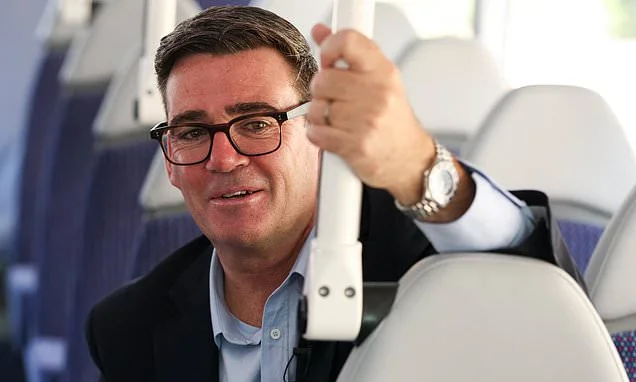
Within 48 hours of entering Downing Street, Andy Burnham has confirmed what much of the country feared. He is heading a fiscally illiterate government and he has no economic plan that even begins to make sense.
Despite this, the incoming Prime Minister is already spending money like a drunken sailor on shore leave.
Yesterday he floated the notion of a ‘national care service’, to tackle the problems of looking after an ageing population. Like so much of his unwritten manifesto, this concept was scarily short on detail. But he intimated that the new system would be a sister service to the NHS, an idea that has previously been costed by the Health Foundation think-tank at an additional £18.7billion a year.
As health secretary under Gordon Brown in the Noughties, Mr Burnham proposed raising billions for more healthcare by imposing a flat rate inheritance tax of 10 per cent – a universal death duty.
It is difficult to conceive of a tax that would be more unpopular or destructive. The gasps of pain and distress that met Rachel Reeves’ first Budget in October 2024, when she abolished inheritance tax relief for farms worth more than £1million, will be insignificant compared to the national shock and horror if the Burnham regime taxes every bequest.
The majority of the public already favour abolishing inheritance tax, which is regarded as the ‘most unfair’ of all levies. Polling that we at the TaxPayers’ Alliance conducted found that every group – no matter how you splice it – supports cutting or abolishing inheritance tax, with the exception, bizarrely, of those with PhDs. Reform UK’s Richard Tice summed it up succinctly as ‘an awful grief tax’.
As health secretary under Gordon Brown in the 2000s, Mr Burnham proposed raising billions for healthcare by imposing a flat rate inheritance tax of 10 per cent, writes John O'Connell
The majority of people are able to leave everything they own to their family and friends, because most of us don’t have enough in savings and property to exceed the tax threshold of £325,000 (frozen since 2009), which rises to £500,000 where their main home is left to direct descendants.
This means ordinary people, not wealthy by any stretch of the term, who have scrimped and budgeted all their lives, are able to provide a nest-egg for their children and grandchildren.
The ability to do something for the people we love best is the most basic right in an economy based on property ownership. And it’s the primary reason why the concept of a communist society sends an instinctive shudder through most people’s veins.
M r Burnham’s scheme, which forms no part of the manifesto that saw Labour elected two years ago, will undermine that right. It will cause untold damage to the economy, all for a shapeless, uncosted ‘national care service’ that might as well be called the Bottomless British Money Pit.
Without a clear plan, geriatric health care will swallow all the money we can throw at it, without providing any tangible benefits. This is certain, because we already have the template: the NHS, apparently the envy of the world, is now a broken system that wastes tens of billions of pounds in taxes.
The reality of this will hit Mr Burnham like a sledgehammer, as soon as he tries to impose his social care scheme. Neither the economy nor the voters will be able to bear it.
Yet there is also talk of a second death duty, with the removal of capital gains ‘uplift’ on inherited assets.
At the moment, for the purposes of inheritance tax, property is assessed on its value when the owner dies, not the price originally paid. But Labour is thinking of abolishing this rule and imposing tax on the difference.
The effect of this double whammy would leave most grieving families unable to hang on to the family home. They’d have to sell, just to pay the swingeing death taxes. Not only would this cause misery to individuals, it would flood the housing market and send prices crashing. The chaos it could create is hard to overstate.
It is difficult to conceive of a tax that would be more unpopular; the majority of the public favour abolishing inheritance tax, which is regarded as the ‘most unfair’ of all levies
What Mr Burnham fails to understand, despite all his talk of easing the cost-of-living crisis, is that Britain is already buckling under the heaviest tax burden since the Second World War. We have entered a doom loop and to increase taxation and state spending now will only cause the country to spiral down faster.
The cause of both the economic crisis and the unsustainable taxation ought to be obvious to everyone. We are spending far more than we can afford on welfare. More than four million people now claim Personal Independence Payments (PIP), a benefit which is not means-tested – an increase of 400,000 claimants since Labour came to power.
Almost a quarter of all PIP claimants cite ADHD, autism, depression or anxiety as their main disability. Benefit payments to people with mental health problems have reached £3billion a year. The total cost of sickness and disability benefits for working age people now stands at £58billion and is predicted to rise to £78billion within five years.
Yet the disability minister, Sir Stephen Timms, states in an internal government report that he does not regard this as any cause for concern. The complacency is staggering.
The previous Prime Minister, Sir Keir Starmer, made a timid attempt at slowing the increase of the welfare bill and was forced into a humiliating U-turn by raging backbenchers. But the scale of the crisis was spelled out by Pat McFadden, the Work and Pensions Secretary under both Prime Ministers.
What Mr Burnham fails to understand, despite all his talk, is that Britain is already buckling under the heaviest tax burden since the Second World War, writes John O'Connell
In a WhatsApp message made public during the Peter Mandelson scandal, Mr McFadden said that every discussion he had with colleagues amounted to one dilemma: ‘Who can we tax in order to pay benefits to others?’
The answer, evidently, is ‘everyone possible, dead or alive’.
According to research by the TaxPayers’ Alliance released yesterday, one million people will be dragged either into paying income tax during 2026-27 or into a higher tax threshold, including an extra 600,000 pensioners.
Half of them will pay the basic rate, while another 41 per cent will face the higher rate. Just 7 per cent will pay the top rate – emphasising that it’s lower paid employees and self-employed workers, with their families, who bear the brunt of these stealth taxes.
The average taxpayer will have been hit with an increase of £640 since 2024-25. Yet for those on welfare, prospects are rather better. A claimant in London who takes full advantage of all the various potential entitlements could have an income of £710 a week, equivalent to an annual salary before tax of £46,000 – only slightly less than the median annual salary in the capital of £49,700, or about £756 a week take home.
There is also the potential benefit, for those who qualify, of a subsidised Motability vehicle.
Once the costs of working are taken into account, such as commuting and workwear, it’s probable that full-time employment pays no better, or actually worse, than welfare for many people.
That can’t continue – not just because it’s morally abhorrent but because people will not stand for it. No amount of tinkering around the edges with bus fares or grand promises about ending the blight of rough sleeping can disguise the disaster facing Britain.
The Government cannot afford to keep paying millions not to work. It cannot keep forcing more people to pay taxes. And it cannot keep raising those taxes.
This is the doom loop. Unless it is halted, it will spin our country to destruction.
John O’Connell is chief executive of the TaxPayers’ Alliance.