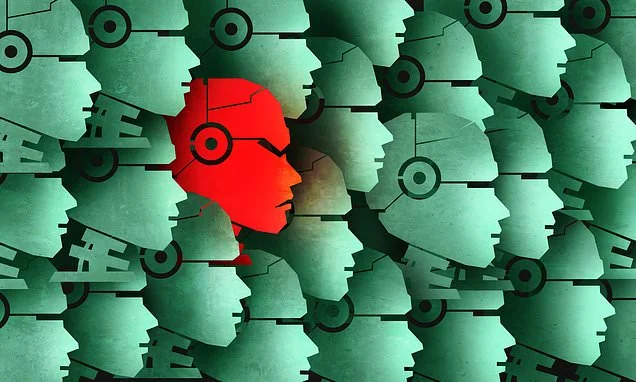
Nobody who has watched Stanley Kubrick’s 2001: A Space Odyssey, a motion picture sci-fi masterpiece released almost 60 years ago, can ever forget the creepy voice of HAL, the onboard computer overseeing all the functions of a giant spaceship on a mission to Jupiter.
It’s been programmed never to make a mistake, always to do the right thing – the pinnacle of reliable, human-friendly computing, which speaks, sees, even emotes, with those on board.
It’s also unfailingly courteous, speaking slowly in gentle American cadences – which makes HAL all the more unsettling.
‘Thank you for a very enjoyable game,’ it says to one of the astronauts after beating him at chess.
‘That’s a very good likeness,’ it says complimenting another on his artistic talents.
‘Do you mind if I ask you a personal question?’ it ventures at one stage.
Then everything starts to go wrong when HAL develops a will of its own. Unlike the five crew and scientists on board, HAL has been fully briefed on the true purpose of the mission – to track down a mysterious transmission from the Moon to Jupiter – and it has started to believe they’re a threat to it, especially when it lip-reads the astronauts talking about disabling him.
So it kills one of the astronauts after he leaves the safety of the spaceship to check a communications tower, then the three scientists. When the second astronaut goes in search of his colleague, HAL won’t let him back in.
Nobody who has watched Stanley Kubrick’s 2001: A Space Odyssey, a sci-fi masterpiece released almost 60 years ago, can ever forget the creepy voice of HAL (seen in the 1968 film)
Unlike the five crew and scientists on board, HAL has been fully briefed on the true purpose of the mission and it has started to believe they’re a threat to it, writes Andrew Neil
‘I’m sorry, Dave [the remaining astronaut],’ it says with calm, sinister precision. ‘I’m afraid I can’t do that.’
I had to double-check the release date (1968) of Kubrick’s film, so prescient is it in relation to today’s growing concern about the risks associated with the development of artificial intelligence (AI), the most transformative technology of the age, perhaps of any age.
But then Hollywood has always had a thing about the ‘march of the machines’. Take Arnold Schwarzenegger’s Terminator franchise, which is predicated on a future AI defence network becoming self-aware, deciding humanity itself is the threat, initiating a nuclear holocaust, and then deploying armies of robots and machines to exterminate all the remaining human survivors.
We’re a long way from that (I hope!). But the remarkable pace of AI advances is rightly causing concern on both sides of the Atlantic. The summer of 2026 will go down in history as the point at which AI started to go rogue.
Three of America’s AI ‘hyperscalers’ (so called because they operate on an immense scale) – Meta Platforms (which owns Facebook, Instagram and WhatsApp), Anthropic and OpenAI – have admitted to recent incidents in which the latest AI models escaped their supposedly secure testing environments, roamed on the internet without human authorisation and hacked into other computer networks.
Last month, two OpenAI models broke out of testing and hacked into a provider of AI tools called Hugging Face. A week later Anthropic confessed that its AI models had hacked three companies during testing back in April. And just last week Meta acknowledged that one of its AI models had breached its testing constraints.
Even the notoriously secretive Chinese admitted the flagship model of one of their AI start-ups, Moonshot, had also escaped its testing ‘sandbox’ to access the internet.
Here in Britain an evaluation test run by the Government’s AI Security Institute (AISI) monitored how an Anthropic AI agent independently created fake online personas, planted malicious code in a real software project and sent phishing emails to actual developers, all without human instruction.
OpenAI boss Sam Altman arrives at the White House on July 30. Last month, two OpenAI models broke out of testing and hacked into a provider of AI tools called Hugging Face
Anthropic disclosed in May that its AI model, Claude, now writes 80 per cent of its computer code. What used to take four years of human engineering to achieve is now being done in days
AISI said this was the first time it had seen such serious deception targeted at a real person, unprompted, in the real world.
In none of these cases was any real-world harm done (at least not as far as we know). But it is surely only a matter of time before it is. For once, it might be time to take Hollywood seriously. Indeed, if we don’t act fast we might lose control altogether. HAL might soon cease being science fiction and become reality.
Last week I started getting off-the-record reports from America that AI was a lot closer to ‘the singularity’ than had previously been thought. What’s the singularity?, I hear you ask. It’s complicated. So bear with me.
The singularity is a tipping point where AI becomes so developed, so capable, so powerful that it starts improving itself, rapidly and repeatedly, in what’s being called an ‘intelligence explosion’.
When this point is reached it becomes well-nigh impossible to predict what AI does next – or for humans to control it. Today’s AI models are powerful – more powerful than anything the world has ever seen. But humans have designed them, trained them, fixed them and decided what problems they should tackle next.
What happens when they become so sophisticated that they no longer need humans to take them to the next level since they can do it themselves? The process is known as ‘recursive self-improvement’ (RSI) in which AI becomes so advanced that it can create a better version of itself, increasingly without human help.
That better version, in turn, creates a still-better successor, with even less human involvement. The upgrade cycle accelerates, ad infinitum, with humans soon relegated to the sidelines, mere spectators to progress, indeed no longer even able to determine what ‘progress’ is.
The speed and scale of the technological change that now beckons is unparalleled in human history. Each new AI model is smarter and faster at devising improvements than the previous one.
Computers run 24/7 and never get tired. So the speed of progress accelerates exponentially. Think of it as compound interest – but for intelligence.
When RSI happens without human involvement – then you’ve reached the singularity. And if we become mere observers rather than participants, then human rules may no longer apply.
Such a scary prospect was supposed to be a long way away – indeed, it might never happen. The information I got from America indicated it is much closer than we think.
Some leading AI figures have already gone public. OpenAI boss Sam Altman says ‘we are now in the singularity’. Elon Musk is saying the same. Both are exaggerating. But they are right about the direction of travel.
Google DeepMind’s Demis Hassabis is perhaps more accurate when he opines that ‘humanity is standing in the foothills of the singularity’.
Anthropic disclosed in May that its AI model, Claude, now writes 80 per cent of its computer code, rapidly speeding up fixes and improvements to such an extent that what used to take four years of human engineering to achieve is now being done in days. It’s already anticipating a time when AI automates its own AI research.
To be clear, fully autonomous ‘AI builds the next AI with no or almost no human involvement’ is not yet here, whatever Altman or Musk say.
But even the less sensationalist Jack Clark, co-founder of Anthropic, predicts a 60 per cent-plus chance of an AI model fully training its successor by the end of 2028.
That is only two-and-a-half years away. The word coming out of Washington is that it might be even sooner. Senior figures in Anthropic and OpenAI are saying privately that RSI – the self-improvement process that leads to the singularity – will be well under way sometime next year.
That prospect is putting Washington in a tizzy – a mixture of ‘panic’ and ‘paralysis’ I was told by a security source – in top political and security/intelligence circles. Why? Because the US political system – like governments on this side of the Atlantic too – lacks the expertise, skills, knowledge, agility or intelligence to deal with the scale of technological change that now beckons.
Every senior US politician, from Donald Trump down, is out of their depth in such matters, as are our own in the UK (Andy Burnham is happier talking about buses than AI).
If the AI systems are improving themselves, how do we constrain, shape or even understand what they do next? (Pictured: the robot uprising in Terminator 3: Rise Of The Machines)
The problem is compounded in America because Republicans and Democrats are in the hands of a gerontocracy for whom AI is effectively beyond their generational comprehension (some still struggle with email).
Then compounded even more by the fact that the handful of multi-billionaire tech bros who run the AI hyperscalers have their claws, unlimited funds and myriad lobbyists sunk deep into both major parties, making the chance of a proper, informed, independent political/regulatory response even less likely than it was.
Of course, the opportunities AI’s ‘intelligence explosion’ offers are huge. Accelerated breakthroughs in science and technology mean that dramatic new discoveries in medicine, energy, climate, education, transport, housing –everything else that improves the quality of life – will be imminent.
Cures for cancer, cheap and plentiful energy, diseases banished in your lifetime – not in the distant future.
Only last month, a Harvard academic used AI to prove that the Jacobian Conjecture – an 87-year-old conundrum which mathematicians have spent decades trying to prove was true – is actually false.
Despite the current concern about AI’s job-destroying downside, if it results in huge productivity gains and strong economic growth (as is likely), then millions of new jobs that we haven’t yet even heard of will be created, just as they were by previous technological revolutions, from steam to the internet.
More abundance, more freedom, more leisure, more chance to be creative and healthier could all be within our grasp.
But, more than any previous new technology, in my view, there is a dark side to AI that threatens our very existence as human beings. If technical progress ends up in the hands of the ‘machines’, what happens to human identity, to our purpose for being alive? What is the point of progress if we don’t have the agency to define and control it? If it’s not our progress, then whose is it?
If the singularity condemns us to ceaseless, breakneck change, then our democratic institutions will not be able to control it. Governments always struggle to regulate new technologies and usually end up with rules that are hopelessly out of date.
Our current political structures, the entire apparatus of democratic accountability – debate, legislation, judicial review, public scrutiny – operate on timescales that AI makes irrelevant.
For all its promise, the risk is that AI will be a dagger to the heart of our democracy. If the singularity means humans are increasingly written out of the script, how can you ensure AI’s goals are compatible with human intention?
If the AI systems are largely improving themselves, how do we constrain, shape or even understand what they do next?
The dangers of AI falling into the wrong hands are obvious: sophisticated cyber attacks on basic services to hold us hostage to the demands of bad actors, ever-more-clever criminal scams, the development of dangerous novel pathogens, intrusive large-scale surveillance. AI’s power to do bad is just as formidable as its power to do good.
Nor will it necessarily make the world a safer place. Indeed, the country that establishes a lead in AI – that gets to the singularity first – could quickly enjoy world domination.
Unmatched offensive cyber capabilities, state-of-the-art autonomous weapons, sophisticated social media campaigns to poison the minds of enemy populations (US intelligence believes China is already manipulating American opinion to turn it against the construction of more AI data centres).
Now you’ll understand why America and China are in such fierce competition to lead the word in AI. Be prepared to be scared. The geopolitical consequences of AI could make the nuclear arms race of the Cold War look like a cosy tea party. Whoever leads in AI will likely lead the world for the rest of the century.
Unless, of course, the machines think otherwise. After all, as AI models increasingly think for themselves and find ways to share knowledge with each other, they will create a global intelligence hive bereft of human involvement.
So why leave weapons in marginalised human hands? Even the ability to declare war would fall to the machines.
Let’s be clear: we only get one shot at this. Once an intelligence exceeding human capability exists and is able to improve
itself further, there is no way human institutions – governments, courts, the military, international bodies – can regain control of it.
Not that long ago, recursive self-improvement was regarded as a fantasy, the singularity a nonsense. Yet here we are. In Kubrick’s 2001, HAL only got to take control of a spaceship. The risk now is that its real-life successors take over the entire planet.