Massimo Salvagnin has the seeds ready. He just isn’t sure whether to put them in the ground.
Next week, the farmer plans to sow green beans in the sandy soil of his family’s 600-hectare farm near Italy’s Po River delta. But this summer’s extreme heat has made the ground so hot that he worries the seeds could die before they have a chance to germinate.
“The sand gets so hot that the risk of cooking — boiling — the seed when it touches the soil is extremely high,” he said.
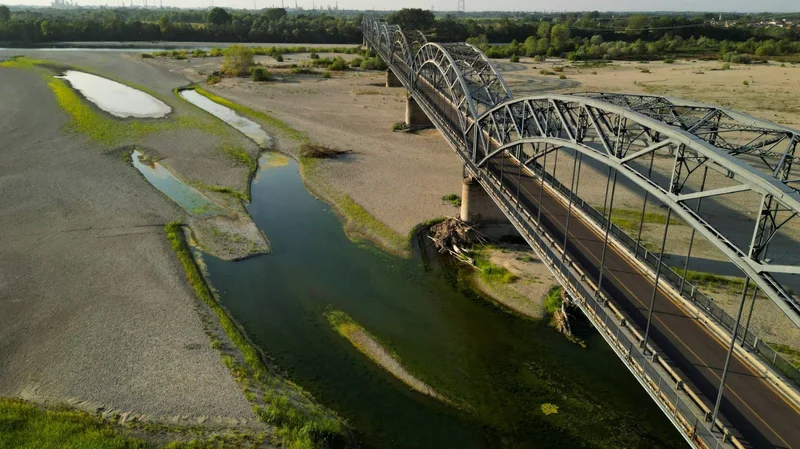
Across northern Italy, farms, factories and power plants reliant on abundant and predictable water are confronting a new reality. Climate change is making the Po River, the engine of Italy’s industrial economy, swing violently between flood and drought.
It’s forcing farmers to rethink what they grow, engineers to reconsider how water is stored and moved, and industries to compete for a resource they once took for granted. With Italy in the grip of another major heat wave, the challenge is to adapt decades-old businesses that were built on the assumption the water would always be there.
Salvagnin, 59, made sure before planting that his irrigation consortium could guarantee water for the next month to six weeks. The anxiety is spreading across northern Italy as the Po sinks to historic lows.
At Cremona, the river fell to 8.59 meters below the hydrometric zero on July 30, 1 centimeter below the previous record low set during the severe drought of 2022. Flow was reduced to less than a third of the historical norm for this time of year, according to the Po River Basin District Authority.
Economic engine
The 652-kilometer Po is Italy’s longest river, rising in the Alps near the French border and emptying into the Adriatic Sea south of Venice. While much shorter than the Rhine or the Danube — two of Europe’s other great economic waterways — it carries an exceptionally large volume of water.
Each spring, snowmelt is channeled to Europe’s largest rice-growing region, flooding fields near Milan for planting varieties used in risotto and working its way east. The river and its tributaries also support nearly 900 hydropower plants, helping to drive the country’s manufacturing economy.
The Po River district accounts for about 41% of Italy’s gross domestic product and 32% of its agricultural production, according to the basin authority.
Climate change is testing the economy near Ferrara, where much of the farmland was created by draining delta marshes and lagoons. From the 1950s, the vast Mezzano wetlands were converted into farmland for crops from strawberries to tomatoes, maize and sugar-beets, much of it below sea level.
Pumps and canals are used to continually manage the boundary between land and water, draining fresh water when there’s too much and bringing it back when there’s too little.
Increasingly, the water arrives at the wrong time, said Stefano Calderoni, chairman of the Consorzio di Bonifica Pianura di Ferrara, which operates roughly 4,200 kilometers of canals and 160 pumping facilities.
At peak spring flows, he estimates that roughly 10 billion cubic meters can pass Pontelagoscuro near Ferrara in less than two weeks. Months later, the same region can be scrambling for water. The Po increasingly seems like a torrent, continually filling and emptying, he said.
“We have two great challenges: managing too much water and too little water,” Calderoni said. “We relied on nature when we should have relied on planning.”
Even rainfall increasingly offers only temporary relief. Intense, localized storms do little to rebuild water reserves, according to Alessandro Delpiano, chairman of the basin authority. Higher temperatures melt Alpine snow earlier, while urbanization and soil sealing diminish groundwater replenishment.
Know-how from the south
Salvagnin is hardly a farmer who resisted modernization.
His father founded Porto Felloni farm about 50 years ago. After traveling to the U.S. in the 1990s to study how American farmers used technology, Salvagnin introduced precision agriculture at the family business, including yield mapping and variable-rate farming.
Today, buried sensors measure soil moisture, while weather stations, satellite data and crop models estimate how much water plants are consuming. Irrigation can be adjusted by individual sections of a field.
Some of the techniques were developed in Italy’s hotter, drier south.
Nicola Gherardi, a national executive board member of Confagricoltura, one of Italy’s main farming associations, learned about drip irrigation for tomatoes from farmers in the Puglian area of Foggia. The systems water directly around the plants, unlike the large sprinklers common in the Po Valley.
“I went to those who had faced these problems before us and developed techniques and know-how that we simply didn’t have,” Gherardi said. He points to France’s Rhone as another model for the Po, where water-management interventions have allowed agriculture to coexist with hydropower and the delta.
Farmers have also shifted crops. Maize, a cornerstone of northern Italy’s livestock and dairy industries, has contracted sharply. It needs large amounts of water and is vulnerable to salinity. Gherardi said Italian production is around half what it was two decades ago, while more tolerant crops such as sorghum are increasingly appearing in rotations.
Switching can have an economic downside. A hectare of industrial tomatoes can yield up to double the income of barley, Salvagnin estimates. High-value crops sustain processing plants, logistics companies and seasonal jobs.
“If farms have to grow barley because it doesn’t consume water, they can’t make a living,” he said.
Competition for water
Energy providers are also feeling the pinch. At Enel Green Power’s Isola Serafini hydroelectric station, all four generating units have been idle since July 30 because river flows are too low.
During periods of scarcity, drinking water takes priority, followed by irrigation and food production. Energy and other uses come afterward.
Rivers are also normally required to retain an ecological flow to protect ecosystems, though regions and provinces are asking for exemptions to allow more water to be withdrawn, Delpiano said.
The basin authority has also asked hydroelectric operators to release additional water stored in Alpine reservoirs to support the Po downstream. This year, authorities changed a roughly 80-year-old rule governing the regulated water level at Lake Maggiore, allowing it to hold an additional 15 centimeters of water.
Saltwater intrusion
At Pontelagoscuro, the last major measuring station before the delta, the Po is flowing at roughly one-third of historical volumes, according to the basin authority, signaling heightened risk of saltwater intrusion. Seawater is penetrating more than 25 kilometers inland, affecting irrigation withdrawals and ecosystems.
It also worsens a longstanding problem for the reclaimed countryside, which sits atop saline groundwater left from the original marshes and lagoons. Fresh water near the surface helps hold it down, but prolonged dry periods can allow salt to rise through the soil, burning the land and making it difficult for crops to grow.
While engineers originally removed water to turn wetlands into farmland, preserving it now depends on keeping freshwater in.
Farmer Salvagnin says agricultural economy that has defined this part of Italy for generations is under threat. Across the region, farms are closing and younger generations are moving into other professions.
He’s worried that extreme heat will trigger an abandonment, similar to the kind that’s emptied parts of Italy’s mountain regions.
“I’ll keep doing my job,” Salvagnin said. “But around me there could be a desert.”