- What kind of cases do you want to read more about? Let us know at: crimedesk@dailymail.co.uk
A 50-year-old double death mystery which has been linked to 'Bullseye' serial killer John Cooper is being reviewed by a coroner again after police took a fresh look at the case.
The 1976 case in which two siblings, Griff, then aged 73, and his sister Martha Thomas, 70, were found dead at their family farmhouse in December 1976 has haunted the small coastal town of Milford Haven in Pembrokeshire, Wales, for decades.
The bodies of the elderly siblings were found inside their isolated Ffynon Samson farmhouse on a cold December morning by a postman, who raised the alarm after spotting unopened letters on the porch and smelling burning coming from the home.
Inside, the badly bludgeoned body of Martha and burnt body of Griff were found.
The scene, described as a 'bloodbath' by a surviving family member, was one of utter disarray.
Martha, also known as Patti, was found lying slumped on a magazine rack in the corner of the living room, having suffered severe head injuries.
At her feet was an overturned television, still switched on and eerily playing static noise. Chairs were scattered about the room and Griff's burnt body lay nearby on the floor.
Police opened a double murder investigation, yet failed to ever find the culprit.
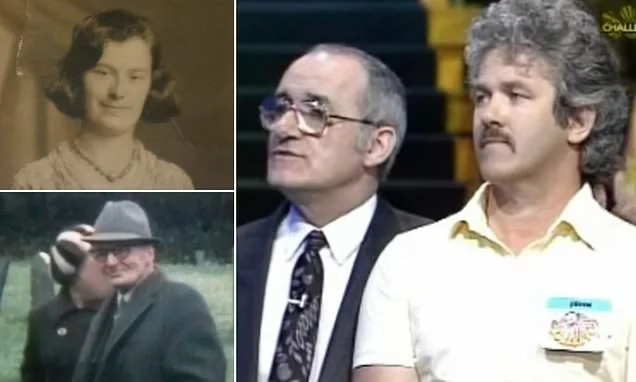
Serial killer John Cooper (pictured, right) has been linked to the Thomas' 1976 deaths
Griff Thomas (pictured) was found dead alongside his sister in December 1976
Martha Thomas (pictured) was found with severe head injuries slumped on a magazine rack in the corner of the living room
In January 1977, the detective leading the investigation decided that Griff had 'probably' killed his sister.
An inquest decided that Martha was 'unlawfully killed' - by her 73-year-old brother, who had a curved spine and hand function issues, hitting her over the head with a kitchen chair before starting a fire, in which he then lay down and died.
Their bereaved family members and friends of the churchgoing siblings never believed police's theory, maintaining that they were both murdered.
In fact, some argued that John Cooper, known as the 'Bullseye' serial killer after he appeared on the 1980s game show, was behind the deaths.
The notorious killer, now aged 81, was behind a string of brutal murders and rapes in south Wales in the 1980s and 90s.
He shot and killed two couples on separate occasions in 1985 and 1989, before holding five teenagers at gunpoint in a wooded area behind the Mount Estate in Pembrokeshire in 1996, and raping and sexually assaulting a 16-year-old and a 15-year-old girl.
Cooper was eventually arrested in 2009 after a cold case review team used new forensic technologies and, ultimately, matched a police e-fit to his 1989 appearance on the TV game show Bullseye, which was an almost identical drawing to Cooper's stature, his hair, and his face.
Thereafter, Cooper would be dubbed the 'Bullseye serial killer'.
John Cooper, left, appears on television show Bullseye in 1989
A police artist composed this sketch of Cooper after the murders of Peter and Gwenda Dixon. It showed a near-identical image of Cooper as he appeared on Bullseye and allowed police to connect him to the unsolved murders
It was not until 2009 that Cooper was arrested, finally going to jail on May 26, 2011 at Swansea Crown Court after being handed life imprisonment with a whole life order.
His crimes bear similarities to the Thomas' 1976 cold case, leading many people to connect the killer to the deaths over the years.
Firstly, Cooper was from Milford Haven, in Pembrokeshire, where Griff and Martha were found dead in their country farmhouse, and lived there for much of his life.
During the 1985 double murders of siblings Richard, 58, and Helen Thomas, 46, Cooper also set their home, Scoveston Manor, on fire after killing them.
The case has sinister parallels to the 1976 unsolved double deaths, which also included the deaths of a brother and a sister, even of the same surname.
Forensic psychologist Dr Clive Sims, who helped profile the Suffolk strangler, is one expert who supported the theory that Cooper was behind the 1976 deaths.
He argued in 2011 that the verdicts reached in the inquest were 'unsafe' and calling for the case to be looked at again as a cold case.
He pointed out to BBC Wales the similarities between the two crimes and proposed the theory that the deaths of Martha and Griff were the result of a 'botched burglary'.
Cooper protested his innocence as he was led into court in 2009
He said: 'There is an empty cash box, the bureau has been broken into, the back door is unlocked and certain aspects of it simply do not make sense.'
He also pointed out that during the 1985 double murder of Richard and Helen Thomas, Cooper had also taken their bank cards and jewellery.
Cooper would have been 40 at the time that Martha and Griff were found dead in 1976. Dr Sims believes he likely started committing serious crimes long before he killed the Thomases in 1985, although this is, of course, unknown.
He added: 'It's quite probable that he would have been offending earlier.
'It would be extremely unusual for someone to start that late in life on a criminal career, and to start with that level of violence.'
But others were unconvinced that the Bullseye killer is behind the Thomas' unsolved deaths.
Steve Wilkins, the former senior investigating officer for the John Cooper inquiry, welcomed the review into the deaths of Griff and Martha, but remained doubtful that the Bullseye killer was the culprit in that case.
Mr Wilkins said it would be 'surprising' if Cooper had been responsible, saying that there were differences in the 'modus operandi' between their deaths and Cooper's crimes.
He argued, for instance, that Cooper was a 'professional criminal' whose motive had always been 'financial gain'.
But if someone had murdered the Thomases, they had left behind thousands of pounds in cash at the farmhouse.
Dyfed-Powys Police reopened the cold case and launched a forensic review in October 2022.
The review used new forensic technologies to collect enhanced fingerprints, make DNA enquiries, and examine blood-group evidence again.
Police said among the evidence re-examined was Martha's handwritten diaries, original investigation documents, fingerprint lifts, and postmortem moulds of their hands.
Yet four years on, police have still been unable to find the answer of what happened to Martha and Griff Thomas in December 1976.
Now, the case is being handed to HM Coroner, who will be asked to provide advice and guidance on how the force should proceed.
It has not been confirmed whether the case will remain an active investigation or whether discussions with the coroner could result in a fresh inquest.
Dyfed-Powys Police said in a statement: 'We can confirm that a significant amount of complex work has been undertaken as part of the forensic review process, and the family of Griff and Martha Thomas have been updated of the progress made so far.
'The scope of the review was to examine:
- Photographs, plans and scientific findings of the scene for interpretation using current knowledge and police practices.
- Fingerprint lifts from the scene for accuracy and consideration of further identification analysis.
- Original fingerprint lifts for blood, cellular material and hair with a view to obtain DNA evidence.
'To ensure all available material was obtained, several detailed searches have been conducted by the force in line with an overarching forensic strategy.
'Search locations included police stations in Pembrokeshire, our scientific support unit archive at Police Headquarters in Carmarthen, The National Archive of Wales, Aberystwyth, and the Forensic Science Service Archive, in Birmingham.
'As a result of these searches the following items were identified:
- Handwritten diaries kept by Martha Thomas
- Original investigation documentation
- Fingerprint lifts and photographs of fingerprint marks
- Postmortem moulds of the hands of the deceased
- The tapestry, which remains with family in London
'Following the retrieval of all available material, we have been able to carry out three phases of work: Fingerprint enhancement and analysis, DNA enquiries, and consideration of the blood grouping work carried out by the original investigation team.
'The family has been updated on the findings from these enquiries, and the limitations faced in reviewing an incident that took place 50 years ago.
'We are now at a stage where communication has begun with HM Coroner to keep them informed of the latest position, and to seek advice and guidance on how we proceed.
'We will continue to keep the family of Griff and Martha updated on the review, along with any recommendations from HM Coroner.'