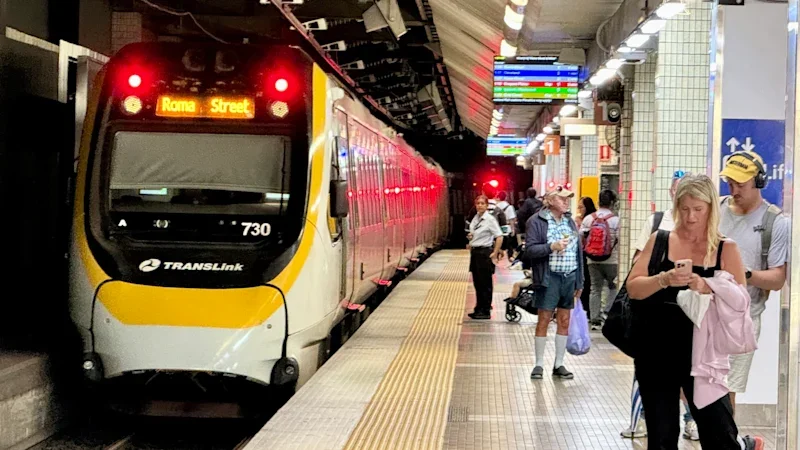
South-east Queensland train lines have adopted a new numbering system, in a move some hope will prove the death-knell for plans for an Elizabeth Line named after the late monarch.
As part of the overhaul, train lines would be numerical, rather than destination-based. The line between Ipswich/Rosewood and Caboolture/Nambour will now be known as T1, between Springfield Central and Kippa-Ring will be T2, Doomben-Roma Street T3, Cleveland-Shorncliffe T4, Varsity Lakes-Brisbane Airport T5 and Beenleigh-Ferny Grove T6.
It has raised hopes from transport advocates and the Labor opposition that the new numbering system would make one of the LNP’s pet ideas, the Elizabeth Line, too difficult to implement.
A Translink spokesperson said the line numbers would be introduced across the network this month.
“They will be added to your destination to help you identify your service at a glance,” the spokesperson said.
“The new numbering system makes the network easier to understand, navigate and use, particularly for visitors and customers with accessibility needs. There are no changes to timetables, routes or stopping patterns.
“The destination will continue to be shown alongside the new number.”
Along with the T-lines, Brisbane Metro lines would continue to have an M prefix, ferry services would have an F prefix and Gold Coast Light Rail an L prefix.
Bus numbering will be standardised to three-digit numbers, with some high-frequency routes such as the CityGlider to continue to use two digits.
Better Transport Queensland president Rowan Gray said the organisation, which was formerly known as Rail Back on Track, strongly supported the introduction of train line numbering in south-east Queensland.
Gray said it was a common practice worldwide and matched what was already done on Queensland’s buses, ferries and light rail.
“Line numbering will be a good thing for the legibility of the rail network,” he said
“Anyone who’s ever looked at Google Maps – or the official journey planner – and been befuddled by VLDB [Varsity Lakes-Doomben], RPIP [Redcliffe Peninsula-Ipswich], or even CACA [Caboolture-Caboolture], will soon see sensible, legible labels like T1.
“It’s important to get this bedded in well before Cross River Rail opens. That way the information changes, but the presentation is already familiar.”
Passengers could expect changes when Cross River Rail opens, now slated for 2029, including a link between Brisbane Airport and Ipswich.
Labor opposition transport spokesman Bart Mellish, who served as the portfolio’s minister in the former Miles government, said he hoped the new numbering system would spell the end of the Elizabeth Line idea.
“Hopefully this means sanity prevails and [Deputy Premier] Jarrod Bleijie’s nonsensical naming suggestion never sees the light of day,” he said.
On the occasion of Queen Elizabeth II’s death, Bleijie launched a petition to have Cross River Rail named after the late monarch.
The LNP collected the names, suburbs, phone numbers and email addresses of signatories and the party was accused of using the petition to harvest data.
The petition, which the LNP claimed attracted about 5000 signatures, was never presented to parliament.
Gray said he was relieved the new system would make the Elizabeth Line even harder to implement.
“The biggest reason it doesn’t make sense here is that Cross River Rail isn’t a standalone line,” he said.
“It’s not a self-contained corridor like London’s Elizabeth Line. CRR is a trunk through‑route that feeds directly into the Gold Coast, Sunshine Coast, and Kippa‑Ring lines.
“Naming it as if it were its own separate line would actively confuse people about how the network works.
“Keeping it unnamed reinforces the reality: it’s core infrastructure, not a new colour on the map.”
Despite this, a spokeswoman for Transport Minister Brent Mickelberg said there would be no impact on the government’s Elizabeth Line plans.
More: