When conversations around screen addiction come up, they almost always centre on children and teenagers. But what about the adults who spend their workdays peering into laptops, unwind by scrolling through social media, and end the day glued to the television screen?
Here is the outline of an answer to that. And it is being sketched by The Kraft Faktor, a small-batch handmade products brand, creating soaps, shampoos, perfumes, candles and home fragrances, that has over time tucked an experience-based initiative into the shopping bag, conducting craft-based workshops, curating personalised gifts and developing DIY kits for people to continue crafting at home.
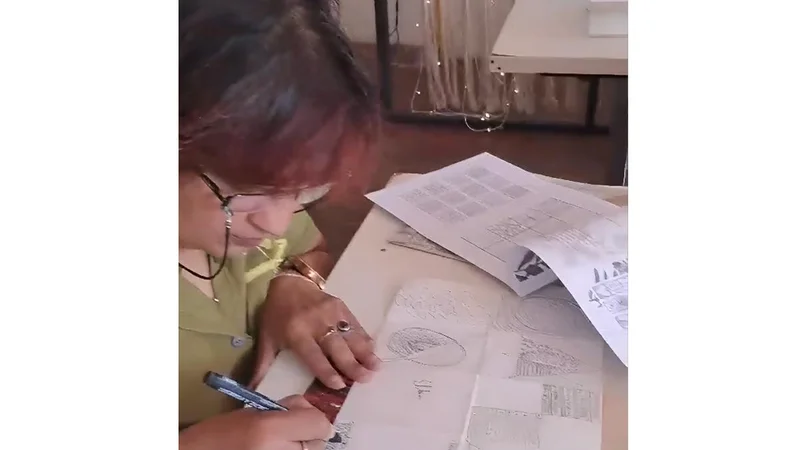
Deepa Sam and Nabeela Rehman, founders of The Kraft Faktor (TKF), view digital overload as cutting across demographic divides. TKF has inked in a couple of small-batch workshops (Mindful Line Art & Pattern Making and Paper Alchemy - Beginner-friendly Decoupage) for August 15 (11 a.m. to 1 p.m.) at Playbae Cafe in Thoraipakkam that indirectly address screen addiction. For participation, the number of birthdays someone has had so far carries little weight. For additional details about the workshop, DM them on Insta @thekraftfaktor.
These workshops have a philosophical underpinning, simple but far-reaching.
“We are saying: consciously build a habit in your 20s and 30s of practising some form of art or craft every day,” says Deepa. “It could be anything. It could simply be cooking a meal or consciously grooming yourself. If these small routines are done consciously, the results are not visible in one or two days, but over time they make a difference.”
Participants of TKF’s workshops range from young professionals looking for a break from busy work schedules to retirees trying to fill the void that often follows decades of routine. “We noticed that this stage of life often leaves a huge vacuum,” says Deepa. “Many people naturally fall into digital consumption.”
For the founders, the concern is not simply the amount of time people spend online. It is the way screens constantly compete for attention. “For me, it is very simply put — overstimulation versus correct stimulation,” Deepa says. “On a screen there are hundreds of images and notifications. Even if you are only watching a few posts or one reel, you generally do not stop because social media is designed to keep you hooked.”
Here is the contrast TKF seeks to drive home through its workshops.
“When you are creating a craft with your hands, your brain focuses on one task for 15–20 minutes. You are following one process, one sequence, one goal. There is also a natural stopping point. You finish one page, one piece or one step, “ Deepa adds.
Unlike scrolling through an endless stream of content, craft requires people to interact with real materials, making decisions, changing tack and reviewing the output. Paper has to be folded. Wax has to be poured. Glue has to be applied. Hands move objects, feel textures and respond to the material in front of them. Instead of reacting to rapidly changing colours, movement and notifications, attention stays with one activity at a time.
Nabeela elaborates: “With doomscrolling, you are only taking in information. Every second you are absorbing something new. When you are doing an activity, you are constantly asking yourself, ‘What next? How can I do this? Is there a better way than last time?’ There’s a give-and-take in the process.”
Mindfulness is a healthy byproduct. Someone who makes things regularly is also more likely to think carefully about what they buy, how they use materials and whether something can be repaired, reused or repurposed instead of discarded.
The workshops themselves are intentionally small, with no more than eight participants at a time. A DIY kit is part of what every workshop offers, making it easier for participants to keep practising long after the session ends.
Published - August 10, 2026 11:06 am IST