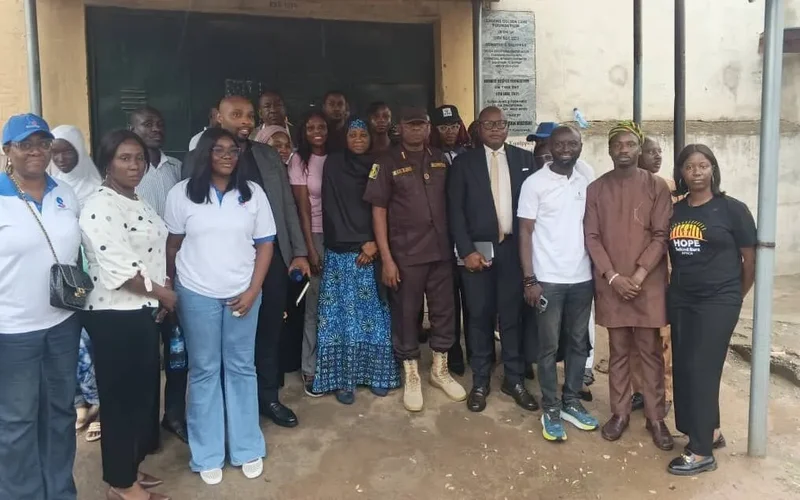
The National Human Rights Commission (NHRC) and a development partner, the Hope Behind Bars, on Wednesday, facilitated the release of eight inmates from the Suleja correctional facility in Niger State commemoration of the International Nelson Mandela Day.
The eight inmates were released from the prison in Suleja, which borders the federal capital, Abuja, after the NHRC and Hope Behind Bars offset the fines imposed on them by courts.
The Executive Secretary of NHRC, Tony Ojukwu, said the action remained a powerful tribute to former South African President Nelson Mandela who was in prison for 27 years during the struggle against apartheid in the country.
Stressing the significance of the commemoration, he said on the Nelson Mandela Day, “the world pauses to honour the legacy of Nelson Mandela, a towering figure whose life reminds us that justice, dignity and compassion must extend to everyone.”
“In 2015, the United Nations General Assembly broadened the scope of Mandela Day to highlight humane conditions of imprisonment.
“The recognition of prisoners as continuous members of society and the vital role of correctional service staff as a social service of great importance was broadened,” he said.
Mr Ojukwu, represented by Benedict Agu, special assistant to the executive secretary and the head of monitoring department of the commission, said the adoption of the “Nelson Mandela Rules” remained a powerful tribute.
The Nelson Mandela Day is celebrated annually on 18 July and this year’s commemoration is themed, ‘It’s still in our hands to combat poverty and inequity.’
Mr Ojukwu, who said the commission was unable to mark the day on its official date, added that “today’s commemoration is not about the calendar but about the principles Mandela stood for.”
“For us, it is not just a memorial but a reaffirmation of a life lived for the human person, for the values of human dignity and for the principles of freedom,” he said.
Mr Ojukwu also noted that many in prisons are only there because they were into crimes as a result of poverty.
“For us at the NHRC, it speaks directly to the realities we encounter in our work. Most crimes that bring people into custody are often rooted in poverty. When you look at the fines that continue to keep low‑risk inmates behind bars, you can see how poverty and inequity sustain overcrowding in our correctional facilities.” he said.
He called on institutions to fight poverty and inequity not only through practical interventions beyond assessing conditions of detention and making recommendations.
“For people of means, it is an invitation to join hands in supporting these efforts, so that custodial centres are not overwhelmed, and society can benefit from the values and contributions of rehabilitated inmates because they still have something to offer,” he said.
Speakers at the event in Suleja also spoke on the Bangkok Rules to give inmates orientation on their fundamental rights and re-sensitise correctional officers to adhere to international standards of care.
Other partners present at the centre include Shamies Unusual Hearts Foundation \& Eyesavers Healthcare Initiative (EHI).
The EHI provided free medical eye care to both male and female inmates. Similarly, care packages including sanitary towels and toilet rolls were distributed.
The officer in charge of the Suleja Correctional Facility, Sunday Ejeh, lauded the NHRC and its partners for the visit and intervention.
Shedrach Oka, a representative of the Shamies Foundation, encouraged the inmates to take advantage of the skills acquisition programmes at the centre and called for more collaboration between private and public stakeholders.
“Correctional centres are centres of transformation and not just confinement; no one is defined by their lowest moments,” Mr Oka said.
Mandela and Bangkok rules
Damien Pogbu, a staff member of the NHRC, said the Nelson Mandela principles comprises 122 rules.
He stressed the components on freedom from discrimination and torture and limitations of solitary confinement for Persons with Disabilities, children and the mentally unstable as important rules.
Mr Pogbu noted that incarceration is important to protect society and the successful reintegration of inmates back into society.
Pauline Olorunyomi from the Hope Behind Bars also said the rule is for female inmates because of their peculiarities and small number.
Assuring female inmates that they “are not forgotten,” she noted that the rules address female inmates’ admission into custodial facilities, healthcare, how they should be searched with dignity and exploring non-custodial measures for nursing mothers.