Forty cooperative cocoa farmers gathered at the chief’s home, under an iron-roofed shed in Ekombitie village within Cameroon’s South Region, Dja-et-Lobo. Occasionally, the meeting on agroforestry best practices was interrupted by the noise and hooting of passing timber trucks. Judging by the sad expressions on their faces, the farmers were concerned about the price of cocoa, which has fallen drastically since early 2025 and began dropping dramatically in early 2026.
They are aware that a European Union regulation on deforestation-free cocoa will be implemented next year, and are trying to adapt despite doubts about whether the price will rebound. EU Deforestation Regulation (EUDR) mandates that certain products, including all cocoa and cocoa products imported into the EU, must be deforestation-free, fully traceable, and legally produced.
This regulation will undoubtedly place a higher burden on cocoa farmers, both organizationally and in terms of labor, but could also lead to greater yield and long-term sustainability. Local farmers say they are willing to adhere to the new regulation, but they also hope the added effort will lead to increased compensation — particularly amid the recent cocoa price dip.
Cameroon’s cocoa farmers
Paul Mbarga Jr. is a farmer based in Ekombitie village. Clad in a yellow sleeveless tank top, he sits on the floor and knits bamboo strips into a hat. He created his one-hectare (2.47-acre) cocoa farm when he dropped out of school in 2016. He explained to Global Voices that his farm is located in an old-growth forest, clarifying that he has not contributed to deforestation in creating his farm.
These are forests that have been exploited by the foresters who cut the wood; this is where we now cultivate cocoa.
Scientists have warned that protecting old-growth forests is essential in the fight against climate change, as they have higher carbon densities and play a more significant ecological role compared to new, less diverse forests.
Issah Naimuaforkang Kinyui, the chief of Ekombitie village, also runs a cocoa farm, and thanks to agroforestry and good farming practices, he has managed to increase his annual yield from 3 to 10 bags of cocoa (100 kilograms) from his four-hectare (9.88-acre) farm.
Mbarga and Kinyui are among the farmers who contribute to Cameroon’s national production, which recently reached a record 309,518 metric tons, placing the country as the world’s fifth-largest cocoa producer and Africa’s fourth-biggest grower of quality beans.
Fluctuating cocoa prices have been affecting their revenue. Kinuyui told Global Voices, “Last year we had problems, and many farmers did not have money for inputs.”
Over the years, the farmers have constructed houses with money from the cocoa profits. Prices peaked during the 2023–2024 season, when they hit FCFA 6,000 (USD 10.42) per kilogram in some production areas.
Since then, prices have plummeted. According to information from the National Cocoa and Coffee Board, in the 2024–2025 season, cocoa prices reached as high as FCFA 5,400 (USD 9.37) per kilogram. Meanwhile, this year, cocoa traded at between FCFA 2,750 (USD 4.77) and 2,850 (USD 4.94) per kilogram on July 9 — less than half of what it was three years ago.
Agroforestry best practices
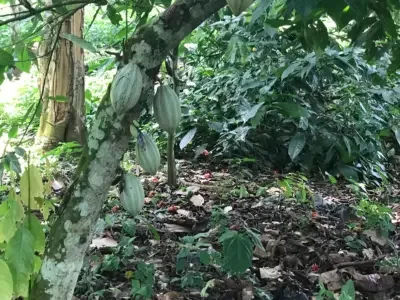
To conform to the EU regulation, farmers have been sharing their own strategies for protecting the surrounding areas and ensuring their cocoa grows healthy and sustainably. While reviving old farms or creating new ones, cocoa farmers like Mbarga and Kinyui say they never cull all the trees within a growing area.
We target the trees that are not useful, those that suck up too much water, whose fruits rot, attract flies and spread disease to the cocoa; we preserve medicinal and fruit trees.
Though Mbarga’s farm is not completely healed from years of less-than-ideal farming practices, new agroforestry techniques and good agricultural practices are helping him increase his harvest. Mbarga shares:
Initially, we planted just any kind of cocoa seeds, without respecting the right distance. Later on, we realized that we had more cocoa in the field, but less income. We had to take the cocoa at the crown level of the stem and choose a stem that produces much, take the pod that is not too ripe, remove four beans from both ends, and then take only the beans in the middle to nurse and plant.
For Bernadette Ondobo, Vice-president, Scoops-PROCAM cooperative, whose farm is about 500 meters from the central town, her cooperative has already started working on how to adhere to the EU regulation. She explains:
We are at the stage where we produce certified cocoa respecting standards, which means we have learned to keep the environment, the people, and the cocoa bean healthy — harmony between nature, people, and cocoa. Certification means harmony around the cocoa cultivation.
Ondobo, who sells baked cocoa beans and cassava flakes, has a one-hectare (2.47-acre) farm. She and her husband own another 10-hectare (24.71-acre) cocoa farm with some cocoa trees that are over 80 years old, inherited from their grandparents. She says implementing the EU regulation may help preserve the farm for future generations. However, like other farmers, she hopes that the extra effort will mean she will get a fair price for their work. Mbarga says:
If the EU regulation stipulates quality, premium cocoa, this law should assure us that after stressing, we gain more because it all revolves around money. If after respecting the regulation we don’t see the gains, we will be discouraged.
The farmers agree that they see positive results when they avoid over-crowding their farms; if they plant too many trees in an effort to maximize profits, the cocoa rots, and they spend more. And when they trim cocoa on time, there is less rot, and production increases.
WWF helping cocoa farmers’ cooperatives
Through its Cameroon Agroforestry and Nature-Based Opportunities for People’s Empowerment (CANOPE) initiative, World Wildlife Fund (WWF) has been supporting cocoa producers through cooperatives, teaching them best agricultural techniques, and assisting them in transitioning to sustainable agroforestry practices. According to Estelle Assonwa, a WWF field staffer:
We explain the regulation to the farmers, when it will be implemented. We concentrate on the part concerning the farmers respecting the regulation; no deforestation, geolocation of land, and obtaining a land title. We have been able to map all farms for farmers with whom we work, producing documents proving that the farms belong to them in readiness for the regulation.
According to Patrice Romuald Zeufack, WWF Project Assistant, geo-referencing the farm’s location is essential in establishing a traceability system. This helps ensure buyers know exactly where their cocoa originates from. At any point in the supply chain, officials must be able to identify that the cocoa belongs to such and such a farmer, located in such and such a place, and whose documents are up to date. Zeufack states:
Georeferencing is the first step in cocoa traceability. In the villages, we help to obtain a property ownership document signed by the divisional officer and the chief. The amount of cocoa that leaves the farm is documented in the traceability system and acknowledged during commercialization. The farmer also needs to respect the law and demonstrate not only that it is his farm but also the methods used, such as treating his coworkers with respect.
Zeufack added:
Adopting agroforestry best practices by cocoa producers, such as creating nurseries to replace aging cocoa trees, is a sign of change. Some cooperatives were not operating effectively, but they now understand their responsibilities. WWF works with leaders to increase management capabilities while maintaining transparency. We let them know that good practices and good governance are in their best interest.
To guarantee high-quality cocoa beans, WWF built a sun dryer and storage facilities for the community cooperative in Ekombite, to help the local population.