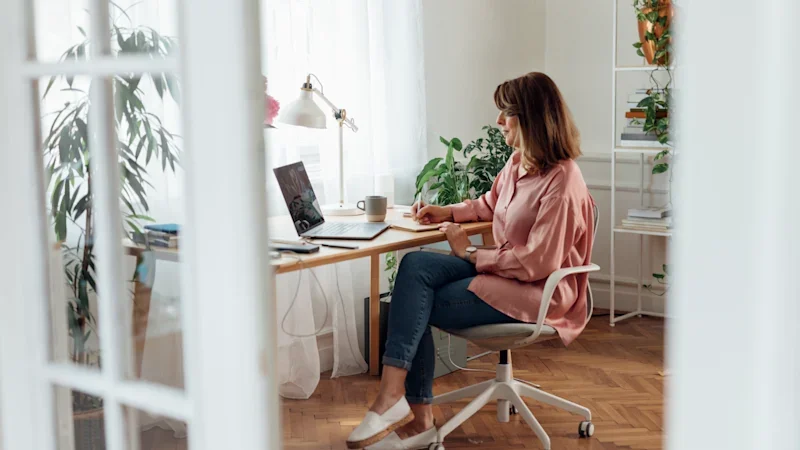
The state Coalition will seek to prohibit unions entering a person’s house and create occupational health and safety exemptions for employers as the Victorian government pushes ahead with its working-from-home laws.
The opposition confirmed on Monday that it will not oppose Labor’s bill, but it will introduce seven proposed amendments to offer businesses greater protection after industry groups launched a last-ditch push to reverse legislation they say will send jobs and investment out of state.
Eight of the country’s largest business lobby groups joined forces on Monday, saying Labor’s plan to legislate the right to work from home two days a week when possible risked sending Victoria backwards at a time when its focus should be on turning around the economy, creating jobs and lifting living standards.
Business Council of Australia executive director of advocacy Ben Wicks said the proposed legislation, which is set to pass the Victorian upper house this week, would increase the state’s unemployment rate of 5.1 per cent.
“It’s exactly the wrong time to be introducing a piece of legislation like this that we say costs jobs and costs investment,” Wicks said. “Our members tell us directly that this … will cost jobs and will cost investment.”
The group said companies already widely offer flexible arrangements, and the proposed laws are another layer of red tape that would see companies desert Victoria and expand their businesses interstate.
“I’m concerned it’s the poison pill for jobs,” said Sally Curtain, chief executive of the Victorian Chamber of Commerce and Industry.
Tim Piper, the Victorian head of the Australian Industry Group, said businesses may even consider going offshore.
“I spoke to a member this morning who said to me, ‘working from home could also be working from the Philippines,’” he said. “You’ve got to remember that businesses have choices, whether it’s the rest of the country or whether it’s the rest of the world.”
If the bill passes parliament as expected, it would come into effect on September 1 and be applicable to full-time employees, as well as part-time and regularly employed casuals on a pro rata basis. Employers would also be compelled to pay “reasonable costs” to enable their staff to work remotely.
The Coalition has said it supports the right to work from home and will not oppose Labor’s bill, but it is seeking to introduce seven amendments to protect businesses.
These include capping “reasonable costs” an employer must pay at $1000, limiting the right to employees who primarily work in Victoria and will continue to work from home in Victoria (unless mutually agreed to), and delaying an employee’s right to appeal a company’s decision until next year.
Other amendments are intended to prohibit the right of union entry into the home (similar to the conditions under which a union may access a workplace), excluding working from home when determining land tax liability, and protecting companies and directors from liability if employees are injured while working from home.
The business groups said they felt there had been a lack of consultation on the legislation. Piper said they had not met directly with Premier Ben Carroll or his predecessor Jacinta Allan, but were expecting to meet Carroll this week.
Since becoming premier a fortnight ago, Carroll has repeatedly said his government would stick to the promise to legislate the right to work from home, which was announced by Allan last year.
Carroll has argued the move would save Victorians time and money, and said Labor had no plans to change the bill, but it would consider “sensible amendments” moved in the upper house.
“My door’s always open to the business community,” Carroll said on Monday morning. “We do know work from home works for families, but we also need to do everything we can to support our business community.”
Members of the coalition of business groups have not ruled out launching or joining a potential High Court challenge against the legislation if it passes. Legal experts have cast doubt over the state government’s ability to legislate a right to work from home, as most workplace laws are under the jurisdiction of the federal government.
“Certainly, I would expect a High Court challenge to occur with this legislation, keeping in mind we do not actually have a bill which has passed through the upper house yet, and time will tell how that will evolve over the coming months,” said Cath Evans, Victorian executive director of the Property Council of Australia.