Conor here: I’ve always failed to understand how this is so complicated. Voters tell the pollsters time and again that the economy/affordability are their top concerns. Political parties and government are either making voters’ lives better or they’re not.
The travesty of the two-party system in “The Greatest Democracy in the History of the World” is that voters who don’t subscribe to the lesser evil argument have nowhere to go.
And anyone trying to create a home for them facing relentless opposition from very powerful actors practiced at using any means necessary to get their way. Couple that with the fact that any attempt by organizers and politicians to win people to their side for programs like universal healthcare will likely require small steps first in order to rebuild trust that government can function to improve voters’ economic lot in this world. There are plenty of places to start, and El-Sayed at least, seems to lost already:
Former President Barack Obama and Abdul El-Sayed discussed Michigan’s U.S. Senate race in a recent phone call
The campaign described the conversation as encouraging, with both looking forward to working together to unite Democrats ahead of the November general election… pic.twitter.com/2VTOEzuJOV
— InteractivePolls (@IAPolls2022) August 9, 2026
WELKER: You’re saying you would not support sending aid to Israel, which was attacked by Hamas, but you’ve also said you would support sending military aid to Ukraine which of course was attacked by Russia. Where do you draw the line?
EL-SAYED: It’s about the conditions. I do… pic.twitter.com/krpjU7MM3C
— Aaron Rupar (@atrupar) August 9, 2026
Meanwhile, Democratic Socialists of America (DSA) on the other hand (El-Sayed is not DSA) are all over the map despite scoring some impressive wins recently:
BREAKING: DSA Co-Chair Megan Romer goes of FOX News and ADMITS they want to abolish prisons, abolish borders, abolish the Presidency and Supreme Court, pass mass amnesty, and give total government control over corporations. pic.twitter.com/4DrAYZDsLu
— Pro America Politics (@proamericapol) July 26, 2026
It’s difficult to know what to make of that coupled with this:
DSA-aligned Democrats are now the most pro-free-trade voting bloc in the United States, in an incredible turn of events pic.twitter.com/BhfaCorZdy
— Joey Politano 🏳️🌈 (@JosephPolitano) August 4, 2026
The DSA seems to suffer from the same big-tent philosophy as the imperial and capitalist party they plan to align with. Here’s Patrick Lawrence:
Decentralization has been the ruling principle since the Democratic Socialist Organizing Committee, good old D–Soc, merged with the New American Movement in 1982 and Michael Harrington assumed leadership of the resulting D.S.A. There was never any question of forming a party: That would require centralized lines of authority and hierarchies of one or another kind. This was Harrington’s most unfortunate miscalculation. The D.S.A. was to work within the Democratic Party, riding its centralized lines of authority and hierarchies like… like a donkey. For decades prior to its recent rejuvenation, the D.S.A. was more or less beside the point, as readers of a certain age may recall.
Now you have Democratic Socialists contesting elections as if they are members of a party, but there is no party. This is not a small detail. You have, in consequence, what amounts to a party platform except that any given candidate can disavow any given plank in it if it is to his or her political disadvantage. It looks more than a little messy, to be honest.
I return to my initial point. Stalinist excess and the Cold War liberals’ cowardly participation in the anti–Communist pile-on of the Cold War decades have been a disaster for left politics in the United States. Centralized organization, the disciplines that come of principled lines of authority: If history is any guide there is no achieving enduring outcomes in the messy universe of politics without these.
Meanwhile polling like the following shows what’s been true for many years now: a lot of Americans are sick of empire and want to rebuild the country/make their lives better.
DSA foreign policies that make younger Democrats (Under 50) more likely to support a candidate:
End detentions/deportations — 71%
End Israel aid to free Palestine — 56%
End Cuba/Venezuela/Iran sanctions — 52%
Cut military + close bases — 52%
Nationalize transport/energy… pic.twitter.com/0ZYXbNW8jG— InteractivePolls (@IAPolls2022) August 7, 2026
It’s the same on the GOP side where even Trump’s MAGA base is abandoning him over his imperial adventures and refusal to improve their economic lives
Whether it’s DSA, El-Sayed, or a future MAGA spin off, voters keep searching for anyone who can deliver. Any candidate who wishes to try just needs to overcome a two-party system meant to squash any populist uprising, a legion of spooks, Zionists, and billionaires, decades of American exceptionalism propaganda, and the courts and media stacked against them.
**By Nicholas Jacobs, the Goldfarb Family Distinguished Chair in American Government at Colby College and the Inaugural Director of Colby’s Public Policy Lab. Originally published at The Conversation. **
Since 2016, when Donald Trump shattered the Democrats’ blue wall by winning working-class voters across the Midwest, a cottage industry has sprung up on the left dedicated to answering a single question: How can Democrats win back the working class?
The answers come in different forms.
Sometimes it is veteran Vermont Sen. Bernie Sanders, railing against “the oligarchs.”
Or it’s Connecticut Sen. Chris Murphy, who after the 2024 election declared, “Democrats must reclaim our identity as the party of the working class.”
Or a new generation of candidates – tattooed veterans, mechanics, bartenders – whose biography is supposed to do the political work that policy has not.
Graham Platner, the Maine Senate candidate who had become the left’s latest blue-collar savior until he ended his campaign in the wake of a sexual assault allegation, put the theory in its most unguarded form.
“We are in a form of class war,” he says. “And if the Democratic Party is going to have a future with working people, it needs to pick the side of working people.”
The most recent high-profile progressive candidate to embrace those working people: Abdul El-Sayed, whose economic populism helped him win the 2026 Michigan Democratic Senate primary. Called a “working class” champion by the United Auto Workers, El-Sayed performed best in wealthier, higher-educated areas of the state. His opponent, Haley Stevens, drew more support from Detroit and working-class communities.
Still, El-Sayed’s victory has led to a familiar refrain: Somewhere out there is a latent working-class majority, held together by shared economic grievances, waiting to be politically reassembled to vote for Democrats. The New Deal did it – “economic populism” can do it again.
I’m a political scientist who has written extensively about rural and working-class communities. I believe it is an open question whether these reformist Democrats are really interested in understanding working-class voters on their own terms. Because working-class voters, as they tell us themselves, are not simply waiting to be activated by the right program, messenger or phrase. “Fight the oligarchy” probably isn’t going to do it.
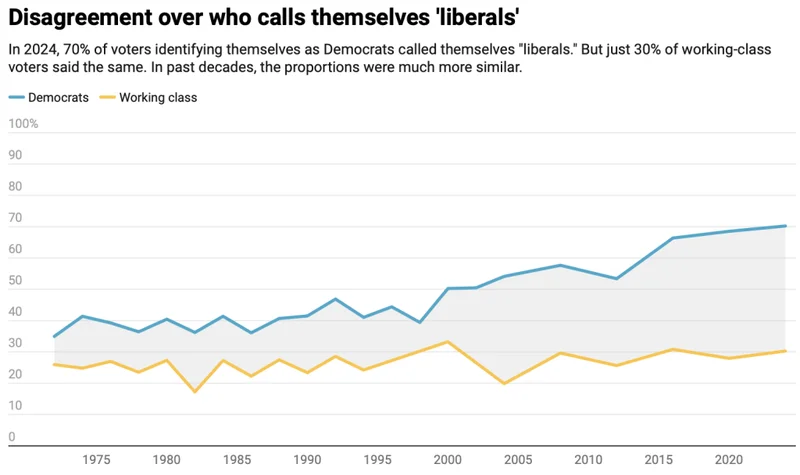
Working-class voters have a worldview. For 50 years, it has been growing less compatible with the Democratic Party’s – not because working-class voters changed, but because Democrats did.
I talked with @chrislhayes tonight about my belief that Democrats have to return to being an aggressively economically populist party that builds a wide tent, asking working class voters to come inside even if they don’t align with us on every social and cultural issue. pic.twitter.com/MKuokr6Moi
— Chris Murphy 🟧 (@ChrisMurphyCT) November 14, 2024
Working-Class Identity
Since the early 1950s, the American National Election Studies has asked respondents whether they think of themselves as members of the working class. This article uses my analysis of that data.
While a larger proportion of the electorate has obtained a college degree and household incomes have risen, the share of Americans who consider themselves working class has remained remarkably stable: roughly 35% of voters for the past 70 years, 38% in 2024.
Working-class identity is more durable and culturally grounded than a description of who isn’t a billionaire. It’s a specific way of looking at the world.
Conventional definitions of the working class often miss how people understand their own place in society. In the 2024 American National Election Studies, for example, 21% of those who identify as working class have a college degree, only 5% belong to a private-sector union, and 37% own stocks. Conversely, most Americans without a college degree do not identify as working class.
Working-class voters have never been a predominantly Democratic group – not even at the height of the New Deal coalition. Based on the American National Election Studies self-report measure, the working-class share of the Democratic coalition peaked around 56% in 1960 and has fallen more or less continuously since, sitting at just about 30% today.
Meanwhile, the share of working-class voters who identify as Democrats has been declining for half a century: A majority did so in 1958, but not since.
Working-class voters have not become Republicans. Only in 2020 and 2024 – the first time in the survey’s history – did more working-class voters identify as Republican than Democrat, and even then by narrow margins.
The data shows a politically homeless working class: estranged from the Democrats, not captured by the Republicans, stuck in the middle with diminishing attachment to either party.
Economic Abandonment
What drove them out?
A segment of the progressive left has a ready answer: Democrats abandoned working-class voters economically – on trade, wages and industrial policy. Working-class voters responded rationally. Fix the economics and the coalition comes back.
Trade is the strongest argument. In 1988, roughly 74% of both Democrats and working-class voters groups favored limits on imports to protect American jobs.
By 2024, only 26% of Democrats favored limits, while 54% of working-class voters continued to do so.
Unlike most Democrats, many working-class communities do not see globalization in their interest. Running alongside the trade gap is a widening divide over values that no tariffs can fix.
What Fairness Requires
In 1984, Democrats and working-class voters broadly agreed that treating people more equally would mean fewer social problems. A divergence opened after 2008 and accelerated after 2016, with Democrats now 28 points more likely than working-class voters to think we should worry more about equality.
In 1986, half of mainstream Democrats and a slightly smaller percentage of working-class voters agreed with the idea that Black Americans don’t succeed because they don’t try hard enough. By 2024, Democratic agreement had collapsed to 13%. Working-class voters also declined, to 32%.
That gap is not primarily a story about rising working-class racial resentment. It’s about the Democratic Party’s rapid post-2008 shift toward a worldview that places far greater explanatory weight on structural barriers and far less on individual effort and personal responsibility.
Working-class voters, who historically understood their own lives through a framework of hard work and earned reward, did not shift so dramatically.
Alignment Becomes Division
On cultural questions, the pattern persists: Working-class voters did not move right in reactionary revolt. Democrats moved left.
In 1986, similar levels of Democrats and working-class voters agreed with the statement “This country would have many fewer problems if there were more emphasis on traditional family ties.” By 2024 a 25-point gap emerged.
On whether religion is an important part of their life: a near-zero gap through the early 1990s, but 17 points by 2024. On abortion, a 3-point gap in 1980 became 30 points in 2024. Whether immigration levels should be increased, the two groups were virtually identical in 2000 – around 8% support. By 2020 Democrats were at 48%, working-class voters at 24%.
Even where working-class voters nominally agree with a Democratic policy goal, they don’t trust the institution asked to deliver it – a distrust decades in the making.
How the ‘System’ Plays
In 1958, working-class voters and Democrats were within 5 points of each other on whether government wastes a lot of tax money. By 2024 that gap reached 27 points – not because working-class voters lurched toward anti-government extremism, but because mainstream Democrats became dramatically more trusting of government as an instrument of social change.
Working-class voters are 17 points more likely than Democrats to say people like them have no say in what government does. In 2024, 88% of working-class voters and 75% of Democrats said government is run by a few big interests. Both groups agree the system is captured.
Yet the Democratic policy response, invariably, is to expand the system.
On support for expanding government – from healthcare to jobs to environmental programs – Democrats and working-class voters have diverged dramatically since the 1980s. By 2024, there were approval gaps of between 20 and 30 points on providing government health insurance, environmental spending and a guaranteed jobs program.
On every major plank of the progressive economic agenda, Democrats are now substantially to the left of the workers they claim to champion.
Not All Class War
Working-class voters have been telling pollsters for 60 years that the political system doesn’t hear them. Democrats, over the same period, have grown more comfortable with the institutions working-class voters have increasingly less faith in.
This distrust stems from specific experiences: deindustrialization that happened on government’s watch, trade deals that economists endorsed and workers paid for, a 2008 financial crisis response that saved the banks and foreclosed on their homes, an opioid epidemic that regulators missed entirely.
To be fair, this is precisely what the new crop of reform candidates say they want to fix. The argument that the right candidate can move the needle is not crazy. Candidate quality matters. Personal trust can substitute for institutional trust, at least at the margins.
But economic-grievance politics is a very small slice of what working-class voters are telling us. The data documents a comprehensive, decades-long divergence in how working-class voters and mainstream Democrats understand fairness, government, personal responsibility and social change.
Reducing that to class war jams working-class voters into a prefabricated progressive agenda rather than taking seriously what they are actually saying.