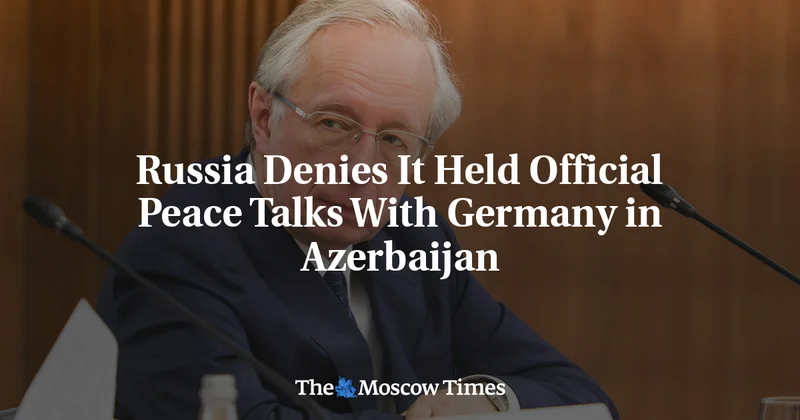
Russia’s Foreign Ministry has denied that Russian and German officials held talks in Azerbaijan last month to discuss the ongoing war in Ukraine.
“There have been no official contacts with Germany regarding a settlement in Ukraine, nor are there any now,” Deputy Foreign Minister Mikhail Galuzin told the state-run news agency TASS. “And they are hardly possible given the extremely aggressive anti-Russian rhetoric and actions of Germany’s leadership.”
His comments come after Azerbaijan’s president said in July that Russian and German officials held a “secret meeting” in Baku earlier that month.
Media reports suggested that former minister-president of Brandenburg Matthias Platzeck and former chief of staff of the German chancellery Ronald Pofalla took part in the talks on the German side. On the Russian side, former prime minister Viktor Zubkov and current presidential human rights chief Valery Fadeyev allegedly attended the talks.
Galuzin said backchannel discussions have taken place between individuals from Germany and Russia who are not affiliated with either country’s government but did not provide further details.
This month, reports emerged that former British, French and German diplomats met secretly with former Russian officials in Vienna as part of an initiative led by the Swiss-based Center for Humanitarian Dialogue.
Galuzin did not mention that Vienna meeting in his comments to TASS.
While European leaders have floated the possibility of direct talks with Russia, the Kremlin has dismissed the idea of the EU as a possible mediator in Ukraine peace negotiations.
Former senior U.S. national security officials and high-ranking Kremlin officials held similar secret diplomatic talks in 2023, sources previously told The Moscow Times.
A Message from The Moscow Times:
Dear readers,
We are facing unprecedented challenges. Russia's Prosecutor General's Office has designated The Moscow Times as an "undesirable" organization, criminalizing our work and putting our staff at risk of prosecution. This follows our earlier unjust labeling as a "foreign agent."
These actions are direct attempts to silence independent journalism in Russia. The authorities claim our work "discredits the decisions of the Russian leadership." We see things differently: we strive to provide accurate, unbiased reporting on Russia.
We, the journalists of The Moscow Times, refuse to be silenced. But to continue our work, we need your help.
Your support, no matter how small, makes a world of difference. If you can, please support us monthly starting from just $2. It's quick to set up, and every contribution makes a significant impact.
By supporting The Moscow Times, you're defending open, independent journalism in the face of repression. Thank you for standing with us.
.