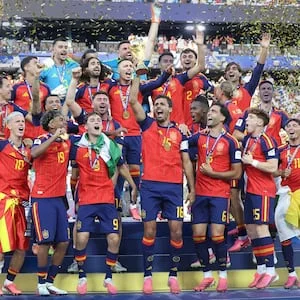
On Monday, Spanish midfielder and captain Rodri was handed the World Cup trophy by Fifa boss Gianni Infantino and Trump. The pair were whistled and booed at the game, with condemnation amplified by one event in particular.
During the knockout rounds, Trump had called Infantino and asked if Folarin Balogun, who faced a one-match ban following a red card in a game against Bosnia and Herzegovina, could be reinstated for the US in the Round of 16 match against Belgium.
Fifa’s disciplinary committee soon suspended that ban for a year, an unprecedented decision that allowed the American striker to play over objections from the Royal Belgian Football Association.
Infantino’s insistence of the committee’s independence was immediately dismissed by fans, who pointed to the Fifa chief’s relentless efforts to ingratiate himself with Trump, including a Fifa Peace Prize that was hastily created and awarded to him last year. Critics saw the series of events as the latest example of deep-rooted corruption in Fifa and America strong-arming its way to whatever it wants.
“I think they should fire the Fifa president,” said Chloe Ligsay, a 22-year-old football player from California who was visiting New York and wearing a US men’s national team jersey. “I think politics should be staying out of sports.”
The shocking reprieve couldn’t save the US, however, as the team played poorly and lost 4-1 – an outcome that kept the scandal from completely overshadowing the tournament. The incident galvanised the Belgians, while Balogun later admitted the uproar from Trump’s intervention was a major distraction for the American team.
After the US lost to Belgium, Balogun made a beeline to the Belgium manager.
“He came to talk to me. I really liked that,” said Rudi Garcia, the manager of Belgium, in an interview after the game. “It is not his fault; he is not the one to blame, and that’s what I told him.”
This was not the only political incident that raised eyebrows during the games, however: Lionel Messi and other Argentinian players celebrated a semi-final victory over England with a fan’s banner supporting the country’s claim over the Falkland Islands, prompting the UK Government to call for a Fifa investigation: the two nations fought a war over the archipelago off the Argentinian coast in 1982.
Egypt’s coach was seen raising and waving Palestine’s flag following a Round of 32 win over Australia, and the Iranian team complained bitterly as they had to fly in and out of the US every matchday from their base camp in Mexico due to American sanctions.
More money, more problems
Fifa faces plenty of questions about the future despite the resounding commercial success of this year’s tournament. The new 48-team format, deemed too big by many, produced moving underdog stories, with seven teams reaching the knockout phase for the first time. Infantino has floated the idea of further expanding the World Cup to 64 teams in 2030.
It’s not clear what the right thing is for the World Cup, however. The tournament has already become huge, with 104 games over 39 days. Players are growing increasingly critical of the sheer number of matches that Fifa, leagues and the regional football bodies are asking them to play.
Fans are also becoming increasingly weary of the sport’s preoccupation with financial gain. In a first for the tournament, Fifa introduced dynamic pricing for World Cup tickets, a system that automatically modifies costs according to real-time demand and available inventory. The results were record-high prices.
“I have mixed feelings with Fifa,” said Asad Hussain, a fan from Nashville, at the first semi-final match, between France and Spain. “To be honest, I think the organisation of the World Cup is good, but I think with dynamic pricing and a lot of those ticket issues and visa issues, I think that’s been really difficult for a lot of people to be able to make the games.”
Fifa has managed to squeeze every dollar out of this World Cup. In addition to taking a cut from match-day food and beverage sales and ticket resale, the organisation is even selling pieces of the pitch where the final Argentina-Spain match was held: for $3000, you can get a tiny section of the turf – preserved in resin – and get a small, crystal cut-glass World Cup trophy.
The organisation has even found ways to guarantee more money in the future. Crowds booed lustily during the controversial “hydration breaks” that interrupted this year’s matches. While Fifa has claimed the decision was solely based on players’ wellbeing during a tournament that took place during punishing heat, the pauses have conveniently provided time for broadcasters – such as Fox in the US – to sell more advertising.
Some estimates suggest that a 30-second World Cup ad typically sells for between US$200,000 and US$750,000, depending on the stage of the tournament, the match-up and expected viewership. With two hydration breaks per match, broadcasters would gain eight new in-game, 30-second advertising slots – or 832 new slots across a 104-match tournament.
That additional advertising inventory could bring in almost US$500 million depending on premiums and average rates offered, potentially offsetting more than half of what Fox reportedly paid for the tournament’s broadcast rights. This in turn means Fifa could net even larger sums for the next round of media rights sales: the organisation has already been quietly marketing the 2030 World Cup rights.
“We had high expectations,” said Cesar Conde, chairman of NBCUniversal News Group – which acquired Spanish-language broadcasting rights for the World Cup in the US – at a media event. “But I don’t think we even in our dream had the expectation it would be this passionate a fan base here in the US.”
The growing revenues disincentivise the organisation and its members from changing course despite the mounting discontent among fans and players. An expansion to a 64-team tournament would exacerbate logistical challenges for the 2030 World Cup, which will be staged across six host countries. But that also means more money for everyone, which ultimately helps Infantino’s standing.
Every member association gets one vote on matters such as Infantino’s future, with the under-fire chief expected to stand unopposed for re-election in March 2027. There are 211 member associations across the world that have collectively received US$2.25b from Fifa over the past three years, and proceeds from qualifying for a World Cup could be a boon for small nations.
Cape Verde made about US$12m from its run in the tournament, a vital windfall for a nation of around 530,000 people that doesn’t have a single grass pitch.
“We want to generate more revenues, and we have to generate more revenues, because in the vast majority of the world, in 80% of the world, if we don’t invest, if we don’t believe, nobody will,” Infantino said in a statement on Sunday. “If not, the concentration will always go to a few, big countries, and we will remain as we are.”
On the eve of the World Cup final, Fifa said “more than 200 member associations” had pledged their support for Infantino for his upcoming re-election.
Clashing priorities
A core objective of Fifa is to expand the game of football and it spends billions doing so, but supporters are increasingly suspicious that financial interests have overridden the sporting ones to a point where even changes to the rules to make the game more fair not only attract controversy, but also have a commercial element.
The Toronto crowd erupted in celebration during the final moments of a July 2 World Cup knockout match when Croatia’s Joško Gvardiol struck the ball into the back of the net to equalise against Portugal.
However, the excitement was cut short. While the goal looked perfectly valid to onlookers, it was disallowed after an in-ball sensor detected a microscopic touch from a teammate’s head or hair, resulting in an offside call.
In the aftermath, the Croatian team slammed the decision as an “abuse of technology”, while critics voiced concerns that the technology meant to help the sport is doing more harm than good.
For Fifa, this incident wasn’t a problem. Instead, it’s a money-making opportunity, part of its plan to reshape the sport with a big push into artificial intelligence, computer vision and other technologies. More than 150 million data points per match have been collected by the organisation, with Fifa now working out how to sell that data for revenue.
“There is significant commercial potential,” Fifa’s chief business officer Romy Gai said in an interview.
Sign up to Herald Premium Editor’s Picks, delivered straight to your inbox every Friday. Editor-in-Chief Murray Kirkness picks the week’s best features, interviews and investigations. Sign up for Herald Premium here.