PSEi slips on weak GDP
MANILA, Philippines — Local stocks ended nearly flat on Monday as investors remained cautious following the country’s weak second-quarter economic growth, while renewed geopolitical concerns added to the market’s worries.
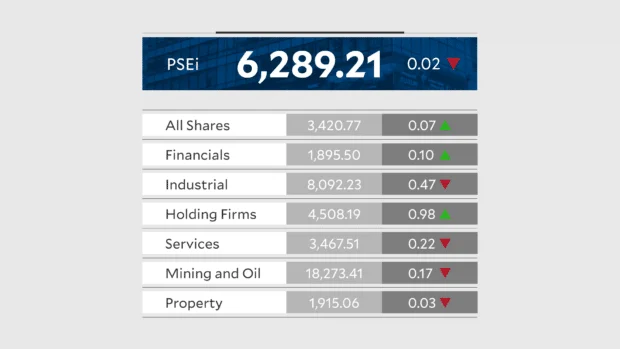
The benchmark Philippine Stock Exchange Index (PSEi) slipped 0.02 percent, or 1.14 points, to close at 6,289.21.
READ: Jollibee now valued at $3.3 billion
Article continues after this advertisement
Brokerage Philstocks Financial Inc. said investors remained on the sidelines after the Philippines posted a “dismal” second-quarter gross domestic product performance.
Market sentiment was also weighed down by Iran’s denial of talks with the US concerning the Strait of Hormuz, adding another layer of uncertainty for investors.
Luis Limlingan, head of sales at Regina Capital Development Corp., said the local bourse ended lower as trading remained relatively flat amid cautious sentiment.
Awaiting BSP move
“Attention now shifts to the BSP’s next policy move and its potential impact on market sentiment,” Limlingan said.
Article continues after this advertisement
Trading activity remained tepid, with net value turnover reaching only P3.55 billion.
Foreign investors likewise pulled funds from the local market, ending the session as net sellers with net outflows of P217.28 million.
Article continues after this advertisement
Sectoral indices finished mixed. Holding firms led the market after gaining 0.98 percent, while industrials posted the steepest decline at 0.47 percent.
Among individual stocks, DigiPlus Interactive Corp. was the top index performer, climbing 3.77 percent to P10.46.
Semirara Mining and Power Corp., meanwhile, was the session’s biggest index laggard. Shares of the Consunji-led coal producer fell 3.90 percent to P19.22.
Analysts said the muted session reflected lingering caution among investors as they weighed the implications of weaker domestic economic growth against heightened geopolitical risks abroad.
Investors are also keeping tabs on developments in the Middle East, where tensions could affect global risk sentiment and potentially add volatility to financial markets.
With trading activity remaining thin and foreign funds leaving the market, investors appeared reluctant to take bigger positions while waiting for clearer signals on the domestic economy and external risks. /pai