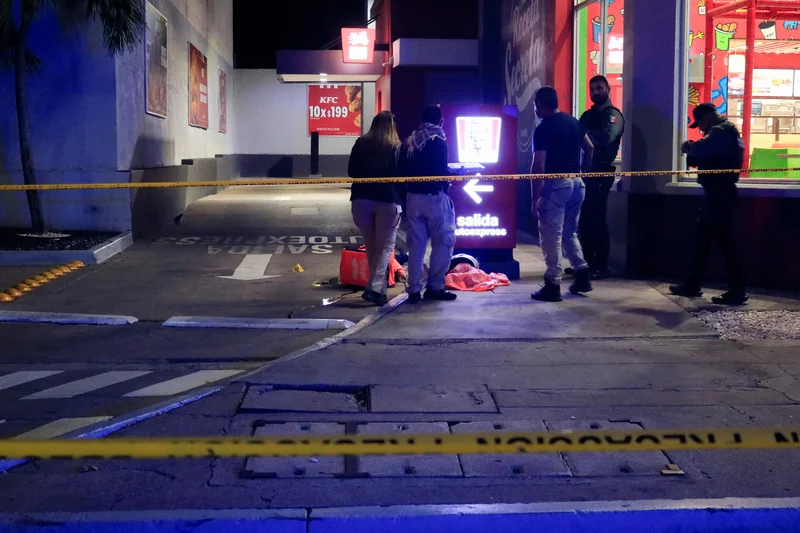
It is a 16-second recording. Three young men are standing there, dressed in the same bright orange as the delivery backpacks on their backs. A fourth person, unseen on camera, is holding the device used to livestream the scene. One of the three is wearing a cowboy hat. He is laughing.
Three seconds later, a motorcycle carrying two riders arrives. They approach the three young men from behind and shoot the one in the cowboy hat, virtually point-blank and in the head. He collapses to the ground, and the video cuts off.
The footage has been viewed hundreds of thousands of times across social media platforms. It is on X, Instagram, TikTok, Telegram, Meta and YouTube, and has also been reproduced by numerous news outlets. The message has landed: those who cross the cartel will come to an untimely end.
From the very first day, Mexican authorities linked the murder of influencer César Gastelum to the messages he shared on his channel in support of one of the factions that emerged when the Sinaloa Cartel split two years ago. Since the criminal organization descended into an internal war following the U.S. capture of one of its founders, Ismael “El Mayo” Zambada, Sinaloa has been left with a trail of killings and disappearances. Among the victims are nine content creators.
Gastelum’s Instagram account, followed by 208,000 people, featured videos that attracted millions of views. The 25-year-old influencer sometimes displayed jewelry bearing the initials “MZ,” a reference to El Mayo Zambada. The leading theory behind his murder in Culiacán, the capital of Sinaloa, is that he was targeted by Los Chapitos, the faction of the Sinaloa Cartel led by the sons of Joaquín “El Chapo” Guzmán. Los Chapitos are locked in conflict with El Mayo’s supporters, while both El Chapo and El Mayo are in U.S. custody.
So far, Mexican authorities have disclosed little else about Gastelum’s role in the criminal underworld. It remains unclear whether he was merely a propaganda conduit, one of the figures who flaunt a flashy lifestyle to attract young followers, or whether, as investigators are now examining, he also served as a vehicle for money laundering.
The world of social media generates vast sums of money. Regulation is lax and oversight, it must be said, is virtually nonexistent. Similar suspicions have also fallen on other public figures, including performers of narcocorridos, the hugely popular Mexican music genre that recounts the exploits of drug traffickers.
Five of the influencers murdered in Sinaloa were found dead in Culiacán, a city that gained international notoriety during the two Culiacanazo episodes, when cartel gunmen unleashed a wave of violence in response to the arrest of one of El Chapo’s sons. The victims had been shot, bound, tortured and abducted from their homes or workplaces. Some had posed on social media with firearms and luxury properties.
Those crimes are still unsolved, but have been seen by millions of Mexicans. They appear in social media feeds alongside cooking recipes, fitness tips, videogame streams and whatever other content the algorithm happens to serve up. They shock audiences while amplifying the cartels’ message of violence.
The cartels have decades of experience committing atrocities and broadcasting them to expand terror and project power. They have done so through narcomantas (banners with threatening messages hung in public places) and bodies left hanging from bridges. Now, they kill live on camera, without filters.