- Published
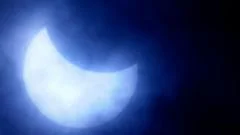
**The most dramatic partial solar eclipse of the century will be visible across the UK this week. **
Astronomers say between 90% and 96% of the sun will slowly disappear behind the moon on the evening of Wednesday 12 August.
While the people of Greenland, Iceland and parts of northern Spain will be lucky enough to see a total eclipse, it will still represent the highest level of coverage seen from the UK since 11 August 1999.
With Wednesday's event also calculated to be the most extensive solar eclipse for the next 54 years, it is clear why astronomers are calling it "really exciting".
What time can I see the partial eclipse?
Experts say that while the sky will not fall into total darkness, the partial eclipse will be enough to make a "noticeable difference" in temperature and light levels.
According to the Royal Greenwich Observatory, times will vary slightly across the UK.
The initial visible signs of the sun disappearing behind the moon will first be visible in Scotland at about 18:08 BST, with the rest of the UK a few minutes behind.
In Manchester and Liverpool, first contact - the point at which the sun appears to slide behind the moon - is expected at 18:13.
The "eclipse maximum", when most of the sun is covered, is expected to fall at about 19:10 in the north-west of England.
The eclipse event will be over by about 20:04.
There will be more coverage the further south-west in the country observers are, but the north-west of England can still expect just over 90%.
Where are the best places to see the eclipse?
The best places to view the eclipse are from higher ground, or areas with a clear view towards the western horizon.
The further east people try to watch the eclipse, the less dramatic the coverage will be.
Imo Bell, a planetarium astronomer at Royal Greenwich Observatory, said: "We're not going to get one this good for a really long time."
A number of events will be taking place across the region to celebrate the once-in-a-generation opportunity.
- Heaton Park, ManchesterThe Heaton Park Astronomy Group has announced a free watch-along event with special eclipse glasses available.
- Crosby Beach, SeftonThe Sefton coastline is expected to be one of the more popular locations to take in the eclipse. The Bus Yard bar in Crosby, which overlooks the beach, has said it will be open during the course of the eclipse and will be hosting live music.
- Jodrell Bank, CheshireThe world-famous observatory has announced it will remain open until 20:00 BST, and will offer guided solar observing sessions (weather permitting), an immersive Space Dome film celebrating the Sun, and cyanotype crafting.
- Rossall Promenade, CleveleysThe Blackpool & District Astronomical Society is hosting a free public observing session from 17:00, with some eclipse glasses available.
How can I stay safe?
A vital warning from experts is to avoid looking at the sun even when it appears to have dimmed during the eclipse.
Looking with the naked eye could cause severe, permanent damage to eyesight.
Mohamed Elalfy, a consultant ophthalmologist and president of the Royal College of the Royal College of Ophthalmologists, said: "Crucially, the retina has no pain receptors, so people will not feel the damage as it happens.
"Symptoms may only become apparent several hours later and can include blurred vision, a central blind or dark spot, distorted vision, reduced colour perception and increased sensitivity to light."
But standard sunglasses should also never be used to observe an eclipse, as they will still allow harmful solar rays to reach the retina.
Certified solar eclipse glasses are available, while another option is using a pinhole projector.