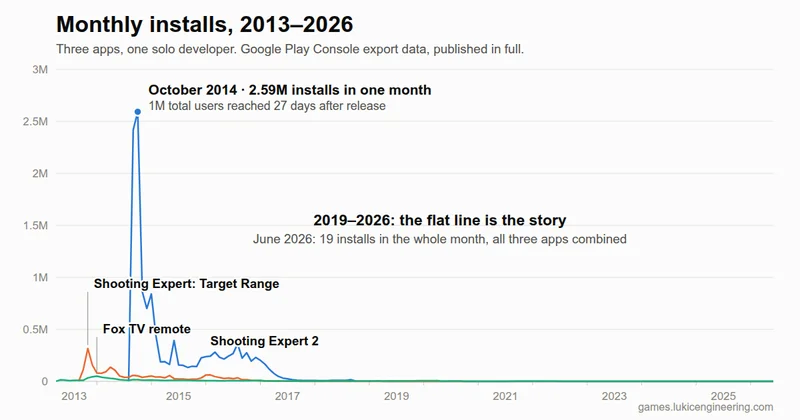
On 21 September 2014 a game I made alone crossed a million installs. That was day 27 after release. The same day it was installed 173,975 times, which is still the biggest day anything of mine has ever had. I had no budget, no publisher and no press contacts. I was outside the industry and did not know the ecosystem at all. I worked it out with common sense, one piece at a time.
At the end of July I released a new game and wrote a post about it in the most relevant place I could find. The post got 493 views and produced no installs at all.
The second attempt took more work than the first, not less. Building is easier now, and AI is part of why. What has piled up is everything around the building: the forms, the requirements, the waiting, the amount you have to get through on Google Play before a single person sees the thing. And the return is not there. I do not mean the money. I mean the feeling of having got somewhere.
I have the export data for both ends of this, so here it is.
| App | First install | Lifetime installs | Biggest month | Peak active devices | Active, Jun 2026 |
|---|---|---|---|---|---|
| Shooting Expert 2 | 25 Aug 2014 | 13,559,906 | 2,591,467 | 886,208 | 499 |
| Shooting Expert: Target Range | 26 Sep 2013 | 2,186,594 | 316,312 | 141,763 | 134 |
| Fox TV remote | 22 Apr 2013 | 774,898 | 50,188 | 16,989 | 105 |
It started with a television
Early in 2013 I bought a TV. Local brand, rebadged hardware, ethernet port on the back, internet features in the menu. It came with the usual infrared remote. What did not exist was any way to control it from a phone.
Looking at it from my desktop I found that the TV was serving its own remote control as a web page on its own IP address. I read that page, watched what it sent when I pressed things, and wrote an Android app that sent the same requests. The TV was selling well here, so I put the app on the store to see what would happen.
People started installing it. First install 22 April 2013. It ended up at 774,898 device installs, and 105 devices still had it in June 2026.
That app is also where I found out what an ad is worth. I put a single AdMob banner in it, which was all there was at the time.
Games, for an unromantic reason
I built plenty of things after that and published none of them. Everything I actually wanted to make needed a backend, and I could not have covered the cost of one through any serious spike in users. If growth had come slowly it would have been manageable. It did not come slowly. So I turned the question around. What can I build that needs nothing behind it?
Games.
The first was a shooting range. One background photo, cut into four pieces so the phone's GPU could load it at all. One photo of a pistol. A white dot for the sight. Phones had almost no memory to spare and my own mobile plan was 325 MB a month. Keeping the download tiny was a decision, not a side effect. I wanted it to reach people who counted their megabytes, and back then that was most people. That game did 2,186,594 installs.
I should be clear that none of this fell on me. There was a stretch of about a year and a half where I worked at this constantly: trying things, watching which ones moved and which ones did not, and carrying what I learned into the next build. It was not a lottery ticket.
Shooting Expert 2
Google was pushing Google+ hard then, and a set of game services came with it: real time multiplayer, leaderboards, achievements. I wanted multiplayer in the first game, looked at how much would have to change, and built a second game around it instead.
It went out on 25 August 2014 and got 22 installs that day. Four weeks later it crossed a million users. October 2014 alone did 2,591,467 installs. By the end of that month it had passed five million.
I want to be exact about my own role here. There was no launch campaign. What existed was the Top New Free chart, sitting on the front page of the store, and once you were on it the store did the distribution for you. Getting onto it and staying on it was the part I worked at. My job was to have something people kept.
The multiplayer held through all of it. Google supplied the infrastructure, which is the only reason it survived that kind of load, but building it into the game was my work and it was not a small piece of work.
886,208 devices I was not allowed to sell anything to
On 3 November 2014 the game was installed on 886,208 active devices.
Until October 2021 it was not possible to open a Google merchant account from Serbia. No in-app purchases, no paid apps, no subscriptions. For the entire run, every one of those devices could only ever produce ad revenue.
At the peak that was roughly a solid US salary per month, which for one person in Belgrade with a laptop was a serious amount of money. After the peak it settled into a good local developer salary. It did change my life, just not in the shape the install count suggests. It moved me into this industry for good and it improved how I live. It did not make me rich and it did not retire me at thirty.
I have no receipts for the money and I am not going to pretend otherwise. Play never issued me earnings reports, because earnings reports require the merchant account I could not have. The ad revenue lived in a different system entirely. Everything below is install data, which I can prove. The revenue is my word.
How it ended
Nothing happened suddenly. It faded out, because the organic discovery the whole thing ran on stopped being there.
Google put ads at the top of Play search results and redesigned the front of the store. The Top New Free chart stopped being the first thing a person saw. The engine that had been doing my distribution for free was still running, just underneath the paid slots.
The obvious response was to buy ads, and I did try it once, with my own money. It lost more than it brought back. The games earned only from ads, so I was buying traffic in order to show ads to it, and without the charts carrying the rest of the distance the gap was too wide to close.
Revenue eroded month by month. There was no moment where it fell over. The moment I understood it was finished was noticing that it had come down to intern money. I moved into web development in 2018, because by that point it was the only thing that was going to pay for anything.
2026
I came back this year and released a new game. Different genre, made properly, released on purpose this time, with a press kit and a plan and a post written for the sub it was going into.
The launch post got 493 views over eighteen hours. That is Reddit's own Post Insights figure, not my estimate, and it made the post the fourth most viewed in that community that day. So the post did not fail. It reached the people it could reach. Store visits from it were in single digits. Installs were zero, and I know that precisely because the game's ad SDK logged no ad requests at all in that window, which cannot happen while somebody is playing.
There is a second piece of evidence for the 2026 side. The reports bucket behind my old account holds a monthly statistics file for every month since April 2013. The account my new games are on produced its first one on 9 August 2026. It covers a single day, 1 August, for Gun Range 3D, the other game I released this year. Zero installs, zero uninstalls, zero active devices, two update events. That is the whole file, and it is down there with the rest of the data.
From 2013 to 2016 the numbers came in every day, at roughly the same hour. Installs broken down by country, by device, by language, all of it sitting there to be read, and I read it a lot. The console now shows zero installs for the past week. That is not even accurate. There have been a few.
That is the whole comparison. In 2014 the store handed a stranger's game to two and a half million people in a month because it had a chart on the front page and I happened to land on it. In 2026 reaching five hundred people takes deliberate work, and five hundred people is not enough to start anything.
What actually changed
Two things moved, and they moved in opposite directions.
Discovery got worse. The route that launched my old games, the Top New Free chart on the front page of the store, is not there any more. My new game got essentially no organic traffic. I do not know what Google's ranking does internally and I am not going to pretend I do, but the practical effect is that you supply the first push yourself, and if you have no money the only currency left is other people's attention, one community at a time.
Monetization got better. The thing that made 2014 structurally hopeless for me is fixed. I can take payments now, and my new game ships with a purchase in it from day one. With 886,208 active devices to sell to, 2014 would have gone differently.
Both old games are on the new account now
The two Shooting Expert games have moved to the account my new games are on. I rebuilt both of them in Godot this year, same packages, same install history, same ratings, and they are in front of players again. The TV remote stayed where it was.
That leaves a question I can actually measure. Shooting Expert 2 has 13.5 million lifetime installs and a rating built from tens of thousands of reviews, and in June 2026 it was down to 499 active devices. If a decade of history is worth anything on Play in 2026, it should show up there before it shows up on a game nobody has heard of. I do not know yet what Play produces for an app that changed hands. Whatever the reports say, they go up here with everything else.
I do not think 2014 was better. It was easier in one way and impossible in another. What I miss is knowing that I could reach people at all. That somebody out there was actually playing the thing I made.
The data
These are exports from my own Play Console, not screenshots. Take them apart if you like.
- ltslab-monthly-installs.csv 32 KB
Monthly device installs, uninstalls, active devices and the peak day, per app, 2013 to 2026. - coverage.csv 1 KB
First and last month per app, and the exact last day present in the export. - installs_com.lukicengineering.shootingexpert.reload_202608_overview.csv 584 B
The first statistics file Play ever produced for the account my new games are on, under its own name, untouched. One day, one row, all zeros. - raw-shooting_expert_2.zip 137 KB · raw-shooting_expert.zip 133 KB · raw-wifi_tv_remote.zip 144 KB
The untouched monthly export files the CSV was built from, exactly as Play Console produced them, one file per month. They are UTF-16, which is how Google writes them.
The two CSVs are plain UTF-8. The files inside the zips are UTF-16, because that is how Play Console writes them. If a spreadsheet opens either one as a wall of Chinese characters it has guessed the wrong one of those two, and the import dialog will let you set it. LibreOffice in particular remembers whatever you picked last time.
Why no console screenshots: the Play Console interface will not display anything older than 2019, so there is no dashboard view of 2014 left to photograph. The report files still exist in the bucket behind it, which is what these are.
Caveats, because someone will check
- Active device installs were redefined by Google in December 2016.Every app on Play shows a large drop that month. Shooting Expert 2 goes from about 430,000 to about 156,000. That is a change in the definition, not people uninstalling. The chart above plots monthly installs, which was never redefined, so it does not cross that boundary.
- Some columns stop.Cumulative user installs was dropped from the reports in mid 2018, uninstall data in mid 2019. Where a number ends, it ends.
- The export ends 23 July 2026, so the last complete month in the chart is June 2026. The tail is not a collapse, it is where the data stops.
The new game is REDLINE: Longest Burn, an arena roguelite for Android. It is free, it works offline, and as of this writing almost nobody has played it. Discovery is my problem to solve this time.