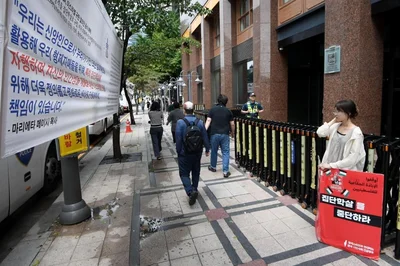
Graduate student Kang Eui-young stages a one-person protest outside the Israeli Embassy in Seoul’s Jongno District, July 15, holding a sign that reads, “Stop the genocide of Palestinians.” Korea Times photo by Yoon Gi-hoon
Every day at noon, someone stands outside the Israeli Embassy in Seoul’s Jongno District, holding a placard.
“Stop the genocide against Palestinians,” it reads.
A different person takes the spot each day. Yesterday, it was an office worker. Today, a college student. Tomorrow, it will be a poet. Over the past two years, the one-person daily protest has drawn participants from across Korean society, including feminists, queer people and people with disabilities.
Organized by a coalition of 352 civic groups, the protest denounces Israel’s military campaign in Gaza. It also seeks to show the world that voices opposing war and violence exist in Korea as well.
The guilt of not showing up
July 15 marked the 684th day of the protest. Standing outside the embassy that day was Kang Eui-young, 29, a postgraduate sociology student at Sogang University.
Kang first joined the protest last spring. She has since returned every month or two, taking part on no fewer than 10 occasions.
“The little I can do is let people know what is happening in Palestine and remind them that the embassy of the occupying power is right here,” Kang said. “It is the least we can do.”
She added that she felt “guilty” whenever she went too long without participating.
A one-person protest takes place outside the Israeli Embassy in Seoul’s Jongno district every weekday during lunchtime. Kang Eui-young, far right, stands with a protest placard during the 684th demonstration, July 15. Korea Times photo by Yoon Gi-hoon
The sidewalk outside the embassy is no more than 5 meters wide, and the section closest to the building is occupied by police barricades. Kang stands in front of them, holding her placard sign. Her view of the road is blocked by two large riot police buses, while office workers heading out for lunch breeze past her.
“It is not as lonely as it looks,” Kang said. “Occasionally, people give me a thumbs-up or applaud.”
Her protest will not stop Israeli troops from marching into the Gaza Strip. But Kang believes that sending Palestinians a message of solidarity is not futile.
“It is incomprehensible that such violence is still being committed today,” she said. “And people perishing like this must not be allowed to go unnoticed.”
A shocking reality left untold in Korea
When Park Young-seo, a 22-year-old sociology student at Gyeongsang National University, joined the protest for the first time on July 3, it marked the 1,001st day of the war between Israel and Hamas.
The war, which began on Oct. 7, 2023, entered the first phase of a peace plan last October, two years after it began. Yet the conflict continues, with Israeli missiles still striking the Gaza Strip.
“I spent those 1,000 days as a college student who knew nothing of war: no deafening roar of airstrikes, no fear for my life, no hunger and no grief over losing loved ones,” Park said, explaining the decision to travel to Seoul from Sacheon, South Gyeongsang Province.
“On the 1,001st day, I finally took action, however briefly, to stand in solidarity with the people of Gaza suffering through the war,” Park said.
Two riot police buses block the view across the street from the Israeli Embassy in Seoul’s Jongno District. A banner condemning Israel’s invasion of Gaza hangs nearby. Courtesy of Palestine Peace Solidarity in South Korea
How Park became interested in the Palestinian crisis was rather accidental. Park happened to notice a Palestinian flag at a rally calling for the impeachment of former President Yoon Suk Yeol over his imposition of martial law. Curiosity prompted Park to search for more information, and the findings were both shocking and eye-opening.
“I couldn’t believe nobody had ever told me anything about Palestine and its history."
Apparently, neither do most Koreans, according to Park. That is why Park plans to create a study group on Palestine during the fall semester.
“Not many people know what Israel has to do with all this, how the United States is involved or, more broadly, what is going on in international relations,” Park said. “But once you learn about it, it is hard to ignore. That is why letting people know is important.”
‘A stronger sense of solidarity than ever’
In Nov. 17, 2023, a protest was held in front of Bosingak Pavilion in Seoul’s Jongno district to mourn the victims of Gaza crisis. Heeum, a poet, then wrote and recited a poem which she titled "To a little hand holding onto snacks."
"I'm a person," the poem began. "who saw a little hand on its 12th birthday, hoping not to die on the day it was born. I am a person who realized the hand is no different from hands of 75 years ago, now gone."
Most of victims in Gaza district are women, children and the elderly. To join the people of Gaza calling in "the right to live with dignity and the right of all to coexist,” she also took to the streets on July 6.
Two thousand pairs of shoes are displayed in the plaza outside Bosingak Pavilion in Seoul’s Jongno District during a protest on Nov. 17, 2023. Korea Times photo by Ha Sang-yoon
She has been met with skepticism more than once. Heeum herself acknowledges that it is understandable to believe a lone protest can only go so far. Still, she believes these protests carry meaning.
“By coming here together, standing with Palestinians and calling for their freedom, we have undoubtedly built up pressure.”
The artists’ group she belongs to, which focuses on climate change, has also joined pro-Palestinian activists in Korea in solidarity.
Solidarity is not so difficult, she said. More than at any other point in human history, the age we live in allows us to tangibly feel that we are all living together in the same world.
“The cries and testimonies of Palestinians reach us directly through news reports and video footage,” Heeum said. “Isn’t it actually more difficult to ignore those cries — to turn a blind eye and a deaf ear to them?”
‘There are things only Korea can do from here’
Above all, participants in the one-person protest argue that Korea is not entirely removed from the war.
Heavy equipment manufactured by HD Hyundai, for example, has been used in Israel’s demolition of Palestinian homes and construction of Jewish-only settlements in violation of international law. Korea National Oil Corp., meanwhile, is involved through a subsidiary in gas and oil exploration projects in waters near the Gaza Strip.
That is why the international campaign criticizing Israel, known as the BDS movement — short for boycott, divestment and sanctions — has also set its sights on Korean companies and the Korean government.
Dyung Ya-ping, an activist at Palestine Peace Solidarity in South Korea, pointed to a report published last July by Francesca Albanese, the United Nations special rapporteur on the situation of human rights in the occupied Palestinian territories.
“HD Hyundai was the only Korean company among the 48 identified in the report as ‘corporate entities profiting from genocide,’” Dyung said. “We are demanding that HD Hyundai stop selling excavators to Israel and that the Korean government restrict their export.”
Dyung explained that such measures are entirely possible, just as governments around the world imposed export restrictions on Russia in response to its invasion of Ukraine.
“Korea National Oil Corp. must also withdraw from its project, through which it has formed a consortium with Israeli companies to illegally extract resources from waters off Gaza that belong to Palestine,” she added.
“This is something only Koreans can do from here,” she said.
Protesters chant slogans during a press conference condemning Israel outside the Israeli Embassy in Seoul’s Jongno District, Oct. 6, 2024, one day before the first anniversary of the outbreak of the Israel-Hamas war. Korea Times photo by Wang Tae-suk
In the days since the first-phase ceasefire agreement took effect, more than 1,000 Palestinians have been killed in Israeli military attacks. If genocide is defined as acts committed with the intent to destroy a population, in whole or in part, then what is happening in Gaza today is genocide, Dyung said.
“The reason we remember, mourn and learn about the Holocaust is to prevent such a tragedy from ever happening again,” Dyung said. “We must not look away from the Holocaust unfolding in our own time. We must do what we can.”
For that reason, the organizers intend to continue the one-person relay protest outside the Israeli Embassy in Korea until the violence in Gaza comes to an end.
“If the Korean government and Korean companies are complicit in genocide, then we, too, cannot be entirely free of responsibility. That is why we keep saying that we must live up to our responsibility (to prevent any further tragedy).”
This article from the Hankook Ilbo, the sister publication of The Korea Times, is translated by a generative AI system and edited by The Korea Times.