Software engineer Josh Dersch spends long hours tinkering in his Seattle garage, coaxing decades-old machinery back to life. He estimates that he owns over 200 vintage computers and electronics in his home.
"It’s always been fascinating to me to see the origins of things," Dersch said. "It’s a fun challenge to debug and repair. You can understand the entire system from top to bottom."
Dersch belongs to an expanding community of vintage computer collectors working to save the iconic machines that sparked the digital revolution. While Silicon Valley pivots toward shaping artificial intelligence, these hardware enthusiasts are dedicated to preserving classic Commodore, Atari, and IBM systems that serve as ancestors to modern laptops, wearables, and smartphones.
Where others see trash, enthusiasts like Dersch see historical artifacts worthy of respect. They relish hearing the chimes of their youth and launching low-def games like "Pong" or "Space Invaders."
"The enthusiasm for the history of computers and all the stuff around it is growing," said Erik Klein, president of the Vintage Computer Federation, which organizes an annual festival at the Computer History Museum in Mountain View in the heart of Silicon Valley.
More than 3,500 people attended the two-day Vintage Computer Festival in early August, celebrating the 50th anniversary of Apple, founded in 1976 in Cupertino, Calif. The gathering featured a panel with co-founders Steve Wozniak and Ronald Wayne reflecting on the early startup days under the late Steve Jobs.
Over a dozen similar festivals have since popped up in cities across North America, South America, and Europe.
This rising interest is driving higher demand in online marketplaces, Klein noted, where exceptionally rare items like the Apple-1 can fetch hundreds of thousands of dollars.
Exhibitors showed off computing systems restored to original working order, letting visitors interact with hardware built well before the internet, social media, and AI transformed society.
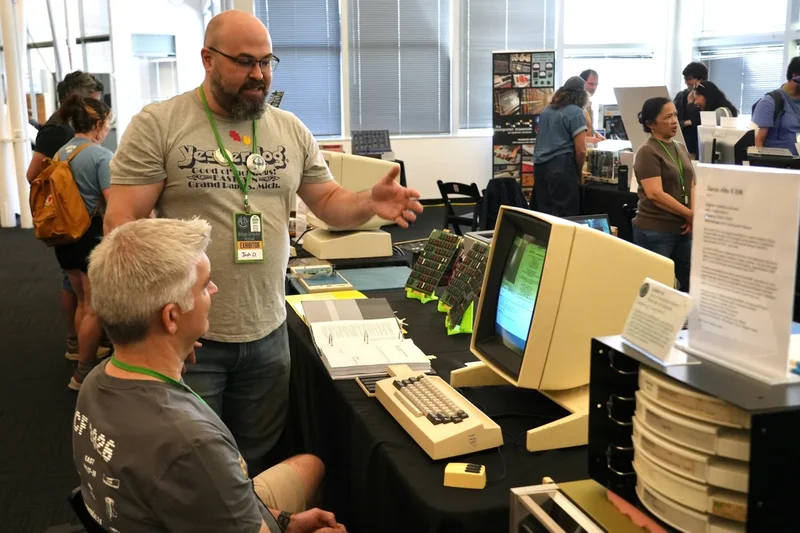
Dersch traveled down from Seattle to display the centerpiece of his collection: a Xerox Alto. He spent years restoring what is regarded as the grandfather of the modern computer, developed in the 1970s at the Xerox Palo Alto Research Center.
The Alto was among the first machines to go beyond text displays, incorporating a mouse and a graphical user interface with windows, icons, and cursors. The design famously inspired both Jobs and Bill Gates in their early products.
Dersch’s display included an operating Xerox Alto workstation with its vertical screen, chunky keyboard, mouse, and pizza-sized spinning disks holding tiny amounts of data by modern standards.
"It’s fun to share what I’ve done with people. It’s fun to share in what other people have done," Dersch said. "Also, there’s a consignment area where I can buy more junk to take home with me, so that’s always fun."
Klein, a Silicon Valley software engineering manager, was once an avid collector until his hobby began dominating his home. He kept up to 150 complete computer systems crammed into his closets and garage.
Fearing his collection had become an albatross that would burden his family, he began selling and giving away machines until only a few favorites remained.
Now, he directs his passion into organizing swap meets, repair workshops, and festivals as president of the Vintage Computer Federation.
"So it’s really about evangelizing that history and evangelizing this hobby of maintaining, collecting and enjoying this vintage technology," Klein said.
Sellam Ismail is delighted to watch the collector community mature since hosting the first festival in 1997, which drew about 150 hobbyists near San Francisco. He organized those events for a decade.
He later co-founded the Vintage Computer Federation, which hosts events in the US and Canada and helped launch similar festivals in Argentina, Germany, and Switzerland.
"The community grew up. More and more people started getting old computers, started collecting them," said Ismail, who once had a massive collection he stored in a warehouse. "Next year is the 30th anniversary. And I expect this to continue and grow even bigger."