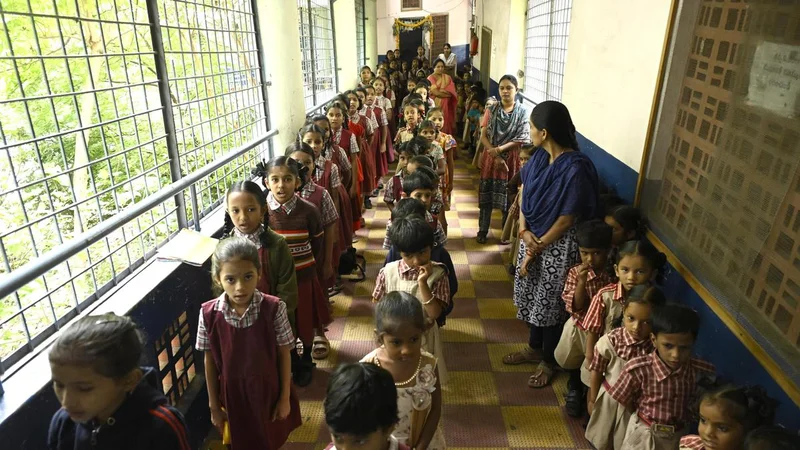
The number of government schools in Telangana fell by 1,969 in 2025-26 from the previous year, while private schools increased by 771 during the same period, according to data from the Department of School Education’s Unified District Information System for Education Plus (UDISE+).
The shift in Telangana’s school education landscape becomes more pronounced when the data from the past decade is evaluated. Private schools have steadily gained the attention of parents and students, while the role of government schools, which saw a sharp rise in enrolment during the COVID-19 pandemic, has once again begun to shrink significantly.
Between 2016-17 and 2025-26, the total number of schools in Telangana fell from 43,134 to 41,762, a drop of 3.2%. Paradoxically, overall student enrolment rose by 16.8% during the same period. While enrolment in government schools declined by 8.2%, private schools recorded a 41% increase.
The divergence is also evident in the number of schools. Private schools increased from 12,573 in 2016-17 to 13,245 in 2025-26, a rise of about 5.3%. In contrast, the number of government schools fell from 29,427 to 28,088, a decline of 4.6%, with much of the reduction occurring in the final year of the period. The steepest decline was recorded among government-aided schools, whose numbers almost halved from 756 to 392, a fall of about 48%.
The number of teachers employed across the State’s schools, however, rose sharply, from 2,43,233 in 2016-17 to 3,70,756 in 2025-26 — an increase of about 52%. Private schools accounted for much of this growth, with their teaching workforce more than doubling from 1,04,853 to 2,11,740, a rise of 102%.
While the number of government schools has declined, the government teaching workforce has expanded. In 2016-17, government schools had 1,33,124 teachers; by 2025-26, the number had risen to 1,56,178, an increase of 17.3%. This marks a reversal from 2016-17, when government schools employed more teachers than private schools; private schools now have a significantly larger teaching workforce.
Aided schools, in line with their shrinking footprint, also saw their teaching strength decline, from 3,618 to 2,704, a fall of about 25%. Once a significant third pillar of the school education system, aided institutions now account for less than 1% of all schools in the State.
Overall student enrolment in Telangana rose from about 65.7 lakh in 2016-17 to 76.8 lakh in 2025-26, an increase of nearly 17%. Much of this growth was absorbed by private schools, where enrolment rose from about 35.1 lakh to nearly 49.5 lakh students — an increase of roughly 41%.
Government schools, in contrast, saw enrolment fall from about 28.9 lakh to 26.5 lakh, a decline of more than 8%. Aided schools recorded an even steeper fall, with enrolment almost halving from about 1.34 lakh to less than 70,000, a decline of roughly 48%.
Taken together, private schools’ share of total student enrolment rose from about 53.4% in 2016-17 to roughly 64.5% in 2025-26. The share of government schools, meanwhile, fell from about 43.9% to 34.5%, while aided schools’ share declined from about 2% to less than 1%.
One bright spot in the data is the marked improvement in the pupil-teacher ratio, which fell from about 27 students per teacher in 2016-17 to 21 in 2025-26. The improvement reflects the robust growth in teacher numbers relative to student enrolment over the period.
Published - August 10, 2026 07:42 pm IST