Scientists discover a hidden switch inside silver nanocatalysts
Silver nanocatalysts can surprisingly switch how and where they work, revealing a new path toward more efficient electricity generation and green hydrogen production.
- Date:
- August 10, 2026
- Source:
- Seoul National University College of Engineering
- Summary:
- Silver nanocatalysts have been found to switch where they perform their most important reactions depending on whether a solid oxide cell is making electricity or hydrogen. The discovery could enable smarter catalyst designs that boost clean power generation while making green hydrogen more energy-efficient.
- Share:
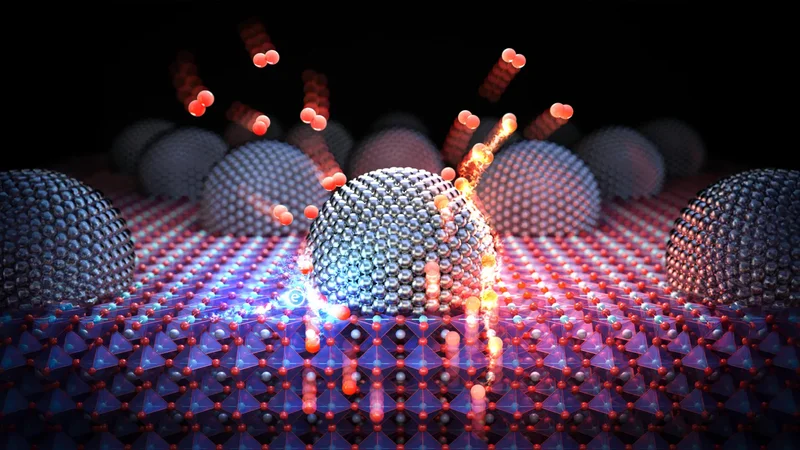
Researchers have discovered for the first time that the same silver (Ag) nanocatalyst can operate at different reaction sites depending on whether a solid oxide cell is producing electricity or generating hydrogen. The finding points to a new way of designing these next-generation energy devices for better performance.
The work was led by Professors WooChul Jung and Jeong Woo Han of the Department of Materials Science and Engineering at Seoul National University (SNU), together with Professor Sang Ouk Kim's team at KAIST and Dr. Beomgyun Jeong's team at the Korea Basic Science Institute (KBSI). Their results clarify how silver nanocatalysts improve solid oxide cell performance and show that both the location and mechanism of oxygen reactions change depending on how the cell is being used.
How Solid Oxide Cells Work
Solid oxide cells move oxygen ions through a solid material to perform two different functions. They can generate electricity, or they can split water to produce hydrogen.
Because of this versatility, the technology is viewed as an important option for expanding clean energy and hydrogen use. Potential applications range from distributed combined heat and power systems in buildings and factories that generate electricity while making use of the high-temperature heat produced during operation to renewable energy-based green hydrogen production.
The findings were published in the globally renowned journal Energy & Environmental Science and were selected as an Outside Back Cover article, highlighting their significance.
Pinpointing Where Catalysts Do Their Work
The performance and durability of solid oxide cells depend heavily on how quickly oxygen reactions occur at the air electrode. But real electrodes have complicated structures, making it difficult for researchers to determine exactly where nanocatalysts participate in those reactions and how they improve performance.
Earlier research had already shown that metal nanocatalysts can make these cells work better. What remained unclear was whether most of the catalytic activity takes place directly on the catalyst surface or at the boundary where the catalyst touches the electrode. Researchers also did not know whether the same catalytic mechanism was responsible for both electricity generation and hydrogen production.
To investigate these questions, the team created a model electrode with carefully controlled structure and composition instead of relying on the much more complicated architecture of conventional electrodes. Metal nanoparticles with uniform sizes and spacing were arranged in ordered patterns, allowing the researchers to examine their catalytic roles much more precisely.
The scientists first compared several metal nanocatalysts, including silver, cobalt, palladium, and platinum. Each was deposited on a thin film perovskite oxide electrode and tested for its ability to accelerate oxygen reactions.
Silver produced the strongest catalytic improvement among the metals tested.
Silver Switches Reaction Sites
The researchers then changed the size and arrangement of the silver nanoparticles to determine where the most important reactions were taking place.
During the oxygen reduction reaction (electricity generation), reaction rates increased as the length of the boundary between the silver nanoparticles and the electrode grew. This showed that the interface between the silver and the electrode is the main reaction site when the cell is generating electricity.
The situation changed during the oxygen evolution reaction (hydrogen production). In this mode, reaction rates increased with the surface area of the silver nanoparticles. That result showed that the surface of the silver particles themselves becomes the primary reaction site during hydrogen production.
In other words, the same nanocatalyst can perform its most important chemistry in two different places depending on the direction in which the energy device is operating.
The researchers examined these differences further by adjusting the applied voltage and oxygen concentration. They found that during oxygen reduction, silver nanocatalysts help transfer electrons to oxygen. During oxygen evolution, the silver instead helps oxygen atoms combine into oxygen molecules and then supports their release.
A Closer Look at the Atomic Mechanism
The team also used synchrotron-based analysis to watch changes occurring on the electrode surface while the system was operating. These experiments were combined with atomic-scale theoretical calculations.
The results showed that silver nanocatalysts alter the electronic structure of the electrode surface in ways that favor oxygen reduction. During oxygen evolution, they create conditions that make it easier for oxygen atoms to join together.
These observations help explain why the catalyst behaves differently depending on whether the cell is producing electricity or hydrogen.
A New Strategy for Clean Energy Catalysts
The findings suggest that nanocatalysts should not simply be viewed as additives that speed up chemical reactions. Their active locations and operating mechanisms can change with the operating mode of the energy system.
That insight introduces a new design strategy for solid oxide cells. Instead of optimizing the catalyst as a single component, researchers may be able to improve performance by separately engineering the catalyst surface and the catalyst electrode interface when developing air electrodes for solid oxide fuel cells and solid oxide electrolysis cells.
If this principle can be successfully incorporated into practical devices, it could improve electricity generation efficiency in distributed energy systems used in buildings and factories. It could also lower the amount of electricity required for renewable energy-powered water electrolysis used to produce green hydrogen.
The approach could also help advance reversible solid oxide cells, which are capable of both generating electricity and producing hydrogen within the same system. Such devices could support more efficient energy production and storage in homes and industrial facilities.
A Platform for Studying Other Catalysts
The precisely controlled nanoparticle array-based model electrode developed by the researchers also provides a way to identify where catalysts operate and how they function in real energy systems.
The platform could be useful well beyond solid oxide cells. Potential applications include hydrogen production devices, other electrochemical energy conversion technologies, and oxygen separation systems.
Professor WooChul Jung, who led the study, stated: "This research is significant because it quantitatively evaluates the performance of nanocatalysts while also identifying their actual reaction sites and operating mechanisms."
He added: "We plan to further establish this as a new design principle that can be applied to various energy conversion materials and catalytic systems."
Dr. Jinwook Kim, who led the research, is currently a postdoctoral researcher at Northwestern University and will soon join the University of Seoul as an assistant professor in the Department of Materials Science and Engineering. He plans to continue studying nanocatalysts and solid oxide cells, with the goal of extending this work toward the development of high-efficiency energy conversion materials and devices.
This research was supported by the Ministry of Science and ICT and the National Research Foundation of Korea (RS-2024-00452853, RS-2025-00521316). Synchrotron-based AP-XPS research at the KBSI-PAL 8A2 AP-XPS beamline was supported by Pohang Accelerator Laboratory/POSTECH and Korea Basic Science Institute.
Story Source:
Materials provided by Seoul National University College of Engineering. Note: Content may be edited for style and length.
Journal Reference:
- Jinwook Kim, Geon Gug Yang, WonJun Lee, Seongwoo Nam, Jinuk Moon, Heejae Yang, Jongsu Seo, Yoonseok Choi, Beomgyun Jeong, Jeong Woo Han, Sang Ouk Kim, WooChul Jung. Quantitative electrochemical evaluation of metal nanocatalysts for oxygen exchange on solid oxide cell electrodes.Energy, 2026; 19 (15): 4932 DOI: 10.1039/d5ee07320k
Cite This Page:
ScienceDaily. Retrieved August 10, 2026 from www.sciencedaily.com